Alerting Workflows That Flag Competitor LLM Recommendations Before Your Sales Team Notices
A tight alerting setup catches AI-driven competitor displacement before deals feel it.
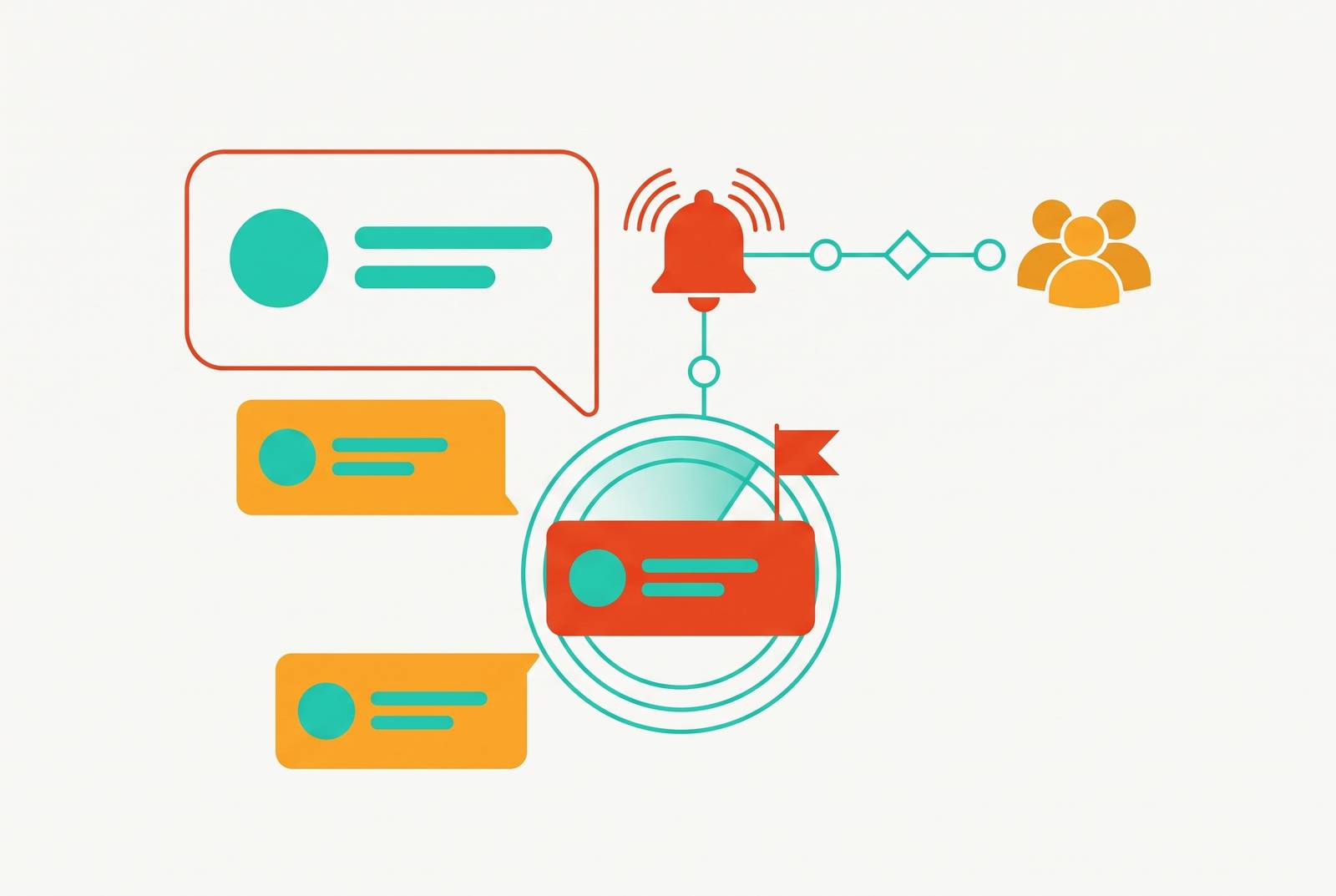
Competitive AI visibility benchmarking shows which competitors LLMs recommend instead of your brand by repeatedly testing buyer-intent prompts and comparing the answers. To catch those recommendations before sales hears about them, marketing teams need an alerting workflow that tracks brand mentions, competitive position, sentiment, and cited sources. The aim is not another dashboard, but an early warning that gives a person time to respond.
Why traditional monitoring tools miss competitor mentions in AI-generated answers
A rank tracker can be working perfectly while missing the recommendation that puts a rival on a buyer’s shortlist. AI platforms synthesize answers. An answer can name a competitor without linking to its website, leaving no referral click for analytics to record. The recommendation happens inside the answer itself. A dashboard built to follow URLs has nothing to follow.
That undermines the idea that search rankings, backlinks, referral traffic, and social mentions together show how a brand stands against its competitors. Those signals show what happens in their own channels, but an AI assistant can make recommendations outside those channels. Non-branded discovery prompts make this blind spot especially costly because buyers ask about a problem before they name a vendor. Branded prompts come later, when evaluation is already underway. Strong visibility when someone asks about your company does not establish that AI introduces it to people who have never heard of it.
How the blind spot reaches the sales team — and why that timing is the real cost
By the time a prospect mentions an AI-recommended competitor to a sales rep, that recommendation has already helped shape the shortlist. The rep now has to change a view that took shape before marketing knew about it. The cost is the lost time between recommendation and response.
Multi-stakeholder SaaS buying makes that delay harder to diagnose. Different stakeholders ask use-case questions, compare specific competitors, and look into jobs to be done at different funnel stages. A brand can win one prompt cluster while losing another, so an overall visibility score can conceal a weak spot. Sales-side intelligence tools serve a different purpose here. They surface deal-risk and pipeline signals after engagement begins, rather than the AI recommendation that prevented engagement from starting.
What a purpose-built LLM alerting workflow actually monitors
An LLM alerting workflow monitors model outputs in response to buyer-intent prompts. Its core measurements are visibility, position, and sentiment. Visibility is the percentage of sampled answers that mention the brand, while position records its rank among competitors named in an answer. Sentiment captures the framing, including qualifications and comparative language. A mention alone is not necessarily a win.
Both branded and non-branded prompts belong in that measurement. Awareness questions show which tools buyers might consider, comparison questions show how competitors stack up, and decision questions test how the model handles value or objections. For SaaS, use-case, alternatives, industry-specific, and job-to-be-done prompts add further coverage. Each cluster tests a different way a brand can get onto a shortlist. Blending them together can hide the very displacement the workflow needs to catch.
Cited sources provide a second monitoring layer. A new “best tools” article or a publication naming a competitor as category leader can influence subsequent answers. Tracking those sources helps distinguish a change in recommendation from a change in the material supporting it. The two are related, but not interchangeable. An answer shows what the buyer receives, while a citation gives the team a source to investigate.
Building the prompt library that drives the workflow
To build the workflow, start with a structured prompt library. Cover awareness, consideration, decision, and head-to-head questions across the brand’s three to five closest competitors and two or three primary use cases. Keep non-branded discovery in its own cluster. Otherwise, strong answers to questions that already name the brand can disguise its absence from discovery.
The prompts should sound like questions a buyer would actually ask. A discovery example is “best software for tracking customer onboarding”. A consideration prompt could ask “what tools exist for tracking customer onboarding”, while a head-to-head prompt could ask “compare Tool A vs Tool B”. A decision prompt such as “is Tool X worth the price” tests a different concern. Organize these questions by their purpose.
Before configuring alerts, run the full library and record visibility, position, sentiment framing, and cited sources to establish the initial baseline. Repeat prompts and test multiple phrasings before treating an apparent displacement as reliable, then rerun the library at regular intervals. When the same change holds across runs and phrasings, the team can tell it apart from the usual variation. Without that distinction, the workflow becomes a very industrious weather vane.
Configuring alert triggers that separate signal from noise
With the baseline in place, configure triggers around competitive displacement. A brand disappearing from a prompt category where it previously appeared deserves attention. So does a fall from a top-three position to outside the top five on high-intent prompts. Another trigger is a rival that keeps entering the top three across a cluster. The common feature is a change in competitive standing.
Sentiment needs its own thresholds because a brand can hold its position even as the model adds a caveat that hurts it. “Good for small teams only” means something different from an unqualified recommendation. Source-level triggers can flag a publication naming a rival as category leader, a listicle dropping the brand, or competitor content becoming a cited source. These changes can precede recommendation shifts.
Changes in wording should not trigger an alert when the competitors stay in the same order. The same goes for one-off results that reverse on rerun or changes that come from model-version differences already logged in the baseline. Confirm the change across multiple runs and keep thresholds tight enough that people can trust the alerts. Attention is a limited resource, even in Slack. A system that treats every adjective as an emergency will eventually teach people to ignore real displacement.
Routing alerts into the right hands at the right speed
Once a trigger fires, send a parsed account of the change. The notification should identify the prompt cluster, previous state, new state, competitor that benefited, and cited sources. A transcript alone transfers the analysis work downstream. It does not finish it.
Route high-intent displacement to the sales enablement lead and relevant account executive, with competitive context attached. Send category-level sentiment shifts to content strategy, including the specific language that changed. Source-level shifts go to SEO and content teams, while marketing leadership should review displacement across several clusters. Each route matches the signal to a decision. Sending everything to everyone leaves a shared inbox with no one in charge of it.
High-intent prompts need the fastest path because AI shortlisting and sales engagement can be separated by hours or days. The routing design should compress that gap. A person still needs to check the context, the accuracy, and the legal exposure before anything goes out.
Turning alert data into content that improves AI recommendation rates
After an alert reaches the content team, use its prompt log and cited sources to identify the gap behind the recommendation. When a competitor wins a use-case prompt, it suggests that coverage of that use case is thin or missing. A rival cited through a directory or “best tools” article points toward absence from third-party sources. These are different problems. More copy on an owned page does not, by itself, resolve absence from a cited list.
Comparison and sentiment alerts suggest other responses. A competitor framed as category leader may reveal a need for owned comparison or head-to-head content that offers an alternative source. A qualifier such as “good for small teams only” calls for positioning content that addresses the objection. The response should follow the evidence in the answer. Publishing a general category article because a specific comparison went badly is activity, but not a close fit.
Make that response well-organized, easy to parse, and dense with useful meaning. Original research, proprietary data, or a framework grounded in real client experience can give AI systems a reason to cite the brand over lookalike alternatives. The prompt clusters show where that authority is needed. To connect the response to downstream results, add UTM parameters such as utm_source=chatgpt and utm_medium=ai_referral to URLs in AI-optimized content and create a GA4 custom segment for AI referral sessions. These measures help connect traffic and conversions to content changes, although linkless recommendations remain outside click attribution.
What tools show when ChatGPT names a rival instead of your company
Purpose-built AI visibility tools handle prompt tracking and competitive benchmarking, but they differ in what else they can do. Gauge has monitoring and prompt-level sentiment analysis, along with workflows for creating content and integrations with GA4 and Google Search Console. Peec AI focuses on analytics for mid-market teams, while Scrunch AI focuses on SaaS and B2B tech and has insights into bot crawling. LLM Pulse tracks SaaS prompt clusters by funnel stage, breaks sentiment down by product line, and supports multi-language tracking.
The sales intelligence layer has a separate job. Crayon has AI-generated battlecards that update when competitors change their positioning, along with win/loss analysis and automated alerts with importance scoring. Its Salesforce and Slack integrations connect that intelligence to sales workflows, and pricing is quote-based. Kompyte monitors competitor websites, product pages, reviews, PR, and job posts through an automated engine with alerting. Its pricing is also quote-based.
Brand24 extends social and brand monitoring into AI mention detection, including real-time alerts when competitor recommendations shift after news events or product launches. Profound sends Slack notifications when sentiment falls below a set threshold or inaccuracy goes above a set limit. Here, the threshold is the important design choice. A notification channel becomes useful when the system has already decided which changes warrant attention.
The stack therefore needs three functional layers, namely AI visibility measurement, workflow automation for routing, and CI or sales tooling for delivery into sales work. No one tool covers all the layers described here. Evaluate the handoffs as carefully as the features, because detection and delivery serve different purposes. Teams without the capacity to build and maintain that stack can work with an AI-powered marketing agency that already operates the monitoring, content, and automation infrastructure.
Signal quality, governance, and the human decisions the workflow cannot make
Poor governance can turn an early-warning system into a source of noise, automation errors, and legal exposure. Keeping the model version with each result helps the team tell changes in the model apart from changes in how competitors stand. Multi-run validation then gives reviewers a basis for treating a shift as confirmed. Keep that discipline during setup and after launch. A reliable baseline is no help if later results are accepted without the same scrutiny.
The risk grows when detection automatically triggers public counter-messaging. Factual claims about competitor products or category performance create liability for the company publishing them, regardless of how the text was generated. Human review is therefore part of the workflow. Accuracy comes before a clever comeback. An alert can show a positioning problem without establishing that a proposed response is fair or defensible.
The strategist’s remaining task is to choose the response the evidence supports. That may mean closing a content gap, equipping a sales conversation, or investigating a competitor’s move before acting. Cultural, legal, and strategic judgment cannot be encoded in a displacement threshold. The workflow earns its place by delivering a clear warning early enough for that judgment to be useful. AI is the tool. A person still decides what to build with it.