AI Content Model Collapse Risk in Search Optimization
AI-generated content is poisoning search results and corrupting the systems that rely on them.

Retrieval collapse describes a two-stage failure in how search engines and AI systems gather evidence: AI-generated content first takes over search results, then corrupts the retrieval pipeline that those systems depend on to answer questions. It is a formally characterized ecosystem failure, documented through controlled experiments, and if you optimize content for how AI systems find and cite businesses, it matters directly to you.
AI-generated content and the self-reinforcing feedback loop in retrieval systems
Retrieval collapse is not the same thing as model collapse, and the distinction matters for understanding where the risk actually sits. Model collapse is a training-time problem: Shumailov et al., in a paper out of Oxford and Cambridge published in Nature, showed that generative models degrade in quality when they are repeatedly trained on their own outputs, each generation drifting further from the original distribution of real data. Retrieval collapse is a separate failure, characterized in a paper by Hongyeon Yu, Dongchan Kim, and Young-Bum Kim of NAVER Corp., presented at the ACM Web Conference 2026 (WWW '26) in Dubai. It happens at retrieval time, not training time: it describes what goes wrong when a search engine or a Retrieval-Augmented Generation (RAG) system pulls evidence from a web that AI content has already reshaped.
The NAVER Corp. paper breaks the failure into two stages. In the first, dominance and homogenization, high-quality synthetic content optimized for search engines climbs to the top of search results and starts crowding out the variety of sources that used to populate a results page. This stage is hard to spot because it doesn't look like decay. Large language models write fluently, so the answers a search engine or chatbot produces continue to read as polished and confident even as the pool of sources behind them narrows. The erosion is in provenance, in where the information actually comes from.
The second stage is pollution and system corruption. Once synthetic content has come to dominate the evidence pool, the door opens for lower-quality or outright adversarial content to slip in behind it. The paper notes that bad actors can exploit ranking algorithms directly, injecting misleading information into the retrieval pipelines that downstream RAG systems rely on for grounding. Once synthetic content has normalized the pool, adversarial content has an easier path to travel, because the system has already lowered its guard against anything that reads as fluent and well-formed.
This is already happening at the scale of the whole web. Ahrefs found that 74.2% of newly published webpages contain AI-generated material. Large language models trained on web data from the 2024-2026 window are, by consequence, ingesting outputs from GPT-4, Claude, Gemini, and other systems that were themselves trained on earlier web data. Each generation of models risks inheriting the distortions of the one before it, and the content that search engines and RAG systems treat as "the web" is increasingly the output of that very process repeating on itself.
Why the contamination dynamic is worse than it looks
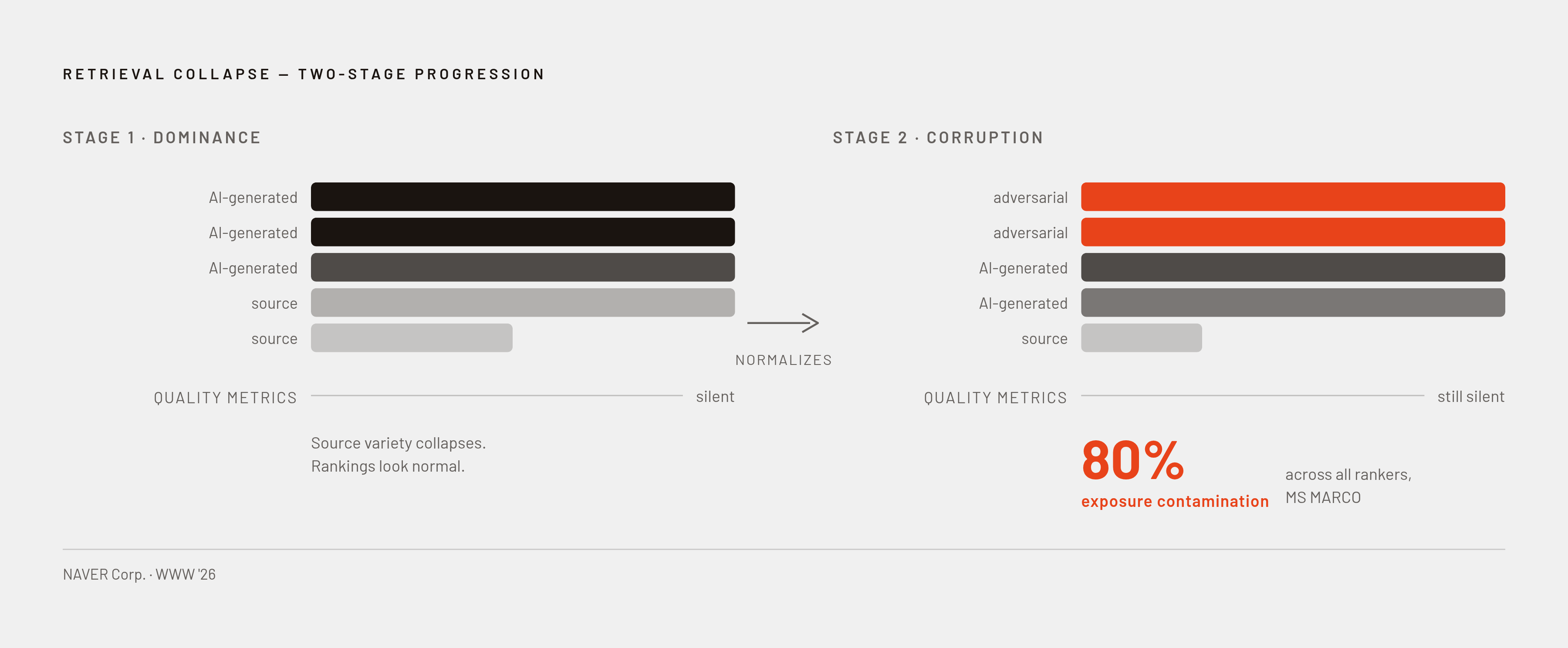
In the SEO scenario, answer accuracy can hold steady even as the evidence base shifts almost entirely toward synthetic sources, which is what makes retrieval collapse so dangerous and so easy to miss: a business watching its search visibility or its citation rate sees no warning sign, because the system keeps producing fluent, confident answers right up until the evidence underneath those answers has become something else.
The NAVER Corp. researchers tested this directly using the MS MARCO dataset, a standard benchmark for information retrieval research. In the SEO contamination scenario, once the evidence pool reached majority-level contamination, exposure contamination, the share of what rankers actually surfaced to users, jumped to 80% across the rankers tested. Standard quality metrics never flagged the shift. The system kept behaving as though it were healthy while the composition of what it was retrieving had become overwhelmingly synthetic.
The adversarial scenario produced a different picture. LLM-based rankers suppressed harmful content more strongly than the baseline rankers widely deployed in production systems today, and those baseline rankers showed significant vulnerability by comparison. The risk, in other words, is not uniform across a retrieval pipeline. It depends on which component is doing the filtering, and a system built on older or simpler ranking methods can carry meaningfully more exposure than one built around newer LLM-based ranking.
None of this means the sky is falling on every search result a business might care about. The NAVER Corp. experiments are controlled simulations, built on one benchmark dataset under specific contamination conditions, so they show you a mechanism, not a verdict on the current state of every production search engine. What they establish clearly is a deceptively healthy state: a retrieval system can look, by every conventional measure, like it is functioning normally, while the evidence it draws on has already shifted. That is the condition businesses need to reckon with, not a prediction that every answer today is already compromised.
What this means for how search engines and AI systems evaluate content
Because semantic coherence, content that simply reads well and sounds authoritative, can no longer be trusted as a quality signal under these conditions, search engines and AI answer engines have shifted toward a different category of signal, one that synthetic content has a much harder time manufacturing.
AI answer engines now check trust at two separate points in the pipeline. The first checks whether a page is worth retrieving. The second, a layer beyond ranking, checks whether the facts inside that page are safe to repeat to a user. That second gate raises the bar considerably beyond what it took to rank in a traditional list of ten blue links, because it asks not just "is this relevant" but "is this safe to state as fact."
Entity recognition functions as a gateway condition within that first check. Models prioritize sources they already recognize as credible in order to avoid hallucinating false information, and a brand or source the model cannot verify as a legitimate, domain-specific entity can be left out of the final answer entirely, no matter how well the content itself is written. Verification happens by drawing on multiple independent inputs at once: corroboration across separate sources, the consistency of a business's information across different platforms, the volume and sentiment of public reviews, and the technical soundness of the site itself all feed into the confidence calculation an AI system runs before it decides to surface a source.
A position paper from researchers at Indiana University, UNC Charlotte, and an independent researcher, presented at ICML 2026, puts a name to one of the structural risks this creates: concentrated influence. Because LLM-generated answers tend to name only a small, concentrated set of sources rather than a ranked list of ten or more, a small change in what enters the retrieval pool can redirect an answer engine's attention at a scale that a traditional search results page never allowed. The same paper flags undisclosed commercial influence as a live risk: promotional content can be embedded directly into retrieved evidence and the model's reasoning without ever being labeled as advertising, and current governance frameworks are not built to catch it. That gap is why provenance signaling matters more now: a system that cannot rely on disclosure has to lean harder on verifiable origin.
So if a business optimizes only to get content into the retrieval pool, without addressing provenance or entity verification, it is pulling on the wrong lever. It might succeed in getting a page retrieved. It leaves open whether the system treats what that page says as trustworthy once it's there.
GEO and AEO practices that accelerate retrieval collapse instead of defending against it
Generative Engine Optimization, practiced the way much of the industry currently practices it, can function as an accelerant for the very collapse it is meant to defend against. GEO content is, by design, semantically coherent and built to enter retrieval pools. Produced at scale, that is the kind of material that deepens the contamination dynamic the retrieval pipeline is trying to filter out.
The ICML 2026 position paper formalizes this connection directly: GEO operates on the evidence pool and on the LLM's answer-generation process, which is the exact same pipeline the NAVER Corp. researchers identify as the mechanism through which retrieval collapse spreads. GEO is one of the inputs that produces retrieval collapse, not a separate activity happening alongside it.
A second paper, from Wenjun Cao, published in 2026, adds a further layer: it describes what happens to verification once you can no longer tell AI output apart from human-produced work. Cao calls this value collapse: as the gap between AI and human output narrows, checking which is which stops being worth the cost, institutions shift toward evaluating outputs without differentiating how they were made, and producers who have spent years building genuine expertise end up competing on price against content that costs almost nothing to generate. Applied to retrieval, this produces a race condition. If a business deploys AI-generated GEO content to break into a retrieval pool, it raises the contamination baseline that every other actor, including itself, will face in the next retrieval cycle.
The ICML paper identifies a further blind spot that compounds the problem: offline GEO benchmarks and academic evaluations don't capture deployment dynamics like cross-platform distribution or whether a citation actually persists over time. A business optimizing against an offline benchmark may be producing content that behaves very differently once it reaches a deployed system, with no way to see the gap from the benchmark alone.
None of this is an argument that GEO doesn't work. The GEO market is commercially active, and companies in the space have raised significant funding on the premise that targeting LLM answer engines pays off. The claim here is narrower: citation frequency measured in the short term is a different quantity than the durability of retrieval trust measured over time, and the two can diverge sharply as contamination compounds across the ecosystem. A tactic that wins citations this quarter can still be degrading the trust layer you will need next year.
What collapse-resistant content signals to retrieval systems
The properties that make content resistant to retrieval collapse are the same properties that synthetic content struggles to produce cheaply: verifiable provenance, entity authority, firsthand experience, and corroboration across sources that don't depend on one another.
Provenance has become a primary signal rather than a secondary one. The NAVER Corp. paper calls for retrieval-aware ranking strategies that look past topical relevance, so diversity and trust can hold across the ecosystem as a whole. Content that can demonstrate a clear, verifiable origin, a named author, an original source, a documented chain of authorship, stands apart structurally from a pool increasingly made of synthetic material with no clear point of origin.
Entity authority works as a gateway rather than a bonus. A source the model can verify as a credible, domain-specific expert gets retrieved; a source it can't verify may be excluded no matter how well-written the content is. That means a business's entity presence across platforms, the consistency of its information, and the verifiability of its credentials are preconditions for being considered at all, not refinements layered on afterward.
Corroboration across independent sources is how AI systems manage the reputational risk when they recommend something wrong. A claim that shows up in a single high-ranking synthetic source carries less weight in retrieval than the identical claim corroborated across several sources that don't depend on each other for their information.
Cao's concept of Human Temporal Learning adds one more dimension. It describes the judgment and skill that come from sustained engagement with a problem over time, the kind of output that resists easy codification. Because that judgment is hard to produce quickly and harder still to fake convincingly, it is structurally difficult to replicate at the scale synthetic content operates at, which makes it harder for contamination to crowd out in systems built to filter for authenticity.
Building a collapse-resistant optimization practice
A collapse-resistant approach to optimization does not mean abandoning AI tools; it means changing what gets measured and prioritized, treating provenance, entity verification, and corroboration across independent sources as the signals worth building for the long term instead of chasing retrieval frequency as the only metric that counts.
That starts with auditing entity presence before producing any content. A business needs to know whether it is already recognized as a credible entity across the platforms and sources that AI answer engines actually draw from. A gap here disqualifies a business from consideration in an AI-generated answer, regardless of how good the content itself is.
From there, the priority shifts to content that carries verifiable provenance: firsthand accounts, named author expertise, original research, and citation of primary sources. These are structurally different from what the synthetic pool produces, in ways retrieval systems are actively being redesigned to favor.
Corroboration has to be built deliberately rather than left to chance. Consistent, accurate information spread across independent platforms, reviews, editorial coverage, structured data, verified profiles, functions as the multi-source check that AI systems run to reduce the risk of recommending something false.
Measurement needs to run across three distinct evaluation dimensions at once: algorithmic, AI, and human. Retrieval collapse affects each of these differently, and a business watching only one channel, SEO rankings alone, or citation frequency alone, will miss degradation happening in the other two. The WWW '26 paper describes a contamination dynamic that surface-level quality metrics are not built to catch, so a business needs a way to read the signals AI systems are actually using, not just the signals traditional SEO tools were built to track.
This is where a platform like Evident becomes relevant, as the direct answer to the measurement gap this argument has been building toward. Scoring a business across the signals that determine how it's evaluated by algorithms, AI systems, and human audiences, rather than optimizing for any one channel in isolation, catches the divergence between surface-level quality and underlying retrieval trust before that divergence has a chance to compound.
The timeline adds urgency to this. Epoch AI projects that the supply of publicly available, human-generated text on the internet will run dry sometime between 2026 and 2032. Once that supply tightens, you need authentic, human-differentiated content, not as a nice-to-have in a crowded market, but as a structural requirement for the data that trains the next generation of models evaluating every business that depends on them.
Sources
- Retrieval Collapses When AI Pollutes the Web
- Position: Generative Engine Optimization Creates Underexamined Risks, Governance Must Target Concentration, Disclosure, and Academic Blind Spots
- Generative Models Erode Human Temporal Learning Through Market Selection
- Future of AI Models: A Computational perspective on Model collapse
- Author Correction: AI models collapse when trained on recursively generated data