Structured Data Markup Strategy for AI-Assisted Content Programs
AI systems now read schema markup in real time to verify source credibility.
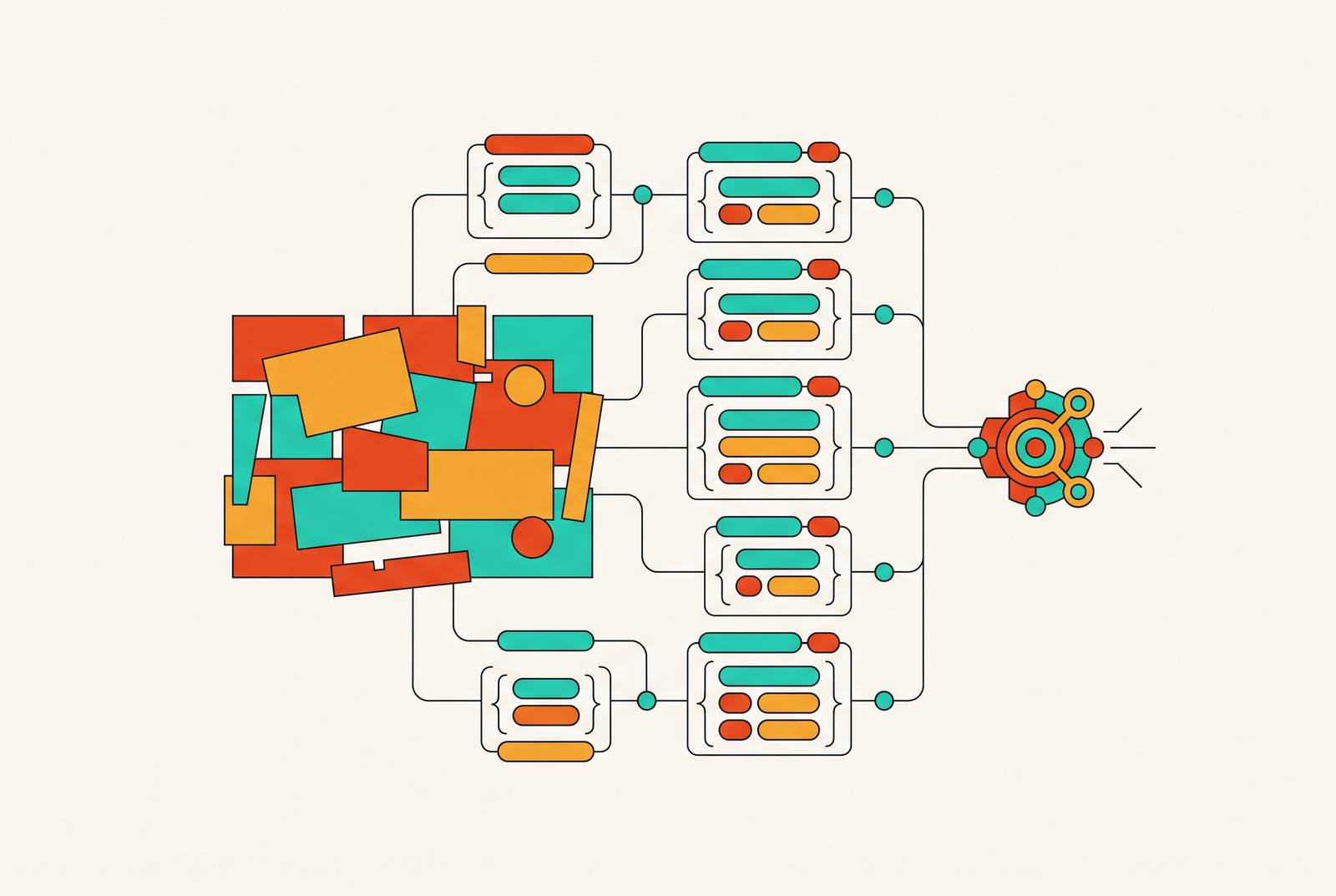
When a model like ChatGPT or Perplexity accesses a page directly, it doesn't just crawl the HTML body for later indexing. It fetches the page and parses the schema markup embedded in it at the moment it is building an answer. Structured data has moved from a static asset into an active input in the reasoning process itself. That single operational change is the foundation for everything else this piece argues.
Confirmation of this came in October 2025, when SearchVIU ran tests showing that ChatGPT, Claude, Perplexity, and Gemini all actively process schema markup when they access content directly, rather than relying on a previously indexed, crawled version of the page. Fetch-and-parse is a different behavior than crawl-and-store, a difference that carries real consequences beyond the technical. If schema is read at the moment an answer is synthesized, it functions as a real-time credibility input rather than an instruction for how a result should look once displayed. Google's Gemini-powered AI Mode illustrates this directly: it uses schema to verify claims, establish relationships between entities, and assess the credibility of a source while it is building a response, not to decide which rich result format to render on a results page. Schema that is technically valid but inaccurate, or accurate but incomplete, now carries a credibility cost at the moment of synthesis rather than simply forfeiting a chance at a visual enhancement.
The older use case for schema, triggering rich results, is receding as a matter of policy, not just practice. Google retired FAQ rich results on May 7, 2026, having already retired HowTo rich results back in 2023. The visual enhancement era that structured data was built to serve is winding down. FAQ markup still has a job to do, but the job changed: AI assistants pull answers from the machine-readable question-and-answer pairs FAQ schema was built to encode, independent of whether Google ever renders them as an accordion in search results. The format survived its own interface.
Schema as a trust input rather than a formatting cue
Once a model is reading schema in real time, the logic it applies to that schema looks closer to fact-checking than to ranking. Traditional SEO worked on the premise that a domain accumulates authority, and that authority transfers to everything published under it.
This explains a finding that would otherwise look like a loophole. Schema that accurately describes a page's content raises the probability that AI Mode cites it, even when no traditional rich result ever appears for that page. The benefit of writing accurate schema has detached from the benefit of winning a visual placement in search. A page can gain nothing in the way of a star rating or an FAQ dropdown and still gain meaningfully in citation probability, because the schema is doing verification work that has nothing to do with rendering.
The verification itself works by consistency checking. A model compares what the markup asserts against what the visible content on the page actually says, and a page whose schema describes content that is not actually there loses trust rather than gaining a formatting edge. Overstated or mismatched schema is read as a signal of unreliability, not treated as a harmless inflation.
Trust, under this regime, functions as a filter rather than one ranking factor weighed against others. A Goodfirms survey found that respondents agreed trust and credibility signals are becoming more important as AI systems take on the work of selecting sources. A source that fails a trust check gets excluded from the answer entirely. There is no equivalent of ranking sixth on a results page, quietly visible to anyone willing to scroll. An AI-generated answer either cites a source or it doesn't, and the bar for inclusion is different from the old bar for ranking.
That bar isn't fixed across systems, either. The AI Perception Index 2026 offers the first empirical measurement of how brand perception varies across large language models, and it finds meaningful drift for the same brand depending on which AI system is evaluating it. A brand can read as authoritative to one system and marginal to another without a single word of its content changing. Structured data strategy built around pleasing one model's behavior will not transfer cleanly to the next one, and that variability needs to be treated as a standing condition of the landscape rather than a temporary inconsistency to be engineered away.
The schema types that carry the most weight in AI evaluation
Of the many schema types available, a small subset does almost all the trust-building work that matters to AI systems, and the common thread among them is that they establish identity and topical authority rather than control how content is displayed.
Organization schema does the foundational work. It establishes brand identity in a form AI systems can resolve against Knowledge Graph records, and entities that resolve cleanly receive higher trust scores during answer generation. Its sameAs property links out to social profiles and authoritative directories, giving the model a consistent cross-web identity to check against. Its knowsAbout property declares the domains an organization claims expertise in, which raises the odds that AI Mode pulls that organization into source selection for queries in those domains. Without Organization schema on a site, the model is left to infer who actually published the content; that inferred ambiguity reduces how confidently it will cite the page.
Article and BlogPosting schema, paired with Person schema for the author, tells a model what a piece is, who wrote it, when it went live, and when it was last touched. The dateModified property gets overlooked often, but it feeds directly into how AI systems judge recency, and both AI Overviews and AI Mode favor content that reads as current and clearly attributed. An author tied to their own Person schema and a bio page gives the model a verifiable trail of expertise and experience to follow, adding a layer that supports the kind of credibility checking described above.
Speakable schema serves a narrower but precise function: it flags the specific passage within a longer document that the content owner wants treated as the citable core of the piece. Without that flag, the model has to infer which section matters most, and that inference introduces imprecision into what gets cited. With it, the content owner effectively nominates its own quote, raising the odds that the intended claim, rather than some adjacent sentence, is the one that ends up cited.
BreadcrumbList schema gives a model site hierarchy, context that makes a page easier to place. A page nested clearly under a relevant parent category reads as situated within a body of related work, where a page with no such context can appear to exist in isolation. Review and AggregateRating schema supply quantified sentiment data that models use when comparing options against each other, a function that matters most for local businesses and service providers whose trust signals directly shape whether they get selected. LocalBusiness schema feeds location-based queries directly, and its value depends on staying consistent with a business's Google Business Profile. Product and Offer schema make inventory legible to AI shopping agents and to AI Mode's commerce queries, and pages carrying complete Product markup, with pricing, availability, and ratings together, see meaningfully higher visibility in AI-driven commerce results.
What unites all of these types is that none of them exist to control layout. They exist to answer questions a model is implicitly asking as it builds a response: who is speaking, what do they know, when did they say it, and can any of it be checked. A page can pass Google's Rich Results Test without a single error and still contribute almost nothing to AI visibility, since that test checks whether markup is structured correctly rather than whether it accurately describes what is actually on the page. Markup that is syntactically flawless but descriptively false, or markup for content that isn't the page's real focus, fails the only check that matters to a model synthesizing an answer. That failure mode, correct code describing an inaccurate reality, is precisely the gap that on-page schema alone cannot close, and it points toward a requirement that sits entirely outside the page.
Off-site corroboration and the limits of accurate schema
Schema tells a model what a brand claims about itself. Separately, the model checks whether sources it already trusts back up that claim, and no amount of accurate markup substitutes for that external confirmation. This is the central limit of a schema-only strategy, and it changes what "doing schema well" has to mean in practice.
Generative engines weight earned media heavily and frequently exclude content that is brand-owned or published on social platforms. A page can be accurate, well-marked-up, and hosted on a vendor's own blog, and still never get cited if that page is the only place the claim exists. The 2026 State of AI Search found that a large majority of AI citations draw from third-party sources rather than from brand-owned content, and this pattern is consistent with an industry baseline brand mention rate of only around 35 percent even among entities being actively tracked. AI source selection is built to favor external validation over self-description.
The right way to hold these two findings together is not to pit schema against earned media, but to see them as covering different stages of the citation decision. Schema makes on-page content legible and citable in the first place, and earned media supplies the corroboration that makes that citability trustworthy.
Part of why earned media matters so much comes down to how AI Mode actually processes a query. It does not answer a single question in isolation. It generates a fan-out of multiple sub-queries from one user prompt, and pulls citations separately from each sub-query's results. A page that answers the primary query precisely but has no presence across the fan-out sub-queries earns no citation at all, regardless of how well it ranks for the original question. Ranking for the question a user actually typed is no longer sufficient on its own.
The consequence of that shift is visible in how citation sources have moved. Citations drawn from pages ranking in the top 10 of organic results fell from more than three-quarters to roughly a third over an eight-month period, and the majority of citations now come from pages that never crack the conventional top 10 for the primary query. This is where the knowsAbout property earns its keep: declaring topical domains through Organization schema raises the odds that a brand gets pulled into fan-out sub-query results across that whole territory of related questions, not just the one query it was originally optimized for.
Recency and formatting compound this off-site requirement, functioning as the on-page signals a model reaches for when deciding between sources that are otherwise comparable. Content cited by AI systems tends to be updated more recently, on average, than content sitting in standard top organic results, and that recency has to be legible both to a human reader and to a machine, meaning visible dates on the page and a dateModified value in JSON-LD need to be present together. Content organized around a sequential heading hierarchy also shows a materially higher probability of citation, because semantic structure itself functions as a trust signal that a model can parse quickly.
How AI citation patterns should reshape content structure decisions
How a model actually pulls its citations from inside a document should determine how that document gets written, not only how it gets tagged. The evidence on citation location is specific enough to act on directly.
Research across hundreds of millions of LLM citations found that nearly half of all citations come from the first portion of a document. The opening of a piece carries a disproportionate share of the citation burden. The practical response is to open every piece with a direct, one- or two-sentence answer to the primary question the piece addresses, written so it stands on its own without requiring the rest of the article for context. That is the passage most likely to be lifted whole. Nominating that same opening passage with Speakable schema compounds the effect, since the markup tells the model exactly which sentence the content owner intends to be cited, lowering the odds that some less precise line gets pulled instead. Length turns out to matter far less than density: word count has essentially no correlation with where a citation lands, and tight, specific, self-contained passages outperform long ones regardless of total article length. That is a counterintuitive finding, and most content teams still write as though length itself were the asset worth optimizing for.
Format and schema reinforce each other, because the content structures AI systems cite most often are also the ones schema can annotate with the most precision. Listicles are the single most-cited content type in LLM citations, with ranked Top-N formats, "Best X for Y," "10 best," "Top 25," dominating that category, an effect especially pronounced for queries with clear commercial intent. FAQ content keeps its value in this same way: even after losing its rich result display, it remains fully machine-readable, and AI assistants continue to draw answers from its question-and-answer pairs regardless of whether Google ever renders them visually. Semantic heading hierarchy carries the same double function noted earlier. It organizes a document for a human reader working through it top to bottom, and it gives a model a structural map it can trust when deciding what the page is actually about and where its most citable claims live.
Put together, these patterns describe a single discipline rather than two separate ones. Structuring a sentence, a heading, or a paragraph for a human reader and tagging that same content accurately for a model are, by 2026, the same job done once.