Entity Optimization in AI-Assisted Content for Search Disambiguation
Clear entity signals now determine which brands get cited in AI answers, not keyword rankings.

AI search systems in 2026 don't rank pages by counting how often a term appears on them. They retrieve passages grounded in identified, disambiguated real-world things, then synthesize answers from those passages.
A query arrives, and the engine fans it into sub-questions. Candidate passages get scored on two properties: how clearly they anchor to a specific, identifiable entity, and how dense they are with verifiable facts about that entity. The generation step then builds an answer from the highest-scoring passages, and citation follows from which passages the model could attribute with confidence. Keyword frequency barely factors into passage selection.
Google's Gemini models illustrate why this shift is structural rather than stylistic. Gemini uses the Knowledge Graph to ground and retrieve information, even though its pre-training data spans the ordinary sweep of public web documents, text, code, images, audio, and video. The "things, not strings" framework that Google talked about for a decade as a background principle now directly governs whether a brand shows up in AI Overviews and AI Mode citations. The Knowledge Graph itself is enormous: practitioners widely report it holding more than five billion entities and over 500 billion facts, and a brand's representation inside that graph functions as its ticket to AI citation eligibility.
The practical result surprises people who spent years optimizing for keyword density. A short, entity-clean passage beats a long, keyword-dense page in retrieval, because the engine selects passages the model can attribute with confidence, not the page that repeated a term the most. Schema markup plays into this too, though not in the way most people assume. Google's Gemini-powered AI Mode reads schema as a trust signal during answer synthesis rather than as a trigger for some visual snippet. It functions as a verification input, one more piece of evidence the model weighs when deciding whether a passage can be cited safely.
The system is built to recognize things, then to reason about them. A page that fails to state clearly what "thing" it is describing gives the model nothing to hold onto.
The disambiguation problem that makes or breaks AI citation
When a brand or term reads as ambiguous, AI systems can't confidently attribute a passage to the right entity, and content that can't be attributed with confidence gets filtered out instead of cited. This is the mechanism from the prior section, narrowed to its sharpest edge. Ambiguity, not obscurity, is what makes brands disappear.
Consider "Mercury" dropped into a document with no surrounding context. Is it the planet, the chemical element, the Roman god, the Ford line discontinued years ago, or the stage name behind Queen's lead singer? Each reading produces an entirely different set of entity relationships and knowledge graph connections, and the model has no reliable way to pick one without help from the surrounding text. The same collision risk applies to ordinary brand names. A software company called "Pilot" can find its content mapped to Pilot Corporation, the pen maker, or Pilot Flying J, the travel-center chain, if its entity signals aren't strong enough to pull the model toward the right referent.
Victorious's technical SEO analysis breaks the resulting damage into three failure modes. Misattribution happens when content earns topical authority in the wrong knowledge graph cluster. Citation failure happens when well-researched, accurate content gets skipped in favor of a competitor whose entity signals are simply cleaner. Relationship errors happen when the inferred connections between a brand and its adjacent entities come out wrong, distorting how the model understands what the brand does and who it serves.
AI systems build entity co-occurrence models from enormous bodies of text, and that statistical process drives all three failure modes. "Mercury" next to Venus, Mars, and orbital periods resolves cleanly to the planet. "Mercury" next to thermometer, barometer, and toxicity resolves to the element. The words that surround a brand name in published content actively shape how AI systems classify that brand, whether the company intended it or not.
That's the mechanism that explains a finding that should unsettle anyone confident in their existing SEO program. A 2026 analysis by Fuel Online examined a thousand enterprise brands and found that a large majority were invisible to generative AI models, despite nearly all of those same companies having invested heavily in traditional SEO. Keyword-era optimization built rankings. It never built disambiguation, and disambiguation is what the new retrieval layer actually runs on.
The stakes of being miscited or absent
AI-generated answers have stopped functioning as a secondary discovery channel. For a large share of buyers, they are now the first and only impression a brand makes before any human conversation happens. A G2 buyer survey found that a majority of B2B software buyers now start purchase research inside an AI chatbot, so the AI answer layer shapes the shortlist before a salesperson ever gets involved.
The Digital Applied guide states that a brand's representation in the Knowledge Graph, which practitioners widely report holds five billion-plus entities and 500 billion-plus facts, is its AI citation eligibility. These answers typically name one, two, or at most three brands, with no list of ten options to scroll through, so a citation functions closer to an endorsement than a ranking. Absence from that shortlist means exclusion from the only conversation a buyer is having.
Accuracy compounds the risk. Columbia's Tow Center examined eight major AI search tools and found they collectively returned incorrect answers to more than half of source-attribution queries. That makes the AI answer layer the reputation surface most likely to carry wrong information about a brand, and it forms before any surface that brand's communications team previously monitored. A company can have flawless press coverage and an accurate Wikipedia page and still get misattributed inside an AI answer that a buyer never thinks to fact-check.
LLM perception of a brand also lags behind the accuracy issues already described. LLM perception of a brand typically trails content publication by three to nine months, so the narrative an AI system is generating about a company today reflects signals and content published months earlier. Fixing an entity problem after it surfaces adds months more before the fix registers. Establishing clean entity signals now is a proactive necessity, not a reactive cleanup task.
The commercial case closes the argument. Semrush's AI Search Traffic Study found that visitors arriving from AI-sourced answers convert at a substantially higher rate than visitors arriving from traditional organic search, which means citation in AI answers carries commercial weight, not just reputational weight. Brands with strong traditional SEO rankings sometimes assume that ranking already covers this ground, but it doesn't fully cover it. The Digital Applied guide notes that roughly 92% of AI Overview citations come from domains already ranking in Google's top ten, but ranking position doesn't decide which top-ten result gets treated as the authoritative source for a given claim. Entity clarity makes that decision.
The six signals AI engines use to resolve and trust an entity
AI retrieval systems resolve entity identity through a layered stack of six signals, and a brand that reads clearly across all six is cited with far more confidence than one that only satisfies one or two of them. Each signal reinforces the others rather than standing alone, so the full stack determines citation confidence more than any single signal.
The first signal is canonical entity definition on the page itself. Every page should define one primary entity and open with a definitional sentence the model could lift verbatim into an answer. This is where the Frase framework's three jobs come in: clarity, coverage, and connectivity are the three functions entity optimization performs, and clarity starts right here, at the sentence level.
The second signal is entity co-occurrence, the same mechanism from the Mercury example scaled into a strategy. Naming the people, tools, methods, and concepts that define a brand's actual domain, accurately and consistently, strengthens how AI systems categorize that brand over time.
The third signal is Organization schema carrying sameAs declarations. The sameAs property links an entity to its canonical representations across Wikipedia, Wikidata, LinkedIn, Crunchbase, Google Business Profile, and relevant industry databases. When a crawler finds a Wikidata Q-ID inside that sameAs array, it cross-references against a knowledge base of verified relationships, and that removes ambiguity at the machine level regardless of whatever else appears on the page.
The Digital Applied guide states that Wikidata is the most powerful sameAs target because it is a primary input to Google's Knowledge Graph. AEOLyft data found brands with verified Wikidata entries saw a 28% higher citation rate in offline LLM responses compared to brands relying on schema markup alone. Most brand teams never touch Wikidata, treating it as Wikipedia's stranger cousin. That gap is exactly where a competitor with a properly filed entry pulls ahead.
The fifth signal sits outside a brand's direct control: the third-party citation network built from earned media and digital PR. Brand mentions correlate more strongly with AI Overview visibility than backlinks do, and AI systems lean heavily on trust signals from third-party sources, weighting earned citations above owned content.
The sixth signal is consistency, plain and simple. AI systems build an entity model from every instance of a brand's name across the web, and inconsistent naming, different legal name formats, abbreviations, or subsidiary names scattered across different profiles, introduces noise that lowers the model's confidence in the entity as a whole.
AI search engines evaluate expertise using verified entities and structured author profiles, which means Person schema for key executives now warrants its own dedicated entity establishment work. Knowledge Panel availability for corporate entities expanded substantially starting in early 2025, and the number of people, including C-level executives, holding Knowledge Panels quadrupled between June 2023 and June 2024.
Building the entity home that anchors brand identity for AI systems
Every brand's AI citation eligibility traces back to one canonical URL, the entity home, and getting that single page right is the highest-leverage technical move available before anything else gets optimized.
Jason Barnard of Kalicube formalized the concept in a March 2026 Search Engine Land piece: the entity home is the single canonical URL, almost always the About page, that carries the Organization JSON-LD block with an @id pointing to the canonical domain, along with the complete set of sameAs declarations. That page serves three audiences at once. Algorithms resolve brand identity there. Bots map the brand's footprint there. Humans verify trust there before they convert.
Google's own description-generation process makes the entity home more consequential, not less. D|The Digital Applied guide states that Google increasingly uses Gemini-generated multi-source descriptions, drawing from a brand's own About section when Wikipedia is absent or a better source is available, which can influence what appears in the Knowledge Panel. The entity home is a direct input into what Google says about a brand across panels, making the About page consequential for both humans and algorithms.
The technical requirements are specific rather than exotic. The JSON-LD block should declare an Organization type, an @id pointing to the canonical domain, the brand's name exactly as it's known publicly, and a sameAs array pointing to a Wikidata Q-ID, a Wikipedia entry if one exists, a LinkedIn company page, a Crunchbase profile, and an official government business registration. Confidence scales with the number of sameAs identifiers provided and how well those sources agree with each other on basic organizational details.
Mismatched business categories in schema create entity noise that makes LLMs less confident about what a business actually offers, so category precision is as important as the presence of schema. The research brief states that citations, consistent name, address, and phone number across the web, serve as third-party corroboration of entity data for LLM optimization.
The content workflow that makes every page entity-rich and citable
Entity-rich content is a structural discipline applied at the passage level, not a style preference, because AI engines retrieve passages rather than pages and select them based on entity grounding rather than a static ranking score.
The first job in the Frase framework is clarity, and it plays out one entity per page. Frase's own example, "Frase is a content optimization platform that scores content against SERP competitors and AI citations," outperforms a keyword-dense, 2,000-word page that never clearly states what it's about.
Clarity alone doesn't finish the job. Fact density compounds it. Research out of Princeton and IIT Delhi, cited in the Frase guide, found that entity-rich, fact-dense content can lift AI citation visibility by a substantial margin across a wide range of query types. A page can name its entity correctly and still underperform if it doesn't back that identification up with specific, checkable facts.
The second job is coverage, and the third is connectivity, adjacent entity coverage in practice. Surfacing the people, tools, methods, and concepts that genuinely define a brand's domain lets an entity get classified correctly even when the brand name itself is unfamiliar to the model. The LocalDominator guide states that because AI systems reason over conceptual relationships rather than exact strings, a page built around a brand's actual attributes, what it does, who it serves, where it operates, can surface for queries that never contain the brand's name at all.
Schema work extends past the Organization type once a content library matures. Product entities, Person entities for authors and named executives, and Event entities all benefit from explicit type declarations and their own sameAs pointers. Siteimprove's September 2026 analysis identifies machine-learning-driven grounding through vector embeddings as the current standard for enterprise-scale disambiguation, having largely replaced the older rule-based and statistical approaches. None of this replaces the fundamentals above. It extends them across a larger content footprint.
Consistency across a brand's full content history matters as much as any single page. AI engines evaluate expertise by scanning for credible data sources and factual consistency across everything an author or brand has published, and contradictions between pages describing the same entity erode model confidence in the entire domain, not just the pages where the contradiction appears.
Earning third-party authority signals that AI systems weight above owned content
Clean structured data and a disciplined content architecture are necessary conditions, not sufficient ones. AI systems treat third-party corroboration as the primary trust signal in the entire stack, which puts digital PR and earned citations at the center of AI search strategy rather than at the edge of a marketing budget.
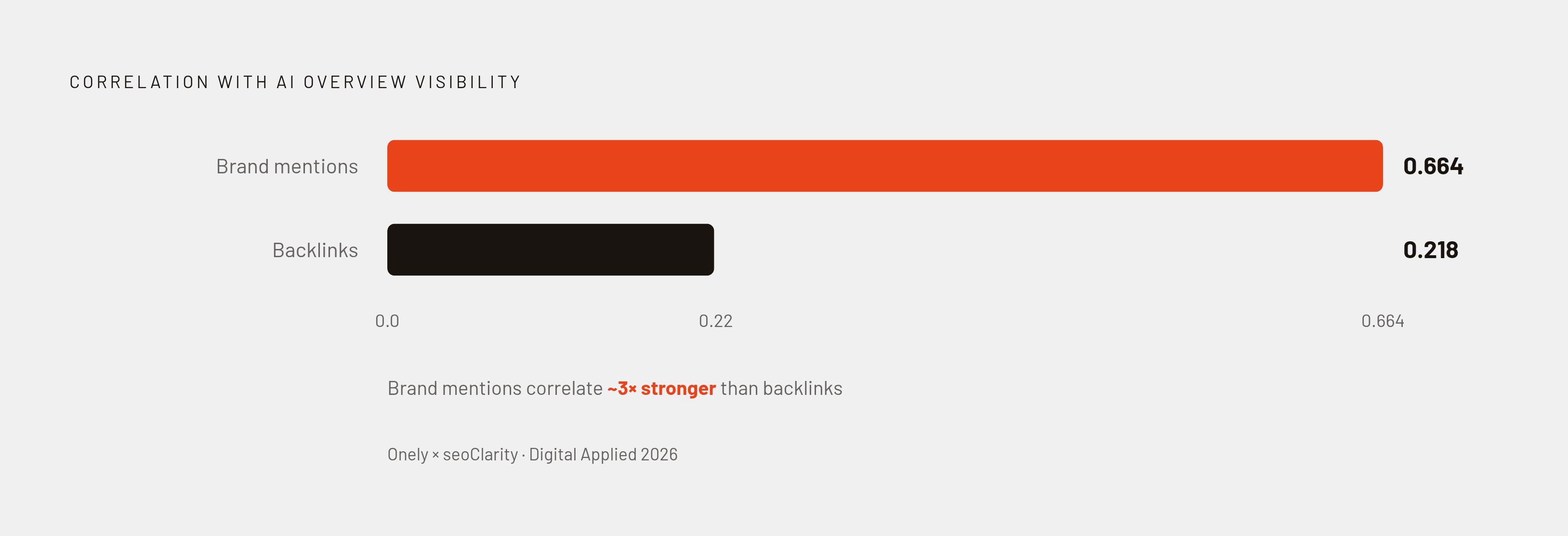
The numbers make the case bluntly. Onely's analysis of seoClarity data, cited in the Digital Applied 2026 guide, found brand mention correlation with AI Overview visibility at 0.664, against a backlink correlation of just 0.218. Earned mentions correlate with AI visibility roughly three times as strongly as the link-building metric that traditional SEO has optimized for over the past two decades. That gap should reorder budget priorities for anyone still treating digital PR as a brand-awareness line item rather than a citation-engineering one.
Digital PR and social search work best as a combined system rather than separate channels. The research brief states that digital PR creates credibility at scale, and social search ensures its distribution, making that credibility visible, repeatable, and memorable across traditional search, social platforms, and AI-powered answers. Neither half does much on its own; credibility without distribution stays locked inside a single article, and distribution without credibility just amplifies noise.
E-E-A-T signals tie this back to citation selection directly. Research on AI Overview ranking factors found that the vast majority of citations come from sources carrying strong E-E-A-T signals, which one analysis frames as the dominant criterion AI systems use when choosing which sources to cite.
Wikidata deserves a second look here as a PR-adjacent lever rather than a purely technical one. Unlike Wikipedia, Wikidata carries a lower notability bar, so a legitimate business that can point to serious, publicly available references, a business registry, trade press coverage, or an industry database, can create an entry and receive a unique QID that search engines use for unambiguous disambiguation. LinkedIn company pages, Crunchbase profiles, and government business registrations then serve as the secondary sources that corroborate that Wikidata entry once it exists. Most brand and PR teams have never filed one, so it's a gap a competitor can close first.