AI-Powered Lead Scoring Model Configuration
AI models need proper configuration, data weighting, and continuous refinement to work.

Configuring an AI lead scoring model is not a single decision, it's a sequence of them: what type of model to run, what data to feed it, how to calibrate what comes out, and how to keep the whole thing from going stale. Most B2B teams still treat scoring like a formula someone wrote once and left alone. That's why 79% of B2B leads never convert while 27% sit sales-ready at any given time. The problem was always qualification, and qualification is a configuration problem, not a marketing problem. It's qualification, and qualification is a configuration problem, not a marketing problem.
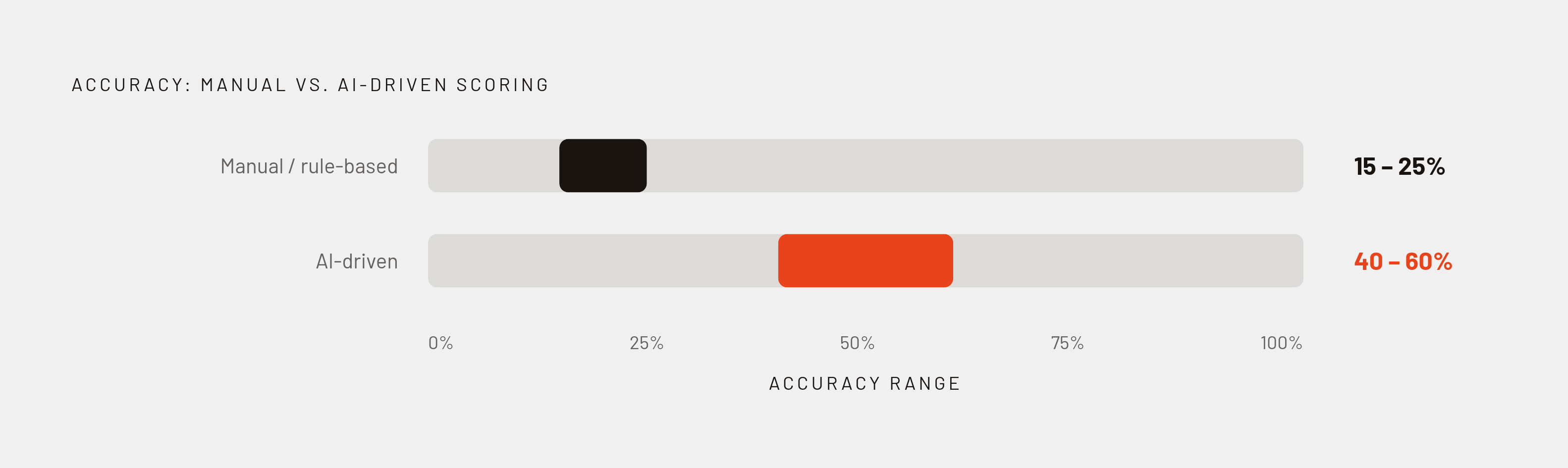
Rule-based scoring fails for a simple reason: someone assigned +10 points to a whitepaper download and +5 to a pricing page visit based on a hunch, not evidence. Those numbers reflect whoever built the spreadsheet, not how buyers actually behave. Manual scoring tops out around 15 to 25% accuracy. AI-driven scoring runs 40 to 60%. Autobound's comparison guide finds that organizations running lead scoring see 138% ROI on lead generation spend, against 78% for those that don't.
The reframe worth sitting with: a score isn't a conversion prediction, it's an action-readiness signal. The real question a well-configured model answers is "where should effort go next?"" It's "where should effort go next?" Get that framing wrong and you end up with a number nobody knows what to do with, which is the actual failure mode most teams are living with right now.
The model types available and what each one is suited for
Four categories solve different problems in practice.
Predictive lead scoring runs on statistical models, logistic regression or gradient boosting, trained against historical CRM outcomes. It works when there's enough won/lost history to learn from. Propensity models take a narrower job: predicting the odds of one specific action, like booking a demo or renewing a subscription, rather than overall conversion. These appear most in nurture and retention flows. Intent-based scoring looks outward instead of inward, weighting real-time signals like product review research, competitor comparisons, and keyword activity to catch prospects who are in-market right now, even ones with zero prior engagement on your site. Composite or hybrid models blend multiple algorithms, often a neural network paired with regression, to balance short-term intent against long-term fit. These tend to suit enterprise organizations managing large, messy datasets rather than smaller shops.
Research into lead scoring models consistently shows that Random Forest and Gradient Boosting tend to outperform more complex architectures in predictive accuracy. The fancier architecture doesn't automatically win. What's changing the game instead is a layer sitting on top of these classic models: transformer-based systems that read unstructured text, email replies, call transcripts, chat logs, none of which older ML pipelines could touch. That extends scoring past clicks and form fills into what people actually say.
None of this matters without enough data to train on. Salesforce Einstein, for example, needs roughly 1,000 converted leads before it produces a reliable score. A sophisticated model type bolted onto a thin dataset still produces garbage. And within any of these categories sits a further choice: explicit scoring, built on declared data like job title and company size, versus implicit scoring, which infers intent from behavior. Most production setups blend both rather than picking a side.
Which data signals to feed the model and how to weight them
Five categories of input appear across almost every serious configuration. Firmographic data (industry, company size, revenue, funding stage, location) answers whether you'd want this company as a customer in the first place. Demographic data (job title, seniority, decision authority) tells you whether the person in front of you can actually sign. Behavioral data, website visits, demo requests, email opens, event attendance, tracks what someone's actually doing rather than who they claim to be. Technographic data, the tools a company already runs, signals whether your product fits into their stack. And intent data, third-party research activity and competitor comparisons, is the most time-sensitive of the five: it decays fast and needs to be acted on while it's fresh.
CRM history feeds the model too, lead source, deal size, time-to-close, because the model needs to learn from your actual outcomes, not some generic industry benchmark that has nothing to do with your buyers.
The harder problem is weighting. Not every signal deserves equal say, and the moment someone manually assigns weights at configuration time, they've baked their assumptions into the system, assumptions that quietly rot as the market shifts. The better approach lets the model learn weights from outcome data rather than inheriting them from whatever rule-based scheme came before it. Transformer models scoring email tone, call sentiment, or chat content pick up signal that classic ML simply never saw.
Just as important is what to cut. Signals that correlate with your existing customer base but don't actually predict conversion are survivorship bias wearing a data hat. So are signals that track marketing activity volume, how many emails went out, rather than genuine buyer interest. And none of this works if sales, marketing, and data teams haven't agreed on what "qualified" even means before feature selection starts. Skipping that conversation causes the model to optimize beautifully for the wrong target.
Training the model on historical data and the minimum data requirements that apply
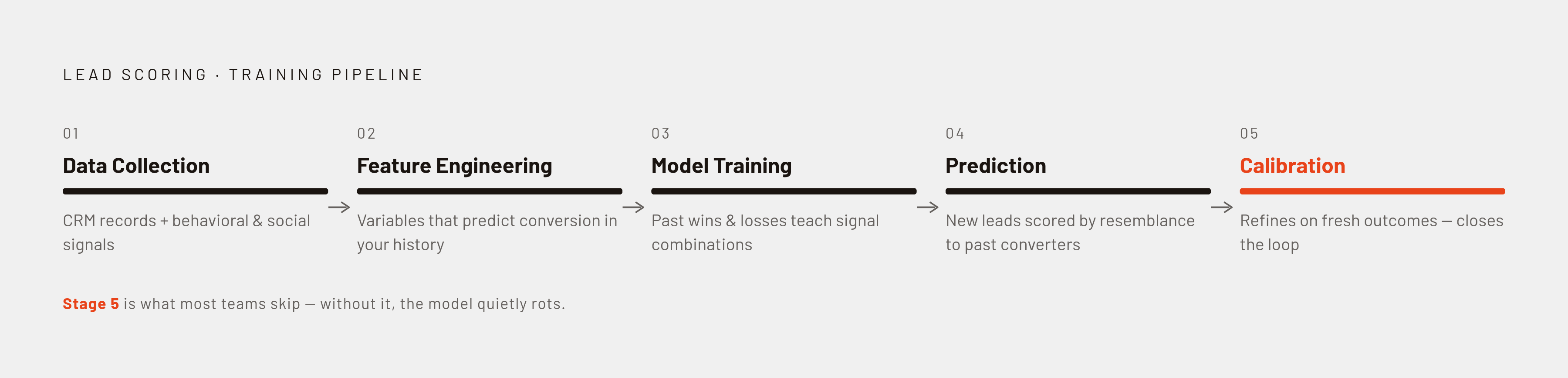
The training pipeline runs in a fairly consistent sequence. Data collection first, structured CRM records alongside unstructured behavioral and social data. Feature engineering next, figuring out which variables actually move the needle on conversion in your specific history, not someone else's. Then model training, feeding past wins and losses into the algorithm so it learns which signal combinations preceded a closed deal. Prediction follows, scoring new leads by how closely they resemble past converters. And calibration closes the loop, with the system refining itself against fresh outcomes as they arrive.
The data floor isn't a suggestion. Einstein Lead Scoring needs around 1,000 converted leads before it builds something reliable, a hard data floor that leaves organizations running small deal volumes or a new CRM instance with weak output no matter how good the underlying algorithm is. That's a hard constraint.
There's also a labeling issue that deserves scrutiny. The model learns from historical wins and losses. It inherits whatever bias already lived in past sales behavior. If reps historically ignored a certain segment, the model reads that neglect as evidence the segment isn't worth pursuing, and reinforces it. A model that scores well on its own training data but hasn't been checked against outcomes it never saw is an overfitting exercise dressed up as one. It's an overfitting exercise dressed up as one.
Done right, this process finds things a human never would. Jeeva AI cites a software company that trained on five years of CRM data and discovered leads requesting a trial within three days of visiting the pricing page converted at five times the rate of everyone else. No rule-based system, built on guesswork and quarterly reviews, was ever going to surface that pattern.
Calibrating score outputs to actual business thresholds
Most platforms hand back a score somewhere between 0 and 100. That number means nothing on its own, it only becomes useful once the organization decides what each range should trigger.
That decision is a business call. At what score does a lead go straight to an SDR? At what score does it sit in nurture? At what score, if any, does the AI start outreach without a human touching it first? Warmly's Compound Score framework illustrates the logic well with what it calls Activity Saturation: if a buying committee has already been emailed, LinkedIn-messaged, and retargeted, the compound score drops because more outreach there produces no marginal return. The model's job is to route effort where it still creates output, not where it's already been spent.
Recency matters just as much. A VP who hit the pricing page this morning is worth more than one who downloaded a whitepaper a month ago, and if the calibration doesn't explicitly build in decay, scores go stale fast without anyone noticing. HubSpot's August 2025 update, which added support for running multiple scoring models at once, lets teams calibrate separately by product line, region, or persona instead of forcing one threshold to fit everyone.
Explainability earns its keep here too. When a platform surfaces which signals drove a given score, Einstein's score reason fields or HubSpot's signal explainability, it becomes possible to catch bad calibration early. If the top driver behind a high score is consistently something flimsy, that's the tell the weights need adjusting, before the model has burned through a quarter's worth of bad routing decisions.
Speed factors into calibration too, more than most teams account for. A scoring API call ran 150 to 300 milliseconds as recently as 2024. By 2026, production systems return scores in under 20 milliseconds, fast enough to score, route, and assign a lead before the browser even finishes redirecting off the form. Calibration built for a slower system leaves that speed on the table.
Ongoing model maintenance: retraining cadences, feedback loops, and drift detection
Drift is quiet and completely predictable. It's quiet and completely predictable: buyer behavior shifts, market conditions move, product positioning changes, and a model trained on last year's wins degrades on schedule whether anyone's watching or not.
The fix requires a real feedback loop, sales and marketing feeding outcome data, won, lost, stalled, back into the model on an ongoing basis. Skipping that keeps the model optimizing for a version of the market that no longer exists. Closed-loop calibration is the practical version of this: if leads scoring above 80 start converting worse than expected, either the threshold's wrong or the weights are, and the model only finds out by seeing those outcomes come back in.
The direction for 2026 points toward scoring systems moving past predictive analytics toward reinforcement learning, adapting their own logic based on engagement feedback rather than waiting for a scheduled batch retrain. That's a real shift in what maintenance means, from periodic recalibration to something closer to continuous policy update.
None of it works on dirty data. Gartner puts the cost of bad data quality at a substantial sum each year per organization, and that's not just a drag on accuracy, it actively teaches the model the wrong lessons. On cadence: batch retraining on cycles that once seemed reasonable already reads as too slow for real-time routing, and the right frequency depends on lead volume and how fast the market is moving, since that pace directly determines how quickly the model's assumptions go stale. And GDPR and CCPA aren't a footnote here. Encryption and role-based access on training data are configuration requirements, the same as choosing a model type, not optional hardening added later.
How AI perception of your business affects lead scoring inputs you cannot control
There's an input layer here that most configurations never touch directly, and it's growing fast: intent and third-party signals increasingly come from AI-mediated sources, what an AI search system says about a business, which summary it generates, which competitors it names in the same breath.
When someone asks an LLM which vendor to look at, they don't get ten options. They get a summary naming two or three. Gravitas Vision and ALM Corp research found that AI search traffic grew 527% year-over-year through 2025 into 2026, and answers generated by a language model had become a fixture on a meaningful share of search results pages. A report from Fuel Online, analyzing 1,000 enterprise brands, found 62% were invisible to generative AI models, despite the vast majority of those same companies pouring resources into traditional SEO. Their brand signals simply never entered the intent data streams that feed downstream scoring models.
E-E-A-T explains a lot of that gap: 96% of AI Overview citations pull from sources carrying strong E-E-A-T signals, so a business without editorial mentions, authoritative citations, or a Knowledge Graph presence is far less likely to surface in the AI research behavior generating today's intent signals. That creates a measurement gap most teams don't even know they're standing in: a company can build a technically sound scoring model and still run on incomplete intent data, because AI systems are underrepresenting or flatly misrepresenting them upstream, before the model ever sees a lead.
Understanding how AI systems evaluate and represent a business, which signals they use, which sources they trust, which credibility markers carry weight, isn't a side project sitting next to lead scoring. It sits upstream of it. A model tuned perfectly on paper is still only as good as the intent data reaching it, and if that data's thin or distorted because the AI-mediated discovery layer isn't picking the business up, calibration downstream can't fix what's broken upstream. Measurement has to happen at that layer first, before optimization at the scoring layer means anything at all.