AI-Assisted Send-Time Optimization in Email Automation
AI learns when each subscriber actually reads email, outperforming one-size-fits-all send schedules.

What AI send-time optimization does at the per-recipient level
Most email programs still send one message at one time to the entire list, no matter when each person actually opens their inbox. AI-assisted send-time optimization (STO) replaces that single scheduled blast with a per-recipient prediction built from behavioral data, timed to land near each subscriber's own peak. What a program gets out of that depends entirely on what data feeds the model, how it learns, and where the whole thing quietly breaks down.
Splitting a list into "Eastern" and "Pacific" batches is batch-and-blast with a timezone dropdown attached, and it ignores the much bigger gap between two people who live in the same timezone: one who checks email at 6 a.m. on the way to the gym, anoth... It's batch-and-blast with a timezone dropdown attached, and it ignores the much bigger gap between two people who live in the same timezone: one who checks email at 6 a.m. on the way to the gym, another who reads at 9 p.m. once the kids are down. Batch-and-blast sending still dominates most programs and caps out around a 14.5% open rate, with click-through near 1.3%. Automated sequences report open rates well above that baseline and click-through near 5.8%, a gap that has widened as the tooling behind STO has matured. Getting timing wrong costs more than a missed open. It builds fatigue, drives unsubscribes, and rots sender reputation in a way that compounds against every send that follows.
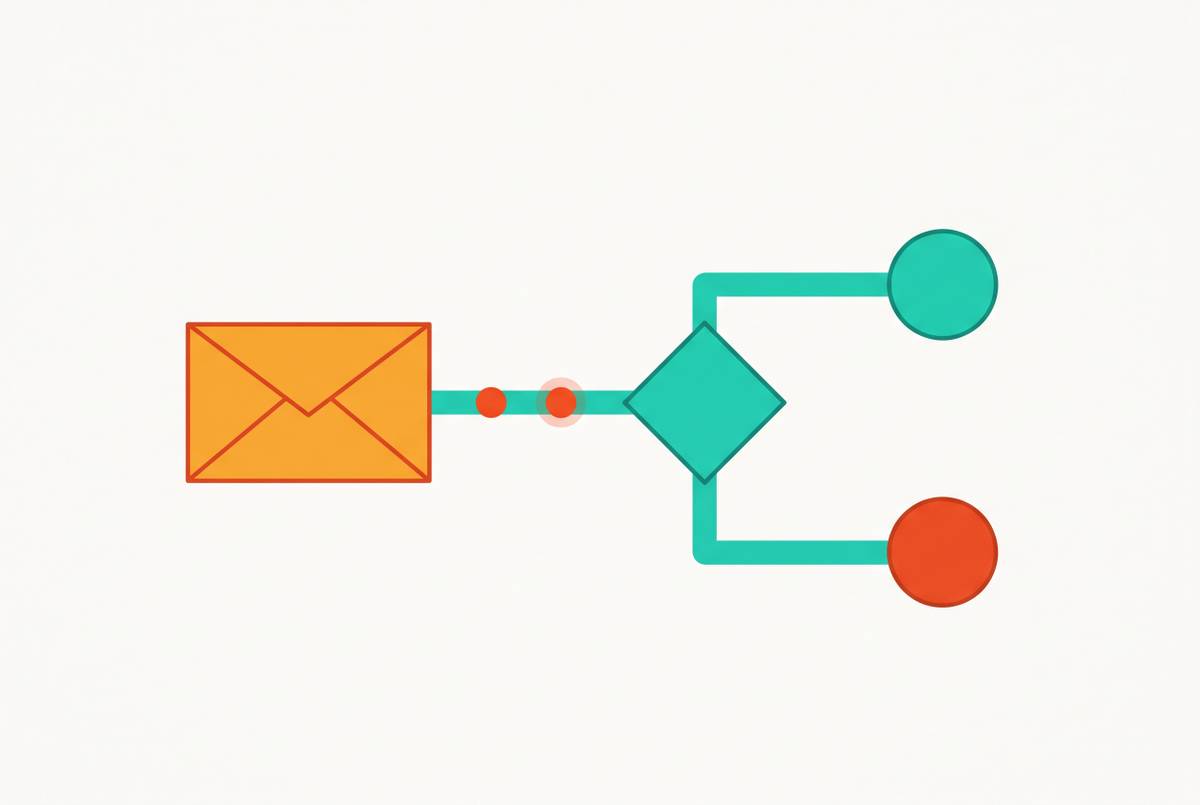
The shift STO makes is structural. Instead of firing one blast, the system builds a probability curve for each contact across the days of the week, then delivers at that contact's predicted peak. The model isn't guessing a single "right" hour. It scores engagement likelihood across a set of hourly slots and picks whichever one carries the best odds.
The signals feeding that curve include historical open timestamps, click events, reply activity, recipient timezone, day-of-week patterns, device type, and inbox-provider behavior. A model worth trusting separates by content type, because a subscriber might read a weekly newsletter at the same hour every Thursday but only open promotional email after work on weekdays. Conflating the two muddies the prediction into something less useful than either signal alone. The output is a schedule unique to that one contact, not an average pulled from a segment and dressed up as personalization.
None of this produces certainty. The model scores likelihood, and every new engagement event updates the curve so the prediction sharpens over time. Data volume matters in a literal way: Klaviyo's Smart Send Time needs at least 12,000 recipients in an exploratory send before it produces individual predictions with any reliability. Below that threshold, the system falls back on population-level heuristics, which is batch-and-blast wearing a data science costume. "Tuesday at 10 a.m." dressed up with a probability score is still Tuesday at 10 a.m. for everyone on the list.
The open-rate signal problem that most STO implementations quietly inherit
Apple Mail Privacy Protection, introduced in 2021, pre-fetches tracking pixels on Apple devices. The pixel fires and registers a proxy "open" even when no human ever looked at the message. That distortion has been baked into open-rate data for years now, and it hasn't gone away, no matter how many platforms quietly stopped mentioning it.
For STO, the consequence is direct. A model trained heavily on open events learns from a mix of real and phantom signals, and it can end up scheduling delivery for the moment Apple's client fires the pixel rather than the moment a person actually reads the email. Insider gets around this by scoring all 24 hourly slots per subscriber but weighting clicks 2.5 times more heavily than opens, a deliberate design choice built to blunt the influence of proxy opens on the predicted send window.
That leaves a concrete question for anyone shopping platforms: is the model open-weighted or click-weighted, and what share of the list runs on Apple Mail? The answer decides how much trust the prediction deserves. It's why a lot of practitioners have already moved their primary success metric away from open rate and toward click-through, conversions, and revenue per email, and that move is correct. Nobody should be picking an STO vendor without first pinning down which of these two flaws their model tolerates: over-trusting a poisoned signal, or under-weighting a real one.
What the performance data shows, and what it leaves unresolved
Reported open-rate lift from STO ranges from 15 to 20% across several platform sources, with an independent estimate spanning as wide as 5 to 25%. That spread is the finding, not a detail to skip past. Nobody has pinned down a tight number, and vendors selling the feature have every incentive to report the high end. Mailsoftly claims a 41% lift from its AI send-time feature, a figure that comes from the company selling the product and should be read with that in mind, not repeated as fact.
The most credible independent number comes from Litmus's 2025 benchmark study of nearly 500 marketing professionals, which found that email marketers using AI across their programs saw open rates improve by 32%, click-through by 41%, and conversions by 53%, against marketers using traditional approaches. That's a real number, but it covers AI in email broadly, not STO in isolation. Most published figures bundle send-time optimization together with predictive segmentation, dynamic content blocks, and subject-line generation, and pulling STO's individual contribution out of that bundle is methodologically hard. Vendor studies rarely even attempt it, because the bundled number looks better in a sales deck than the isolated one would.
Enable STO as a discrete initiative rather than one AI feature among five switched on simultaneously, because that is how teams end up unable to say which one moved the number. Measure for a meaningful baseline period, then layer in segmentation once that baseline is understood. In the same Litmus study, 78% of top-performing email marketers already use AI for at least one part of their program, so adoption stopped being a differentiator a while ago. Execution is what separates the winners now.
Design decisions that distinguish named platforms' STO implementations
Bloomreach's Loomi AI calculates optimal send times across both email and SMS using past engagement data, and pairs that timing work with product recommendations pulled from purchase history, optimizing when a message goes out and what it says at the same time. Bloomreach also runs a frequency policy governed by the model rather than a marketer's calendar: highly engaged customers can receive every relevant email, while low-engagement contacts get capped at one email per week.
Insider scores all 24 hourly slots per subscriber, built from that subscriber's own open and click history, with clicks weighted 2.5 times more heavily than opens, the direct architectural answer to Apple MPP noise. It recalculates the optimal window every time the subscriber engages, so the model updates continuously instead of on a periodic batch cycle.
Klaviyo's Smart Send Time needs 30-plus days of recipient-level data before individual predictions mean anything, and it staggers delivery automatically across a 24-hour window, which fits Shopify and other e-commerce use cases well. HubSpot folds an "optimize send time" option into its broader CRM, which pays off where contact records already carry behavioral data beyond email opens. Mailchimp's Predictive Send leans on ease of use, analyzing past behavior and spreading delivery across 24 hours. Salesforce Einstein builds predictive send timing into its larger CRM and marketing automation stack.
Price stopped being the real barrier a while back. STO and predictive send features that were enterprise-only a few years ago now show up on mid-market platforms starting around $29 a month. What actually separates these products is how the per-contact window gets calculated, how opens and clicks get weighted against each other, and how often the model updates. Anyone comparing platforms on price alone is comparing the wrong column.
The prerequisite layer STO cannot substitute for: deliverability and list health
Timing a message perfectly does nothing if the message lands in spam. Deliverability governs whether an email reaches the inbox. STO only governs when it arrives once it's already there, and no amount of prediction accuracy fixes a domain that's already flagged by a provider.
Authentication is the floor. SPF, DKIM, and DMARC all need to pass, the bare minimum inbox providers check heading into 2026. A cold or unwarmed domain that suddenly sends volume looks like spam no matter how precisely each individual send is timed. List hygiene matters just as much: invalid addresses, role accounts, and unconfirmable catch-alls need to come out before STO gets switched on, since a high bounce rate wrecks sender reputation faster than good timing can rebuild it.
There's a deliverability benefit built into STO itself that gets overlooked constantly. Spreading sends across 24 individual hourly windows instead of firing the whole list at once smooths delivery volume and avoids the infrastructure spike a simultaneous blast creates, which helps deliverability on its own terms, apart from any lift in opens. Brand-level signals matter here too: a registered logo showing in the inbox, the kind of visual verification BIMI-adjacent standards support, can lift opens by as much as 38% and boost brand recall by up to 120%. Inbox providers now treat that kind of brand authentication as part of pre-open evaluation, before a subject line even gets scored.
The sequence is not optional, and skipping steps in it is the single most common way teams waste a good STO rollout. Authenticate the domain, clean the list, warm the sending infrastructure, and only then turn on STO. Doing it in reverse wastes the optimization on a foundation that can't carry it.
Places where AI frequency and timing optimization can go wrong without human guardrails
Left alone, a frequency-optimization algorithm chases short-term engagement and quietly ratchets up send volume to subscribers who look highly engaged, right up until fatigue tips into an unsubscribe. Because a model that optimizes purely for opens or clicks has no built-in reason to notice engagement history is a lagging indicator of tolerance rather than a permanent green light, the damage appears in the numbers, by which point the subscriber is already gone.
The fix is automation with limits it cannot override on its own. Loomi AI's frequency policy, capping low-engagement contacts at one email a week while leaving high-engagement contacts uncapped, is one working example of that guardrail. Certain categories of email shouldn't be fully automated at all: product launches, pricing changes, and crisis communications need a human to sign off before the send goes out, with AI drafting and flagging rather than sending unsupervised. Handing those three categories to an algorithm because it handled last month's promotional calendar well is a mistake, and a fairly common one.
New subscribers create a cold-start problem, since the model has no behavioral history to learn from, and STO falls back on population-level heuristics for them. That's still better than a fixed blast time, but it isn't the individualized prediction the feature promises, so that expectation needs setting honestly rather than assumed on day one. And if success gets measured by open rate alone, an open-weighted STO model will happily optimize toward Apple MPP proxy signals instead of real attention. The metric chosen before launch matters as much as the model itself. STO is not a feature to switch on and walk away from. It needs constraints, the right metrics, and regular human review of how frequency patterns actually evolve over time.
How AI perception of your brand shapes who enters your email list
Everything above concerns what happens after someone is already on a list. AI systems now actively evaluate businesses and shape what gets recommended before a prospect ever reaches a signup form, and that earlier filter deserves as much attention as anything downstream of it, arguably more.
People arriving at a business through an AI-generated answer, rather than a search results page, have stopped being a rounding error, a shift that published traffic data increasingly reflects. What these systems weigh when representing a brand includes the accuracy of what's in their training data, depth of coverage, sentiment, and how often the brand gets recommended at all, and those signals call for different fixes than traditional SEO. The endorsement dynamic is blunt about it: when a model names a brand in answer to a query, it's usually naming one or two options, not ten, and it's staking its own credibility on that specific recommendation. Getting left out of that answer is a structural loss of acquisition, not a minor visibility gap to shrug off.
The connection to email is direct, even if it's easy to miss under all the talk of send times and open rates. List quality is partly downstream of brand visibility and perceived credibility at the point of discovery, so optimizing send times for a list that AI systems aren't directing anyone toward means fine-tuning the middle of a funnel that's already weak at the top. Most companies have no system in place for tracking how AI systems currently describe or recommend them, and that blind spot grows as more discovery routes through AI-mediated answers instead of search results. Measurement has to come before optimization here, the same principle that runs through every layer of send-time logic covered above. Programs that track the full chain, how AI systems perceive the brand upstream, how inbox algorithms evaluate the email itself, and how individual subscribers behave once it lands, are the ones pulling compounding returns out of an email program instead of chasing marginal gains on a single lever in isolation.