Building an AI Content Workflow With Human Editorial Gates
AI content needs human checkpoints to avoid costly brand missteps.

Every AI content pipeline that skips human checkpoints is making a bet: that speed matters more than what happens when a model gets the brand wrong in front of a customer. That bet loses more often than the industry admits, and it loses in a specific, traceable way, not through some vague dip in "content quality." This piece maps the five points where human judgment has to intercept the pipeline. Cut any one of them, and you're not saving time. You're scheduling a failure you just haven't met yet.
The pressure to strip out checkpoints makes sense on paper. Speed, cost, and volume are real goals, not excuses executives invent to justify laziness. But the failure mode that appears once those checkpoints disappear doesn't look like a normal editorial slip, and that difference carries the whole argument.
What AI systems are doing with your content after it publishes
Large language models act as unofficial spokespeople for every brand they've read about. Ask one about a company's pricing, its history, or its return policy, and it answers from whatever the open web happens to contain: no briefing document, no fact-check call, no way for the brand to correct the record afterward. That's a real break from how brand information used to travel, and most marketing teams still haven't priced it in.
Two separate problems live inside this, and they need two different fixes. The first is misinformation: real content, somewhere, that is just out of date. A pricing page that changed last quarter but never got updated on a partner site. Messaging the brand walked back a year ago that's still indexed and still feeding the model. The second is hallucination, where the model doesn't have enough real signal about a brand and fills the gap with something plausible-sounding and wrong. Thin content volume makes this worse: a brand with little written about it online gives the model less to work with and more room to guess.
The AI assistant built into the coding tool Cursor told users their subscriptions were restricted to one device, a policy that never existed. The episode created real customer impact, traced back to a model confidently delivering information that had no basis in fact. That's a support ticket, a churn event, and a headline, all traced back to a gap in what the model actually knew, not a bug anyone could patch after the fact.
Brands stay exposed here in a few specific ways: stale training data still reflecting old positioning, thin content volume forcing the model to extrapolate, and negative signal amplification, where one loud complaint outweighs a stack of accurate but quiet content sitting elsewhere. Model accuracy has genuinely improved. Hallucination rates have fallen hard from where they sat a few years back, and the best systems now run at only a small fraction of that. None of that progress zeroes out the risk. An enterprise running content through these systems still finds false or fabricated details in a meaningful share of complex reasoning and summarization tasks, and a better benchmark score doesn't change what happens on the specific query where the model gets it wrong. Any pipeline feeding an AI model has to be built with that synthesis step in mind, alongside the human reader who was the original audience.
AI Evaluators' Content Signal Scoring Before Human Review
Search used to rank. AI answers endorse. When a model names a brand in response to a question, it's putting its own credibility behind that pick, and the shortlist it draws from usually runs one to three names, not ten blue links a user can scroll past. Getting cut from that shortlist is disappearing from the conversation, not a ranking demotion. It's disappearing from the conversation.
What earns a spot on that shortlist comes down to a handful of things you can actually check. Entity coherence asks whether the story the web tells about who this brand is stays consistent across every platform where the brand appears. Corroboration matters more than most brands want to admit, since the large majority of mentions AI systems cite trace back to third-party pages rather than the brand's own site, so a brand's own claims about itself carry less weight than what other people say about it. Topic-conditional authority counts too: depth in one lane beats shallow coverage spread across twenty topics. Structure counts on a technical level, since content built with clear sequential headings and proper schema markup gets cited at meaningfully higher rates than content without it. And freshness counts on a clock: pages left untouched for a quarter or more fall out of AI citations at a much higher rate.
None of this holds still, either. Most brands don't keep the same visibility from one AI-generated answer to the next, and fewer still stay present across five consecutive runs of the same query. A pipeline that publishes something once and walks away is losing ground continuously, even when nothing about the content itself changed.
A large share of the citations visible in AI answers trace back to community platforms, places like Reddit and YouTube that no brand's content team directly controls. A brand can't publish its way onto Reddit. What it can do is keep the facts on its own site accurate and consistent enough that when Reddit users talk about it, the two stories match. A review gate built only to ask "does this sound like us" never touches any of this, and that's exactly the blind spot most brands are running with right now. Structure, freshness, and factual corroborability need their own line items on the checklist, separate from tone.
The five points in a pipeline where human judgment is non-negotiable
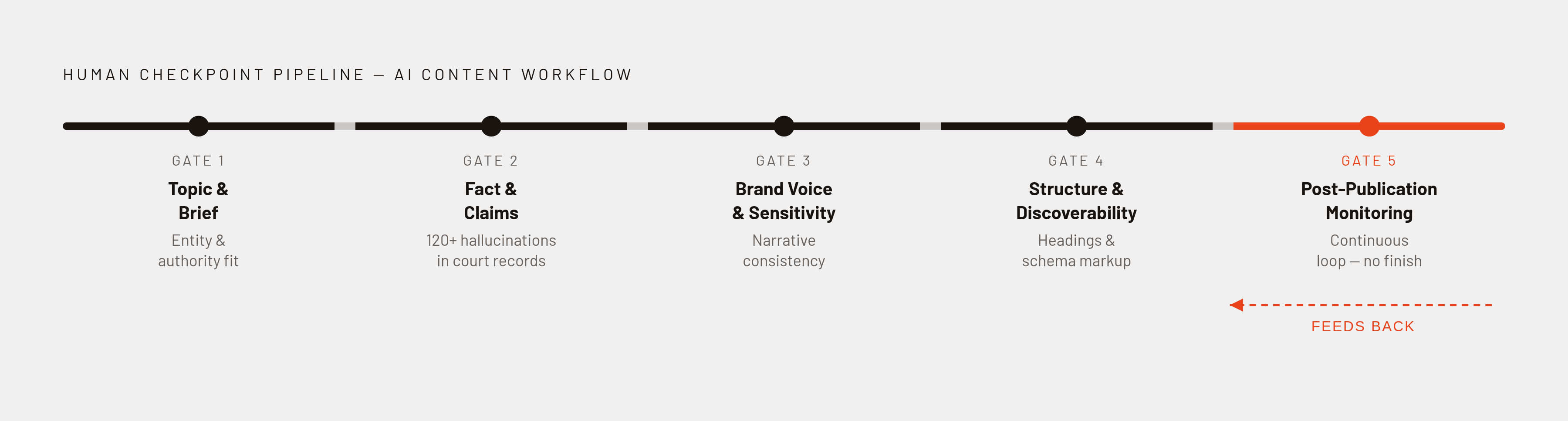
Gate 1: topic and brief validation, before drafting starts. AI tools are genuinely good at finding search gaps and pulling volume data. What they can't judge is whether a topic actually belongs in the brand's declared territory of authority. This gate protects entity coherence and topic-conditional authority, the two signals AI retrieval systems lean on to decide whether a brand deserves treatment as a credible source on a subject at all. The call being made here is strategic, and no AI tool is positioned to make it.
Gate 2: fact and claim verification, before the draft leaves drafting. Drafts produced by AI routinely fold in statistics, citations, and product claims that read smoothly and turn out to be fabricated or simply unverifiable. The Cursor hallucination is this same failure, just further downstream and facing a customer instead of an editor. The stakes are already visible in court records: more than 120 cases of AI-driven hallucinations have been identified since mid-2023, with at least 58 in 2025 alone, including one that carried a $31,100 penalty. This gate protects the plain factual integrity of content that, whether anyone intends it or not, becomes training signal for the next generation of models. It needs a subject-matter expert reading for accuracy, not an editor skimming for tone.
Gate 3: brand voice, positioning, and sensitivity review, before editorial sign-off. AI drafts reflect patterns baked into their training data, and as a result they drift toward generic phrasing, echo a competitor's framing without meaning to, or resurrect an old brand claim that's technically still floating around online. WordPress VIP's 2026 governance framework is blunt about it: a human has to be in the loop on anything contentious or potentially libelous, and approval workflows need editors reviewing content before it goes live, not after. What this gate protects is narrative consistency, one of the AI-specific brand reputation metrics that Britopian has identified in its research. Treating every piece with the same scrutiny here is a mistake in either direction: high-stakes topics should route to a subject-matter expert or legal counsel, while a low-risk evergreen explainer can go to a standard content editor. Tiering by risk is what keeps this gate from becoming either a bottleneck or a rubber stamp.
Gate 4: structural and discoverability review, before publication. Heading hierarchy and schema markup aren't decoration. They're tied to the citation-rate advantage described earlier, where sequential headings and rich schema correlate with higher citation rates, and skipping them is a discoverability decision whether anyone frames it that way or not. An editor asking "does this read well" is answering a different question than "will an AI retrieval system parse this correctly," and the checklist needs both: freshness cues, internal consistency in how the brand's entities get described, and structured data checked explicitly rather than assumed.
Gate 5: post-publication monitoring, ongoing. Publishing isn't the finish line. Models update, rankings move, and a brand's visibility across AI answers shifts on its own schedule, without anyone touching the original content. This gate means interpreting sentiment anomalies (automated sentiment classifiers still stumble badly on sarcasm and inside jokes from online communities), catching content that's quietly aged out of accuracy, and deciding what gets refreshed versus retired. The human-in-the-loop model described by 3D Issue gets this right: feedback from how real readers actually respond feeds back into both content strategy and the prompts driving future AI drafts. This gate is a loop, not a checkpoint you clear once and forget. It's a loop that keeps running, one you never clear once and forget.
What the publishing industry's at-scale implementations reveal about where gates hold
Springer Nature ran more than 1.5 million research papers through AI-assisted processes in 2025, using nearly 60 different AI tools across manuscript screening, editorial evaluation, author retention, and research integrity checks, and expects that footprint to grow another 25% in 2026. At that scale, human gates stop being an optional layer of caution and become part of the architecture itself. No version of that volume runs safely without them.
The design detail is where the human sits. On Springer Nature's Snapp platform, AI tools sit directly inside the editorial workflow, with human oversight built into every stage rather than bolted on at the end. The satisfaction numbers back it up: 90% of authors, 70% of editors, and 81% of reviewers rated the experience good or excellent. Done right, human oversight doesn't feel like friction to the people going through it.
USA Today runs a similar structure for a different reason. Human oversight, including legal review, functions as a check on the work within the pipeline alongside agentic AI handling operational tasks.
Academic publishing had to learn this the hard way. Through 2025, journals dealt with fabricated data, undisclosed manuscripts written by AI, and even AI-assisted content entering parts of the process where human authorship was assumed. The response stacked several fixes together rather than betting on one: mandatory AI-use disclosures, stylometric detection tools, automated image forensics, and multiple layers of screening. Editors Cafe research from that year found many high-volume journals hit roughly 40% faster triage thanks to AI support in the workflow, and nobody serious argues against that speed gain. The argument is about where that speed shouldn't come from: triage is not the same job as verification, and collapsing the two is how a journal ends up publishing something it has to retract.
According to WordPress VIP, 77% of organizations are actively working on AI governance, yet many are struggling to turn governance principles into actual day-to-day process. That gap sits widest exactly where content moves fastest. It's the predictable result of speed getting rewarded now and governance getting scheduled for later, which in practice means never. It's the predictable result of speed getting rewarded now and governance getting scheduled for later, which in practice means never.
Calibrating Gate Intensity Without Turning Every Review into a Bottleneck
Too much review kills the speed advantage that justified bringing AI into the workflow. Too little review kills the trust that justified the content budget in the first place. Both failures point back to the same fix: calibration.
Risk-tiering is the practical answer, and it means treating content unevenly on purpose. Most teams resist this instinctively because uneven treatment feels like favoritism or inconsistency, but consistency applied to the wrong things is what breaks a pipeline. Content that makes factual claims about products or policies, touches legally sensitive ground, names a third party, or is built to be evergreen and cited repeatedly counts as high-stakes and gets full review. Format conversions, meta descriptions, internal link updates, or a summary of a source already verified elsewhere counts as lower-stakes and can move fast. 3D Issue's human-in-the-loop framework applies this directly: headlines get editorial sign-off for tone and audience fit, facts and claims get human verification before anything publishes, sensitive topics go to legal or a subject-matter expert, and everything else gets automated with periodic spot-checks rather than full review every time.
Every correction an editor makes should get captured and fed back rather than fixed in the moment and forgotten. Feed that correction back into the prompt templates and AI configuration, and the next draft cycle needs fewer corrections, which makes the gate a training input as much as a quality filter. Gates also need a clock. 3D Issue's approach sets clear time limits on review stages specifically to stop them from turning into indefinite holds, while still capturing and categorizing the feedback that comes through, so both the AI process and the human process get sharper over time.
None of this works if the humans staffing the gates haven't been trained for the job in front of them. Academic publishing research from 2025 flagged that editors now need to spot AI-generated content on sight, read automated integrity reports, guide authors on responsible AI use, and run a workflow that's half machine and half human. A gate is only as good as the person reading what comes through it, and no amount of process design fixes an undertrained reviewer.
Measuring whether the gates are working (signals that the pipeline's credibility is holding)
Word count and publishing frequency measure output. They say nothing about whether the content is earning trust or quietly losing it across the three audiences that actually matter: algorithms, AI systems, and human readers. Judging a pipeline by how much it produces is judging the wrong thing, and it's the easiest mistake to make because output is the number that's simplest to count.
Britopian's research names metrics worth actually tracking. sentiment tracking checks whether AI responses that mention the brand frame it positively, neutrally, or negatively. Source Trust Differential checks whether the brand gets cited from high-trust third-party sources or mostly from its own pages, the weaker signal of the two. Narrative Consistency Index checks whether different AI models describe the brand the same way or tell conflicting stories. Entity Co-Occurrence Map tracks which other brands and topics show up alongside this one in AI answers, a read on whether the brand owns its category or is drifting away from it.
Volatility itself is diagnostic. Most brands don't hold steady visibility from one AI answer to the next, and a brand watching its own numbers swing that hard has a concrete signal that something upstream, freshness, entity coherence, or corroboration, is breaking down. Gates that catch those problems before publication are what keep the swings smaller.
Sentiment ratio matters more as a trend line than as a single number. A pipeline running clean holds a fairly stable ratio of positive to negative mentions over time. A sharp shift in that ratio with no real change in volume is an early warning that a gate failed somewhere upstream, even before anyone can point to which one.
The loop this all builds toward is simple to state and harder to run consistently. Perception scoring flags which signals are slipping, editorial review traces that slip back to a specific stage in the pipeline, gate criteria get adjusted at that stage, and the next cycle runs tighter exactly where it needed to. Measurement has to come before optimization, not after. Gates without feedback metrics are just effort with no direction. A pipeline with no gates at all produces volume with no credibility behind it, and volume was never the thing worth optimizing for in the first place.
Sources
- Human-in-the-Loop: How Editorial Teams Safely Scale with AI in 2025 - 3D Issue
- Editorial Trust in AI Content Workfows | WordPress VIP
- Redefining Editorial Workflows: What 2025 Taught Us About AI
- AI and Editorial Workflows: Lessons from 2025
- Springer Nature expands use of AI across publishing workflows - Research Information
- britopian.com
- britopian.com