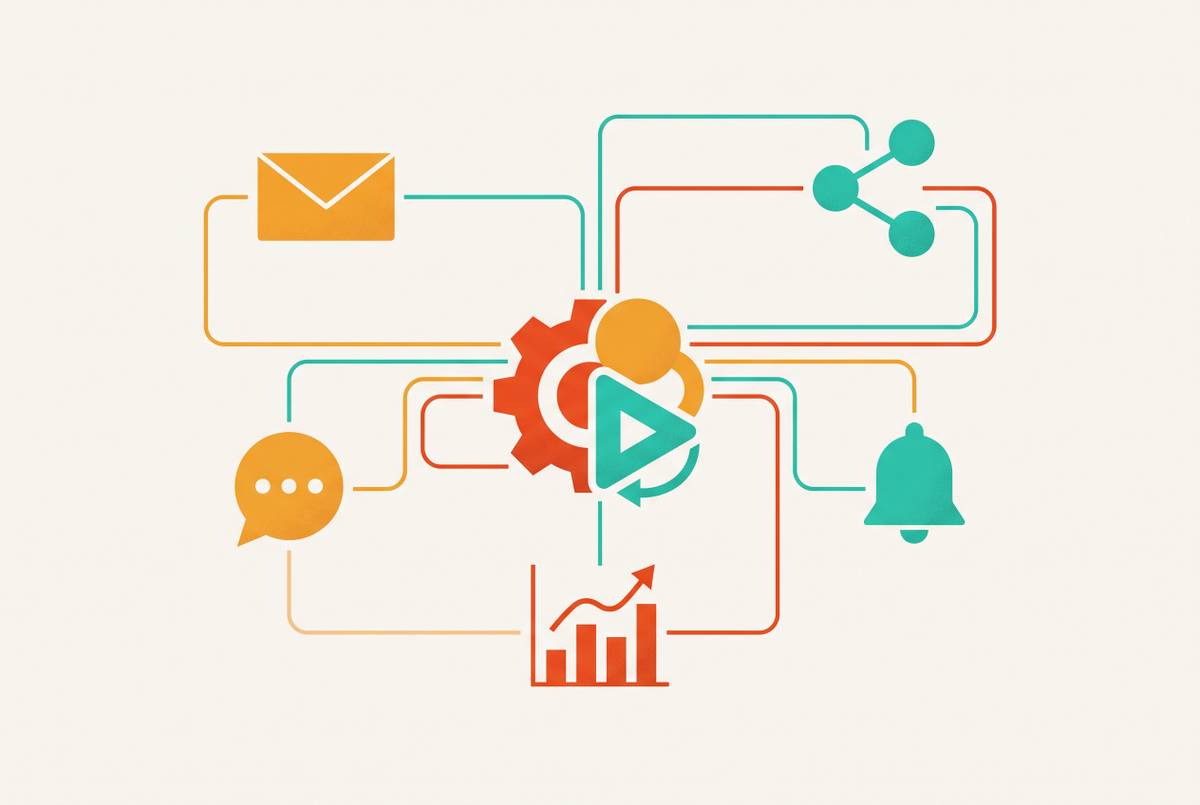
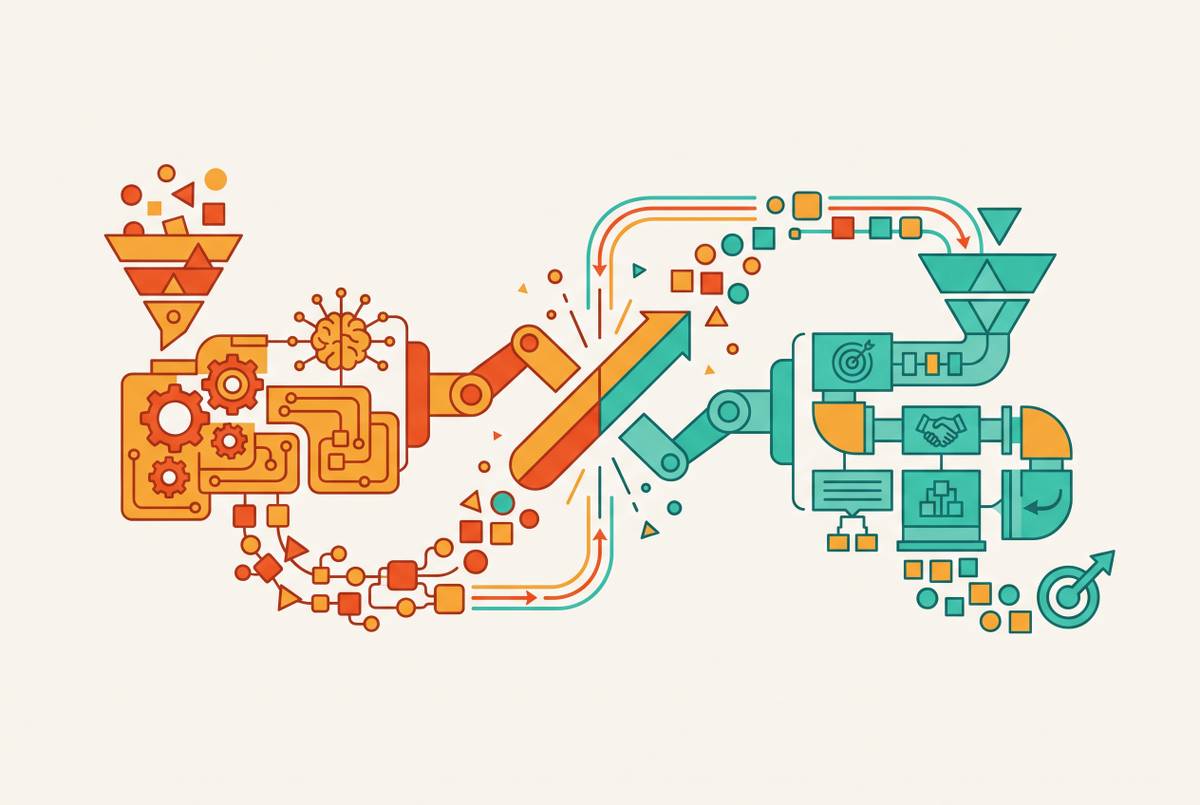
Automation Failure Modes and Recovery Protocols
Most automation failures follow predictable patterns that go undetected until damage spreads.
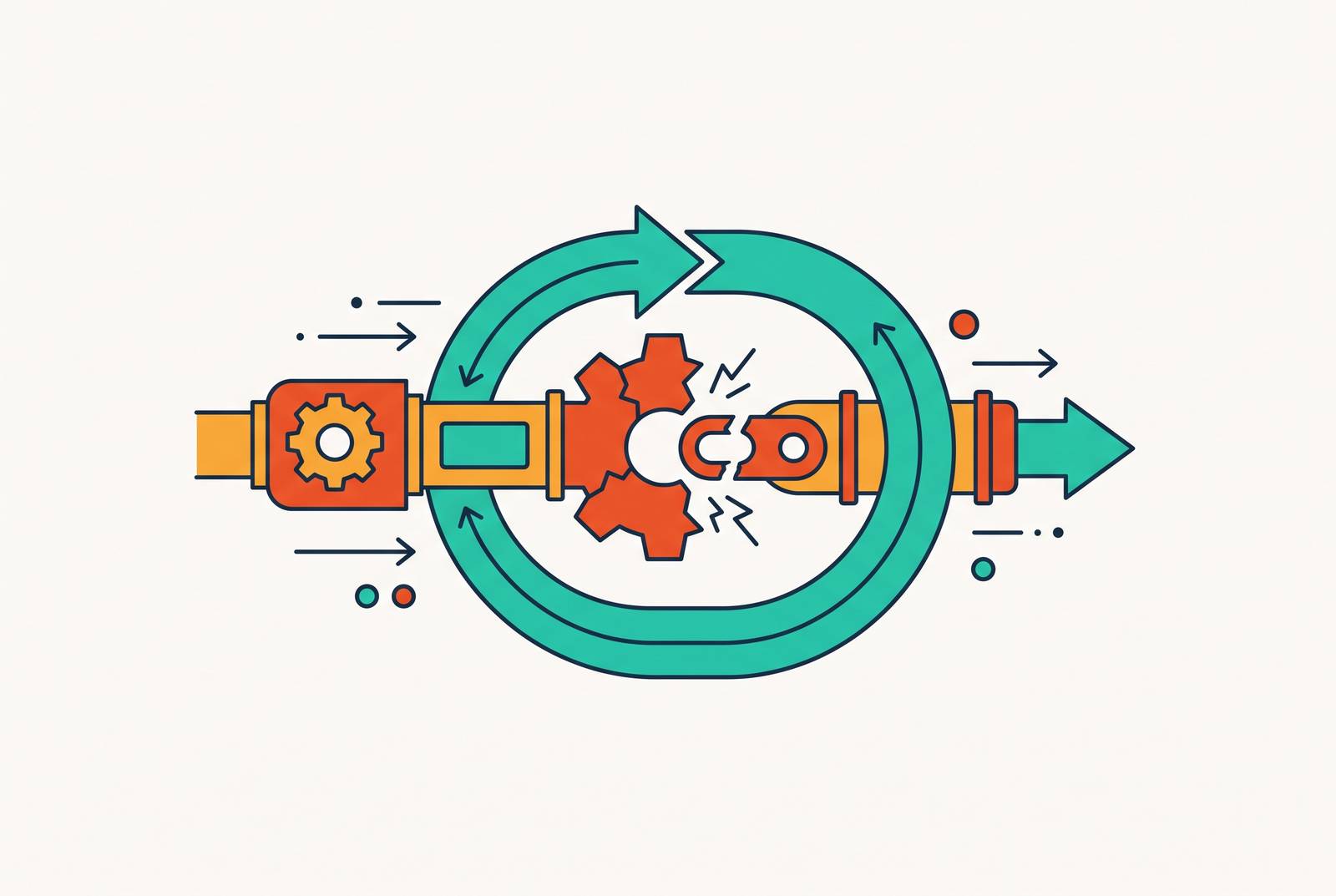
Automation Failure Modes and Recovery Protocols.
Automation failures follow predictable patterns that are rarely exploited.
Automation systems fail in patterns, not accidents. Most organizations still treat every failure as its own novel event, something caused by a strange edge case or a user who did something nobody anticipated. The vast majority of automation failures cluster into a handful of repeating structural categories, and the surprise, when it happens, is almost never technical. It's organizational. Nobody built the detection layer that would have caught it in time.
The timing matters here. Stanford's 2025 AI Index found that 78% of organizations reported using AI in 2024, up from 55% the year before. That's not incremental growth; it's a step change in how much automated decision-making is running inside ordinary business operations, often without a corresponding step change in how failures get caught or handled. Deployment outpaced the discipline needed to manage it. The gap between those two curves, adoption racing ahead and failure-handling maturity lagging behind, is where this piece lives.
Knowing the failure pattern before it manifests is the only lever that separates a recoverable incident from a cascading one. Everything else, the tooling, the vendor, the model architecture, is secondary to whether someone built detection and response into the system before the first thing broke. This piece walks through the six structural failure modes that recur across automation systems, including signal invisibility (where the system is not producing the data needed to know whether it is working correctly), how those failures stay hidden long enough to do real damage, how to build detection in from the start, what a recovery protocol actually looks like hour by hour, why AI recovery protocols require a distinct runbook from standard IT incident response, one that accounts for probabilistic outputs, multi-engine divergence, and lag-mediated correction timelines, and how to triage when more than one failure mode shows up at once.
The six structural failure modes that recur across automation systems
These aren't bugs specific to one platform or one vendor's code. They're systemic patterns that appear whether the automation in question is a decades-old rule-based pipeline, a modern ML model, an AI agent chaining tool calls, or some hybrid stitched together over years.
The first is input drift. The data or signal a system was built to receive changes in character over time, and nobody updates the system to reflect it. It's silent by design: nothing crashes, no error fires, the system just keeps producing outputs against assumptions that no longer hold. The usual trigger is mundane, an upstream process changes, a partner updates their API, user behavior shifts in a way nobody flagged.
The second is cascading dependency failure. One automated step produces output that's subtly wrong, and every downstream step treats it as valid, compounding the error before a human ever sees it. This is especially dangerous in chained AI workflows and agent architectures, where each step in the chain carries its own confidence threshold and nobody is checking whether those thresholds agree with each other. The move toward agentic AI systems through 2026, agents that act across external tools and APIs on their own, has made this failure mode more common, not less, because the dependency chains are simply longer now.
Third: perception lag. The system's model of the world goes stale relative to what's actually happening. In AI systems specifically, this occurs because LLM perception typically lags content publication by three to nine months, so outputs keep reflecting conditions that no longer apply. Rule-based automation has its own version of the same problem, when business logic doesn't get updated to match changed conditions on the ground.
Fourth is threshold miscalibration. Confidence thresholds, alert triggers, decision boundaries, these get set once during development and then nobody revisits them. Left alone long enough, they produce either chronic false positives (alert fatigue, signals everyone learns to ignore) or false negatives, failures that pass through completely undetected.
Fifth: coverage gaps at handoff points. Automation tends to be strong in the middle of a workflow and weak at the edges, because assumptions about what arrives at the start or leaves at the end never get validated. Human-to-machine and machine-to-human transitions carry a disproportionate share of total failure risk for exactly this reason.
Sixth, and arguably the most consequential: signal invisibility. The system simply isn't producing the data needed to know whether it's working correctly. 62% of enterprise brands remain invisible to AI models despite heavy SEO investment, because they were optimizing without ever measuring the dimension that actually determined their performance. You cannot fix what you cannot score. Observability isn't a nice-to-have bolted on after launch; it's a prerequisite for recovery.
The detection gap between when something breaks and when anyone knows.
Most automation systems are built to report on normal operation. They are not built to surface abnormal operation, and that distinction explains almost everything about why failures linger. Monitoring gets grafted on after the fact rather than designed in from the start.
There's a structural reason detection lags behind the failure itself. A human who makes a mistake draws scrutiny almost immediately, colleagues notice, managers ask questions. A system that produces an output is trusted by default, and that output typically doesn't draw scrutiny at all unless something forces the question. The perception-lag failure mode offers a useful model for how large this gap can grow: three to nine months between when an LLM's training reflects the world and when that world has actually moved on. Multiply that kind of gap across an organization's automated decision-making, and the scale of undetected drift becomes clear.
AI-augmented workflows make detection harder in a specific way. Outputs are probabilistic, and they look plausible even when they're wrong, there's no error state to catch, just a distribution of outputs that's quietly degraded. Compare that to a service that's simply down: everyone knows within minutes.
Running multiple engines compounds this. Different AI engines present materially different brand narratives about the same subject, and Google AI Overviews are 44% more likely than ChatGPT to surface negative sentiment about a given brand. A team watching one output channel closely can be completely blind to what's happening on another. Related research on cross-model perception found drift reaching 21.86 points for the same brand across different AI systems, and the same dynamic occurs in any multi-system automation architecture where identical input produces meaningfully different output depending on which engine processes it AI Perception Index 2026.
The organizational cost of this blindness is already visible in survey data. Workday found that 85% of respondents said AI saved them one to seven hours a week, but nearly 40% of that time savings gets eaten back up correcting errors, rewriting output, and verifying content, and only 14% reported consistently positive outcomes. That's not a future risk. That's a cost being absorbed right now, invisibly, by teams who don't have a name for what's happening to their time. Detection, in other words, isn't purely a technical problem. It requires deliberate design choices about which signals get watched, how often, and who's on the hook when something looks wrong.
Building detection into the system before the first failure occurs
Detection infrastructure has to be treated as a first-class design requirement. Not something added after a bad quarter, not a dashboard someone builds after the first embarrassing incident. Before.
A working detection architecture needs a few things running simultaneously. Input monitoring tracks the statistical distribution of incoming data over time and flags when it shifts outside the bounds established during development. Output monitoring defines, in quantitative terms, what normal output actually looks like, not just whether the system ran, but whether its output distribution still matches expectations. In chained workflows, every handoff point needs to produce a loggable, comparable signal rather than simply passing data downstream unexamined. And where the same underlying system feeds multiple outputs, different AI engines, different interfaces, a baseline comparison cadence needs to exist so drift between channels gets caught rather than discovered by accident.
There's a useful analogy from how AI visibility gets built at the entity layer. Brands that stay consistently cited across AI systems tend to have constructed verifiable, externally corroborated signals across four categories: entity identity, reputation and sentiment, high-trust citations, and technical coherence. Automation detection design runs on the same logic. Visibility, whether it's a brand's visibility to an AI model or an engineering team's visibility into its own pipeline, requires signal infrastructure that someone deliberately built. It doesn't happen by default.
Threshold design deserves to be treated as a decision, not an inheritance. Alert thresholds should reflect the actual cost of a false negative versus a false positive for that specific workflow, not whatever default a library shipped with. And thresholds need a standing review schedule, not just a review triggered by visible breakage.
A practical starting point: score the system against all six failure modes before it goes live, and identify which ones it's most exposed to and where detection instrumentation simply doesn't exist yet. This is the same principle behind scoring a business's online presence across hundreds of signals and multiple evaluation dimensions to get a definitive read on where it stands. Measurement infrastructure exists to surface failure before it compounds, not to produce a report card after the fact.
Recovery protocols: what to do in the first minutes, hours, and days after a failure surfaces
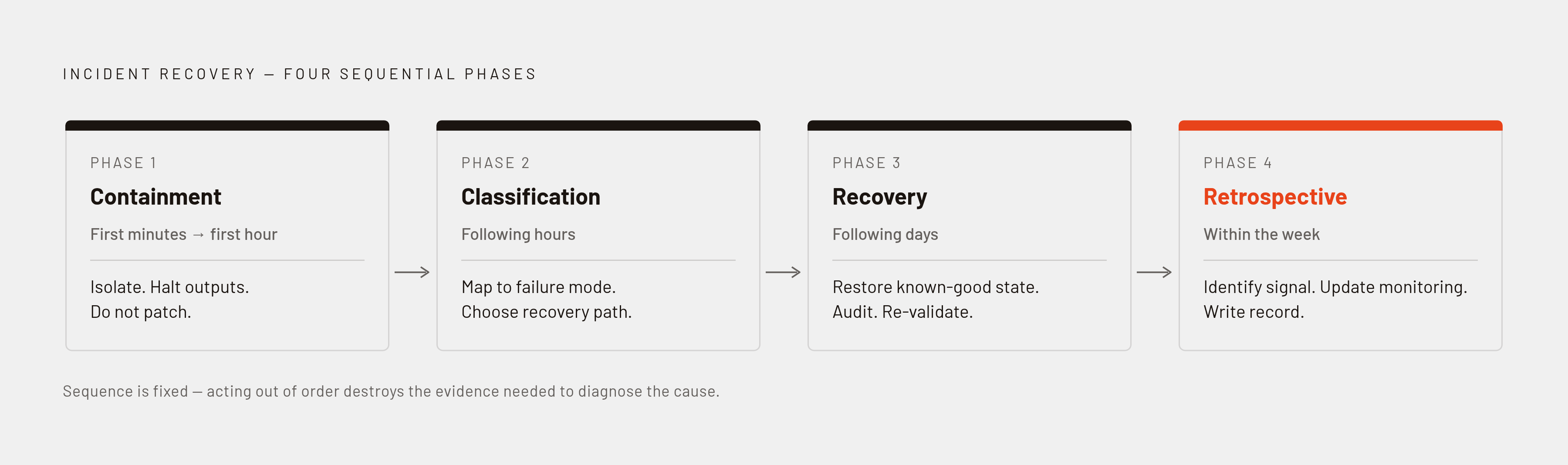
Speed matters less than sequence. Acting in the wrong order can make a failure worse, or it can obscure the very evidence needed to understand what caused it.
The first phase is containment, running from the first few minutes through the first hour. The goal here is narrow: stop the failure from propagating downstream before anyone fully understands why it happened. That means isolating the affected component where possible, halting automated outputs that depend on the suspect step, and flagging any downstream systems that may have already ingested contaminated output. Resist the urge to patch anything before containment is confirmed. A fix applied to a system that's still running can erase the signals needed to diagnose the root cause later.
Phase two is classification, and it happens in the following hours. Map what's observed against the six-mode taxonomy: input drift, cascading dependency, perception lag, threshold miscalibration, handoff gap, or signal invisibility. This classification determines everything about the recovery path that follows. A perception-lag failure needs a retraining or refresh cycle. A threshold miscalibration needs a parameter adjustment plus a retrospective audit of what slipped through. A cascading dependency failure needs the full chain traced before anyone touches a single node in isolation. What was observable before detection, and what wasn't, is worth documenting at this stage, because the invisibility itself is diagnostic information about where the monitoring architecture has holes.
Phase three, recovery, unfolds over the following days. Restore from the last known-good state if one exists. If it doesn't, that absence is itself a gap in the detection architecture worth closing once the immediate fire is out. For AI-generated outputs specifically, audit everything produced during the failure window and assess the downstream impact AI Perception Index 2026. The scale of what's at stake here is not small: research measuring AI perception found a 36-point gap in a standardized perception index between dominant brands and emerging ones, which gives some sense of how consequential a prolonged, uncorrected AI output error can be on how a brand gets represented AI Perception Index 2026. Recovery also means re-running validation checks across every channel affected, not just the one where the failure happened to occur first.
Phase four is the retrospective, and it should happen within the week. Figure out which detection signal actually caught the failure, and which ones should have caught it but didn't, then update the monitoring architecture accordingly. Revise thresholds based on what this specific failure looked like in practice. And write it down: failure mode, detection lag, containment time, recovery path, changes made. That written record becomes the input for the next round of detection design. Skip this step and the organization simply relearns the same lesson at the next failure, at a higher cost.
The challenge of AI system failures under standard IT recovery protocols.
AI failures don't behave like traditional system failures, and treating them with the same runbook is a mistake. A traditional failure is binary: the service is up or it's down, the API returns a result or it throws an error. AI system failures are distributional. Output quality degrades gradually and keeps looking plausible the entire way down. There's no stack trace for a wrong recommendation or a miscalibrated sentiment score, nothing pointing an engineer to a specific line. The failure could live in the training data, in the broader content ecosystem the model draws from, or in the prompt architecture itself, and each of those requires an entirely different fix.
Running multiple engines makes this worse. Google AI Overviews, ChatGPT, and Perplexity don't produce uniform output for the same query, so a correction that fixes representation on one platform may do nothing at all on another. Research on where negative sentiment concentrates found that ChatGPT surfaces it 13 times more heavily near the point of purchase than Google AI Overviews does. A recovery protocol built without that asymmetry in mind is incomplete before it even starts. Recovery has to get assessed engine by engine, not treated as a single-channel fix.
Then there's the lag itself. LLM perception typically runs three to nine months behind content publication, so even after the correct information gets published, AI systems can keep surfacing the old, pre-correction state for months afterward. Recovery timelines for AI perception failures are structurally longer than for a server outage, and expectations need to be set with that in mind from the start. In the interim, direct channel corrections, owned properties, structured data, high-authority third-party citations, can help accelerate how quickly the correction gets re-ingested, though the lag itself doesn't disappear.
Funding size doesn't predict recovery speed. It's a signal-quality problem. Throwing money at a correction doesn't substitute for the correction being accurate, consistent, and corroborated across the right channels. AI recovery needs its own distinct runbook, separate from standard IT incident response, one built around probabilistic outputs, divergence across engines, and correction timelines governed by lag rather than by how fast a patch gets deployed. Tugtekin's AI Perception Index 2026 finds that brands with $29M in funding score nearly identically to bootstrapped firms across AI systems, suggesting that recovery from AI perception failures is not primarily a resource problem but a signal-quality problem.
Prioritizing what to fix first when multiple failure modes are present simultaneously
When an organization discovers several failure modes at once, the instinct is usually to fix whichever one is most visible, or whichever one is easiest. Both instincts are wrong. Neither visibility nor ease tells you anything about which failure is doing the most damage.
The correct principle is to fix in order of propagation risk. Anything feeding wrong data into downstream steps has to be addressed before those downstream steps get touched at all, otherwise the fix gets undone the moment new bad data flows through. And any detection gap that's currently masking additional failures needs closing before anyone declares the incident resolved, because a clean bill of health built on broken monitoring isn't a clean bill of health.
Scoring gives this triage a mechanism instead of a gut call. Each failure mode should get assessed on two axes: how severe the downstream impact is if it's left alone, and how reversible the damage already done actually is. Failures that score high on severity and low on reversibility, AI perception errors that have already propagated across multiple platforms and will keep surfacing for months because of lag, deserve priority even when they're the hardest ones to fix. Difficulty is not an excuse to defer the failure that's doing the most compounding damage.
Reputation scoring research offers a useful template here: a quality score built by weighting verified actions, network density, consistency, and proof of expertise produces something closer to a prioritization order than a static status report. Applied to automation failure triage, the same logic holds: scoring across 400+ signals and three evaluation dimensions, algorithmic, AI, and human, gives a multi-dimensional read on which failure mode is generating the most downstream distortion, and therefore what to fix first. Telling an organization what's broken is only half the job. Telling it what to fix first actually prevents the next cascade.
What separates organizations that recover cleanly from those that suffer repeated failures
The organizations that recover cleanly are the ones that treated detection as infrastructure long before anything broke. There was a written record of the last incident, so the retrospective from failure one actually informed the design going into failure two.
Organizations that suffer the same failure repeatedly tend to share a different pattern: they treat each incident as a one-off, fix the symptom in front of them, and skip the retrospective because the fire is out and the pressure to move on takes over. But skipping that step is exactly how the same input-drift or threshold-miscalibration failure resurfaces six months later, dressed up as a new problem. It never was one. The pattern was predictable the first time. Whether an organization exploits that predictability, or just keeps getting surprised by it, is the entire difference this piece has been describing from the start.
Sources
- AI Perception Index 2026 How Large Language Models Position Brands in the AI Era by Faruk Tugtekin :: SSRN
- Why AI Enterprise Solutions Fail: 21+ Agent Failure Modes Explained
- Common AI Agent Failure Modes: Tools, Automation & Risks | by QuarkAndCode | Jul, 2026 | Medium
- What Are Failure Modes in AI? FutureAGI Guide (2026)
- Updating the taxonomy of failure modes in agentic AI systems: What a year of red teaming taught us | Microsoft Security Blog
- From Failure Modes to Reliability Awareness in Generative and Agentic AI System
- AI Incidents H1 2026 Retrospective: Failure Modes Analysis
- Incidents start before the response does | Brent Chapman