Multi-Channel Automation Workflow Orchestration
AI agents now coordinate workflows across systems, replacing rigid rules with adaptive reasoning.
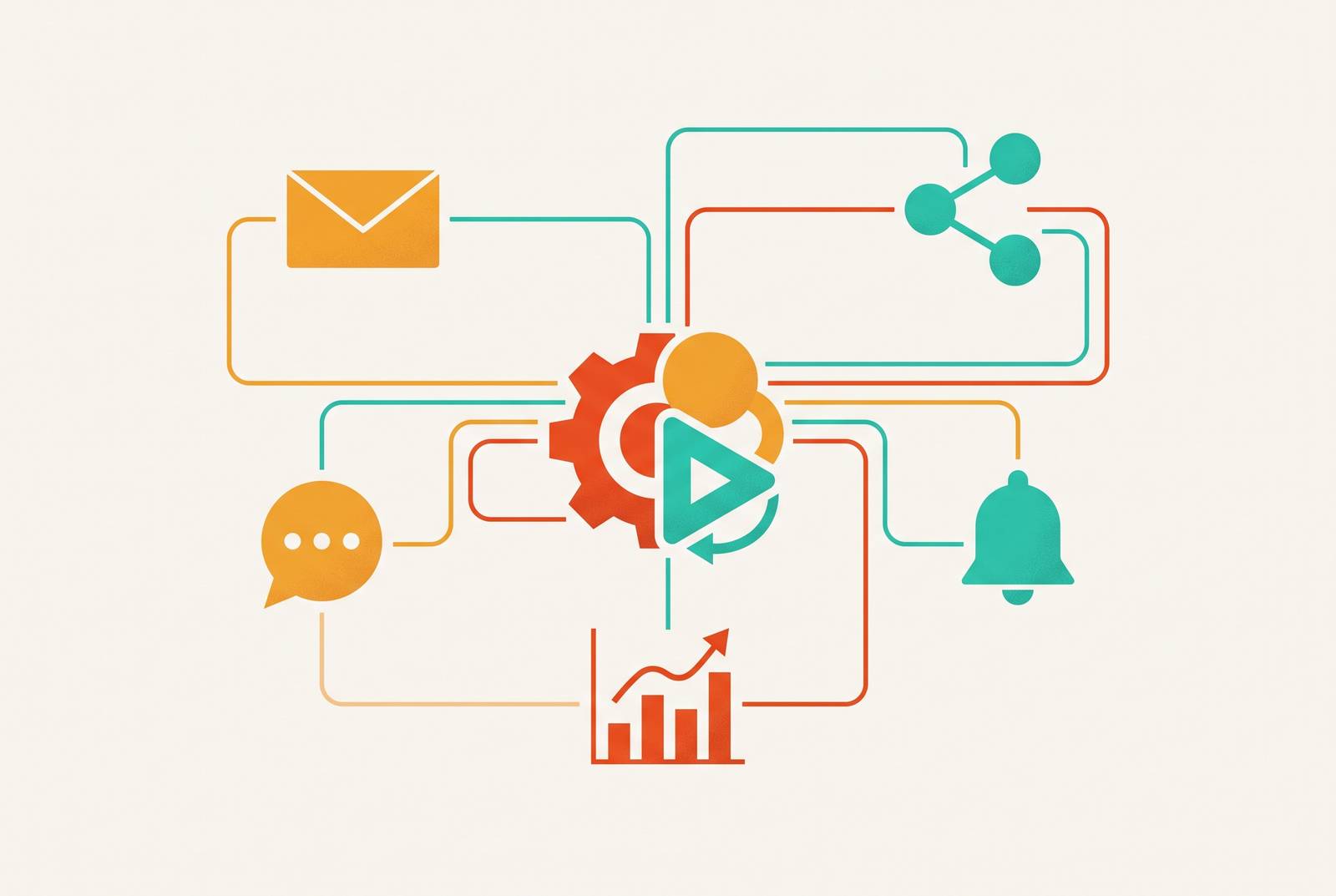
Multi-channel automation used to mean linking tools in a straight line: trigger, action, done. That model is breaking down. What's replacing it is orchestration, a coordination layer where AI agents reason about what happens next, carry memory across systems, and hand off to humans when the stakes require it. Understanding that architecture, not the vendor logos attached to it, is what separates a workflow that survives contact with real customers from one that quietly falls apart under load.
Traditional workflow automation runs on rules. A trigger fires, a script executes a predefined path, and the whole thing works fine until an input doesn't match the pattern someone anticipated. Rule-based automation is rigid by design: it can't improvise, and unstructured input (a customer typing "the thing broke again, same as last time" instead of selecting a menu option) breaks it. What changed is that the decision logic moved. Agents built on large language models now reason about which step comes next, rather than following a sequence someone hardcoded months earlier. The routing intelligence lives inside the agent, not in the workflow diagram.
That distinction affects how platforms should be evaluated and procured. Workflow automation handles isolated tasks, one input, one output, one system. Orchestration coordinates multiple tasks across multiple systems, with dependencies between them, end to end. OneReach.ai's comparison table on workflow automation draws this line clearly: a tool that automates a task is not the same category of thing as a tool that orchestrates a process. Conflating them leads to expensive procurement mistakes.
The shift also isn't experimental anymore. Most organizations are still in the pilot-to-deployment transition, moving systems that worked in a demo into environments where failure has consequences. Orchestration architecture determines whether the deployment survives its first quarter, because after that transition failure has consequences.
What AI agent orchestration is and what it has to manage
Orchestration is the coordination layer that manages how multiple AI agents work together on a single task. It decides which agent handles what, carries context between agents so nobody starts from zero, resolves it when two agents disagree, and moves the interaction to a human being when the situation calls for judgment a model shouldn't be making alone.
That coordination happens on two levels at once, and teams routinely build one while neglecting the other. The first is the agent level: routing work between specialized agents inside a framework, billing agent here, technical support agent there. The second is the conversational or channel level: keeping a customer's identity, history, and channel intact no matter how many different agents touch that interaction over its lifetime. A customer who starts on chat, moves to voice, and follows up by email should not have to re-explain themselves three times because three different agents each had their own private notion of who they were talking to.
Every orchestration layer, regardless of vendor or framework, has to perform four jobs. Routing decides which agent handles the current request, using rules, a model's own judgment, or some blend of both. Shared memory and state give every agent access to what's already been established, so agents don't duplicate work or contradict each other mid-conversation. Conflict resolution reconciles disagreements when two agents write competing observations to the same shared memory store. And escalation determines when a workflow shifts from automated handling to a human's problem.
That's where production systems fail: not in the agent logic, but in the identity and memory layer nobody budgeted time for, because teams build the agent-level routing layer, which appears in a demo, and skip the conversational layer, which becomes visible only when a customer notices their history vanished between channels. That's where production systems fail. Not in the agent logic. In the identity and memory layer nobody budgeted time for.
The four routing and memory patterns that underlie most production architectures
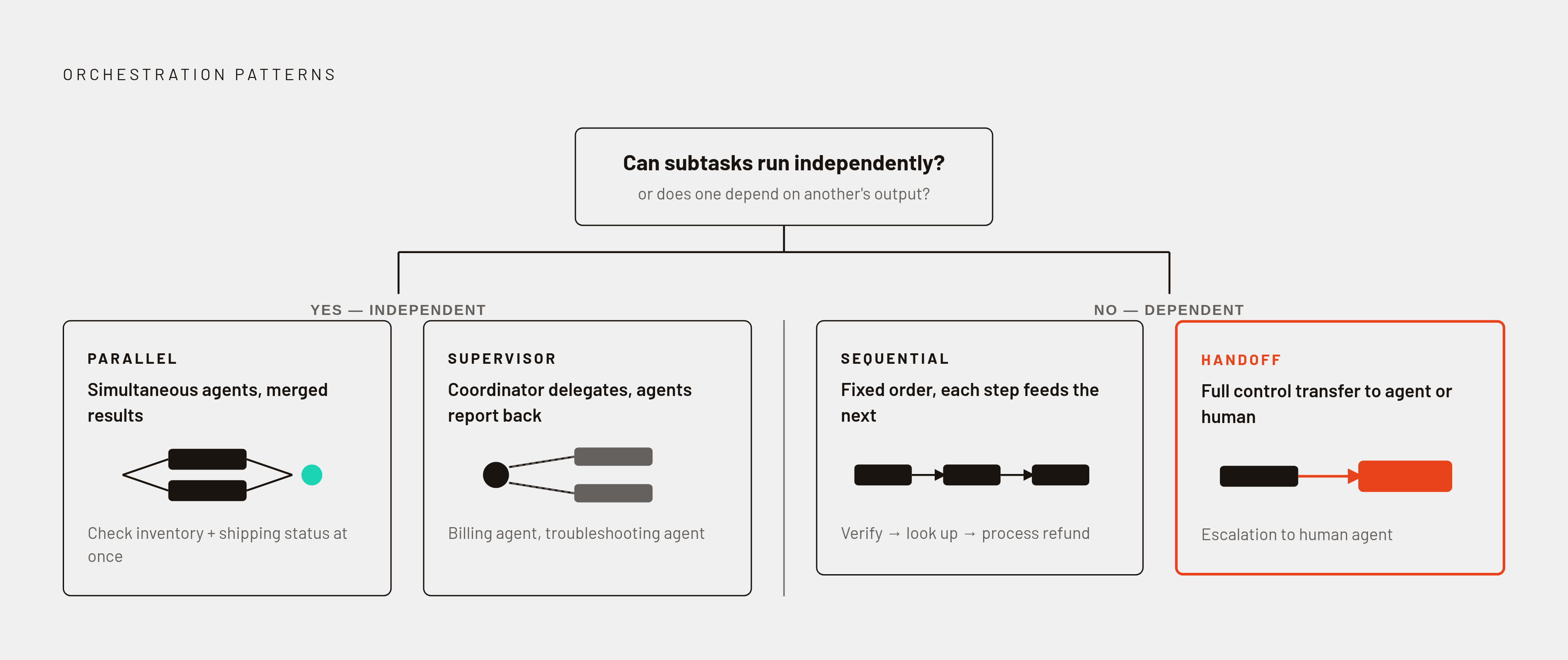
Four patterns account for most of what's actually running in production, and Twilio's documentation on agent orchestration lays them out with enough precision to be useful as a working taxonomy rather than a marketing framework.
Sequential orchestration runs agents in a fixed order, with each agent's output feeding the next one. It suits multi-step workflows with real dependencies: verify identity, look up the account, process the refund. Skipping a step or running them out of order breaks the chain, so sequential makes sense specifically when the second task can't start until the first one finishes.
Parallel orchestration runs multiple agents simultaneously against shared state, then merges the results. Checking inventory and checking shipping status don't depend on each other, so there's no reason to make a customer wait for one before starting the other. Supervisor orchestration puts a coordinating agent in charge, reading the full context of a request and delegating pieces of it to specialized agents that report their findings back. Customer support built around distinct domains, billing on one side, technical troubleshooting on the other, is the canonical use case. Handoff orchestration transfers control fully, from one agent to another or from an agent to a human, and gets used for escalation or for switching between agents with genuinely different skill sets.
Which pattern fits comes down to one question: can the subtasks run independently, or does one depend on the output of another? Deciding whether subtasks run independently or depend on one another is the primary variable to settle before writing a single line of routing logic, because retrofitting sequential logic into a system built for parallel execution (or the reverse) tends to mean a rebuild, not a patch.
Memory deserves separate treatment, because it's where a lot of the actual engineering difficulty lives. Working memory covers the current session, and most agent frameworks handle this reasonably well out of the box. Persistent memory, everything that happened before this conversation started, is where systems fall short. The naive approach, dumping a customer's entire history into every prompt, degrades model performance and inflates cost with every additional token. The better approach uses semantic search to surface only the context relevant to the current request, which keeps prompts lean and keeps the agent focused on what actually matters to the interaction in front of it.
Conflict resolution in shared memory needs explicit rules, not implicit assumptions. When two agents write contradicting observations, most-recent-version-wins is a defensible default rule. But identity resolution, figuring out which customer profile an interaction belongs to when identifiers overlap or conflict, is a separate problem, and just as important. A system that resolves memory conflicts well but resolves identity poorly will still misfire, attaching the right information to the wrong person.
The orchestration lifecycle from trigger to governed outcome
Every orchestrated workflow moves through five stages, whether or not the team building it names them explicitly.
A trigger initiates things, such as an event, a scheduled job, an API call, or a piece of multimodal input like a photo or a voice message. The planner then determines which tools or agents get invoked, based on context and whatever routing logic governs the system. Tool calls execute against actual data sources and APIs, pulling records, updating a ticket, issuing a refund. Validation applies quality gates and, where required, routes the result through a human-in-the-loop approval before it goes any further. Delivery returns the result, along with an audit trail that compliance teams can actually use later.
It helps to know what orchestration is not, because the term gets used loosely enough to blur into adjacent categories that solve different problems. ETL and data pipelines move data from one place to another, but they don't coordinate AI model execution or agent behavior. MLOps manages the lifecycle of a model, training, deployment, monitoring, but it doesn't manage multi-system workflow execution. RPA executes predefined scripts with no reasoning and no adaptive decision-making; it's automation in the old, rigid sense. Agent frameworks give developers building blocks, but on their own, most require additional layers to support enterprise-grade governance and cross-system coordination. Orchestration sits above all four layers, using pieces of each without being reducible to any one of them.
Governance can't be an afterthought bolted onto a finished system. Retries, human-in-the-loop checkpoints, and audit trails belong inside the workflow design from the first draft, because retrofitting them after a system is live means retrofitting them into a data model that was never built to log the things compliance now needs to see.
Durable agent execution is an agent that waits an extended period, hours or days, for a human to approve something before continuing. Durable execution is the name for this specific pattern. It matters for any workflow where the bottleneck isn't compute, it's a person's calendar. A refund workflow that needs a manager's sign-off within five minutes is a different engineering problem than a contract approval that might sit in someone's inbox for three days, and systems built only for millisecond-latency decisions tend to fall over when asked to hold state gracefully across a long wait.
The platforms and frameworks handling this in practice
The tooling landscape splits fairly cleanly between developer-oriented frameworks and managed platforms, and the split matters for anyone trying to figure out where to start.
LangGraph, CrewAI, and AutoGen are among the frameworks most commonly cited for enterprise multi-agent system design when the goal is a custom solution. AutoGen itself is now in maintenance mode, having been succeeded by Microsoft Agent Framework; know this before building anything long-term on top of it. Newer entrants, including the OpenAI Agents SDK and Google's ADK, have joined that same category. All of these are developer-oriented frameworks, building blocks for engineers, not managed platforms a business team can configure without writing code.
Temporal has become the standard specifically for durable agent execution, the go-to choice when a workflow needs to survive a multi-day human approval loop without losing its place. n8n occupies a different niche: execution-based pricing aimed at technical power users, native LangChain integration for teams already working in that ecosystem, and a self-hosting option that matters a great deal to privacy-sensitive deployments that can't send customer data through a third-party cloud.
How to match platform category to organizational need
Start with the actual use case, because it's the first and most useful filter. Business automation, developer-built custom workflows, data pipelines, cloud-native deployment: these are different buyer profiles, and matching platform category to the right one up front prevents the expensive kind of misalignment that appears six months into a contract, not during the demo.
Team composition drives the next decision, no-code versus framework. Business users and citizen automators, people without engineering backgrounds who still need to build and modify workflows, are better served by no-code and low-code builders: Zapier Agents, Kissflow, Lindy, Bardeen, Gumloop. Technical teams building custom agent logic from scratch belong in framework-level tools: LangGraph, CrewAI, AutoGen, n8n. Enterprises that need governed, cross-system automation with real audit trails should be looking at platform-layer solutions, Domo, IBM watsonx, Sana for organizations that need an AI operating system layer. Channel-heavy, customer-facing workflows point toward something like Twilio's Conversation Orchestrator. And workflows defined by high-latency human approval point back to Temporal.
Governance shouldn't be negotiable at enterprise scale: feature richness is not the first thing to evaluate. Retries, audit logs, human-in-the-loop checkpoints, and compliance controls come first, because a platform with a beautiful interface and no audit trail is a liability wearing a good outfit.
Self-hosting versus managed deployment is its own axis, and it maps directly onto regulatory exposure. Healthcare, finance, and government organizations often need the option to keep data on infrastructure they control, and n8n explicitly supports that self-hosted path. A managed SaaS platform that can't offer this isn't wrong for every buyer, but it's disqualifying for some.
Where automation should not run unattended
Human-in-the-loop design appears on lists of the top automation trends heading into 2026, and it deserves to be read as a deliberate architectural choice, not an admission that the automation isn't finished yet.
Certain situations call for a human checkpoint by design, not by exception. High-stakes decisions, where getting it wrong costs more than the delay of waiting for a person to weigh in, are the clearest case. Exception handling, anything that falls outside the boundaries an agent's policy was built to cover, is another. Long-duration approvals, the durable execution pattern where an agent sits and waits days for sign-off, is a third. And anywhere regulation or compliance requires a documented human decision, automation running unattended simply isn't an option, regardless of how confident the model is.
Escalation and supervision look similar and function differently. In the supervisor pattern, a coordinating agent delegates pieces of work to specialized agents and incorporates their results. In the handoff or escalation pattern, control transfers fully from one agent to another or from an agent to a human. The human owns the interaction from that point forward, with no agent quietly still holding the wheel.
The underlying reason all of this matters comes down to a documented shift in how people rate the risk of AI itself. Inaccuracy as a top-cited AI risk jumped 14 percentage points in a single year. That's not a marginal shift. Orchestration systems that run unattended in high-stakes contexts carry that risk forward directly into whatever decision the system is making, and no amount of clever routing logic changes the fact that a model can be confidently wrong.
Why AI systems' evaluation of businesses running these workflows creates a new measurement obligation
Large language models have become active evaluators of the businesses that build on top of them, and this is a separate, less obvious consequence of the orchestration shift worth taking seriously. ChatGPT, Gemini, Claude, Perplexity, and Google's AI Overviews don't just index what a company says about itself. They synthesize third-party evidence, citations, and identity signals scattered across the web to form something closer to an autonomous opinion about a brand, one that a company doesn't directly author and can't simply edit.
That perception isn't reducible to sentiment, positive or negative. It includes the specific attributes a model attaches to a brand, the strengths and objections it surfaces unprompted, the comparisons it draws against competitors, and the factual claims it repeats as settled fact regardless of accuracy. A company can show up frequently in AI-generated answers and still be described inaccurately, or described accurately but attached to the wrong set of attributes.
A high mention rate can hide a real problem: models can name a business often while characterizing it incorrectly, so for any business now running customer-facing workflows through orchestrated AI agents, the way models describe that business has become something worth measuring directly, not assuming.
Sources
- What is AI agent orchestration? How it works in 2026
- 10 AI Orchestration Platform Options Compared for 2026
- Agentic AI Orchestration in 2026: Automating Workflows at Scale
- AI Workflow Automation Trends in 2026: 10 Trends Shaping the Future of Work
- The best AI agent frameworks in 2026
- kestra.io
- learn.microsoft.com