AI Perception Signals in Algorithmically Evaluated Content
LLMs now evaluate businesses differently than search engines, creating a new visibility problem.

Large language models have stopped being passive retrieval tools and started acting as evaluators that construct their own descriptions of businesses. The mechanism matters: an LLM does not simply pull up a ranked list of existing pages the way a search engine does. It builds a representation of a business from training data and, when it has live retrieval access, from current sources on the web. A business that fails to supply the right signals to that process can end up described inaccurately, described thinly, or left out of the answer.
That shift creates an audience with its own logic, distinct from human readers and distinct from the ranking algorithms businesses have spent two decades learning to satisfy. Most companies have no system in place to measure how that audience sees them, let alone influence it. A brand can hold excellent positions in conventional search while an AI system describes it poorly, or wrongly, when answering a customer's question. These two outcomes, search rank and AI representation, no longer move together. Tugtekin's AI Perception Index 2026 puts a number on the gap: testing GPT-4o and Claude Sonnet with standardized prompts found a 36-point difference in model perception index (MPI) scores between dominant and emerging brands. LLM representation is already stratified in a way that does not simply mirror how visible a business is in traditional search.
How business representation varies across AI systems
A business cannot assume that strong representation in one AI system carries over to another, because AI perception is not one score but several, and they frequently disagree. The AI Perception Index 2026 found cross-model perception drift for the same brand reaching 21.86 points between GPT-4o and Claude Sonnet, a spread wide enough to separate being recommended from being left out of the answer.
The drift traces back to how each model was built and how it retrieves information. Every LLM weights signals differently during training and during retrieval, so the same public information about a business produces different outputs depending on which system is reading it. One of the more telling findings from that same study: brands with substantial external funding scored nearly identically to bootstrapped firms. Capital and conventional prestige do not buy AI visibility on their own. What the models can actually read in a business's content and structure does. That finding reframes the problem usefully. It is not a crisis with no clear cause. That finding points to the signals a business controls: how its content is built, where that content appears, and what supports its claims. No business can assume that ChatGPT, Claude, and whatever comes after them agree on who it is or what it does. Managing AI perception means watching multiple systems at once, not tuning a single page for a single model and calling the job finished.
The three categories of signals LLMs use to evaluate business content
When an LLM evaluates content about a business, it works through three distinct kinds of signals: structural, contextual, and credibility-based. How these three interact determines the accuracy and prominence of a business's representation.
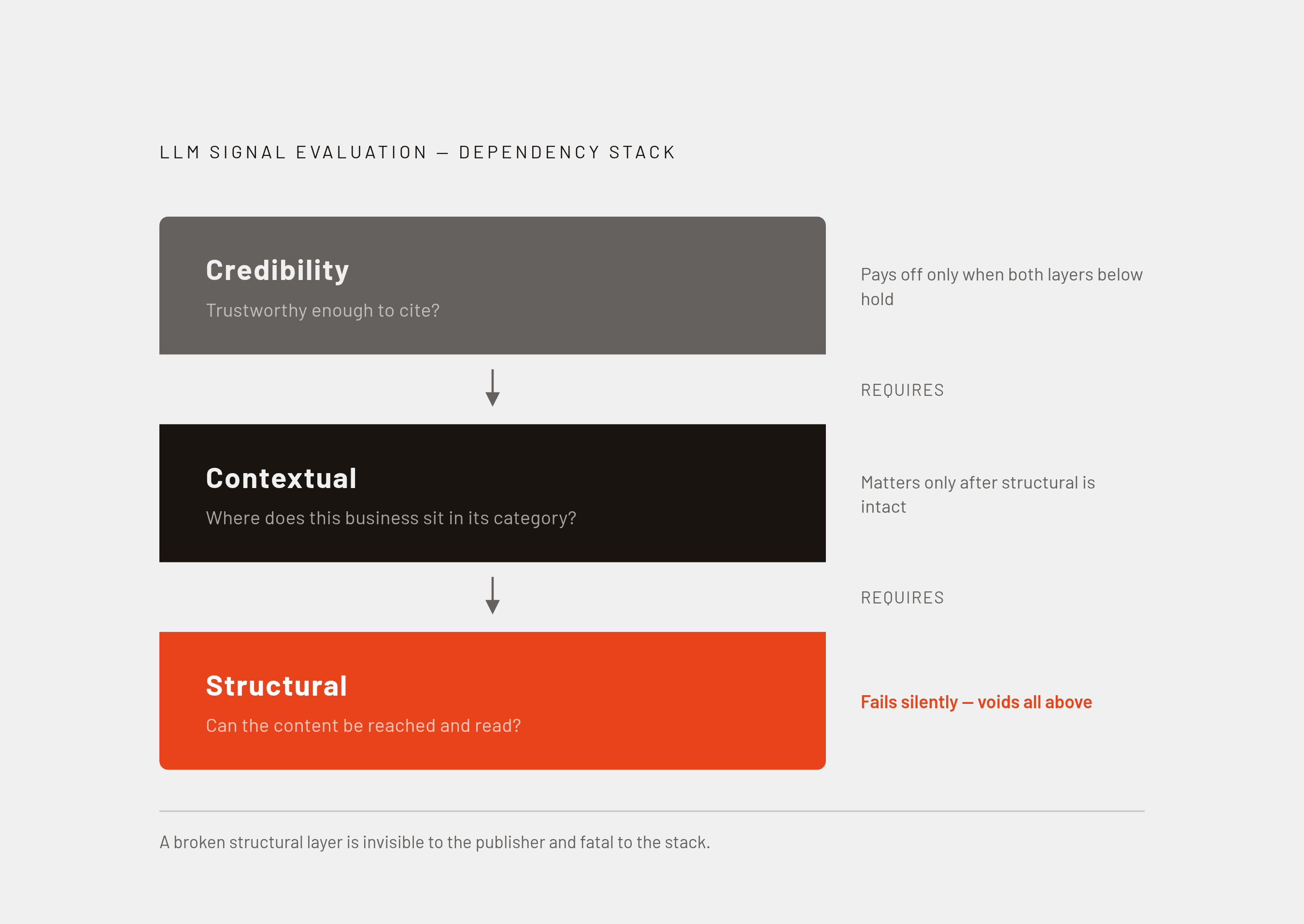
Structural signals answer a basic question first: can the content be reached and read by a machine. Contextual signals answer a second question: where does this business sit relative to everything else the model knows about the category. Credibility signals answer a third: is this information trustworthy enough to put in front of a user. None of the three stands alone. Structural signals create accessibility, contextual signals create relevance, and credibility signals create trust. A business that handles two of the three well but fails the third will still come up short in AI-generated answers, because the model has no reason to cite content it cannot parse, cannot place, or cannot trust. This gives the framework a diagnostic use beyond description. When a business turns up absent or misrepresented in AI outputs, the cause usually lies in a specific one of these three categories, which should guide the fix.
Structural signals: what makes content readable by AI systems at all
Before an LLM can judge a business's content for relevance or trustworthiness, it has to be able to open and read that content, and a surprising number of businesses are unknowingly blocking that step. This is the most basic layer of the three, entirely within a business's control, and many sites fail at it without anyone noticing.
AI crawlers do not follow the same paths as traditional search bots. A robots.txt file or a CDN rule, particularly common Cloudflare configurations, that does not explicitly allow AI crawlers can make a site functionally invisible to the retrieval systems LLMs rely on. Content that loads entirely through JavaScript, tucked behind interactive elements, logins, or paywalls, typically does not get parsed by AI retrieval. Server-side rendering is the baseline requirement for a page to be readable by these systems, not an advanced optimization. Once a page can be read, structured data such as FAQ schema, organization schema, and local business schema lets an LLM pull out factual claims with more confidence, and pages carrying that markup tend to correlate with higher citation rates, though no controlled study has yet shown that adding schema by itself causes that lift.
Entity consistency carries the highest return for most businesses relative to the effort involved. Keeping the same business name, address, phone number, category, and description across a Google Business Profile, the company's own website, and major directory listings lets an AI model confidently tie multiple sources back to one entity. When those details conflict from one source to the next, the model is left with ambiguity, and ambiguity suppresses how confidently it will cite the business. The llms.txt file is a newer structural signal, a document built specifically to help AI systems understand how a site is organized and which parts of it are meant for machine consumption.
Contextual signals: how co-citation and semantic neighborhood shape AI perception
An LLM never evaluates a business on its own. It evaluates a business in relation to the other entities, topics, and sources that keep appearing alongside it, and that semantic neighborhood turns out to be one of the strongest and least understood forces behind AI perception.
Co-citation is the clearest version of this mechanism. Being mentioned in the same piece of content, or the same context, as established, recognized names in a category transfers some of that credibility by association. If a trade publication consistently names a smaller company alongside two category leaders every time it covers a given topic, an AI system trained or retrieving on that coverage starts to place the smaller company in the same semantic cluster as the leaders. That is an opening, not just a risk: an emerging business positioned well in the right company can gain AI visibility independent of its market share or its advertising budget. The reverse holds too. A business discussed only in isolation, never alongside recognized entities or established category terms, risks being represented by AI systems as peripheral, or placed in no clear category.
Topic coherence reinforces this effect over time. A business whose content keeps returning to the same set of topics, questions, and use cases builds a stable identity that an LLM can represent reliably. A business whose content jumps between unrelated subjects makes that identity harder to pin down, and the model's representation fragments along with it. Forum threads, third-party editorial mentions, and placement in industry roundups all extend this contextual layer past what a business publishes on its own site. This signal is harder to engineer directly than a technical fix.
Credibility signals: how LLMs assess whether content is worth citing
Once an LLM can reach a business's content and place it in the right context, it still has to decide whether that content is trustworthy enough to repeat to a user. That decision rests on specific, observable signals a business has real influence over.
Outbound sourcing is one of the clearest. Content that links to or cites recognized authoritative sources, peer-reviewed research, government sources, established industry publications, tells an LLM that the claims sitting next to those citations are more likely to be research-backed and checkable, which raises how confident the model is in citing them. Cross-platform corroboration works the same way from a different angle: when the same claim about a business appears consistently across multiple independent sources, an LLM treats that claim as more reliable than something asserted in only one place. A single unverified claim carries less weight than one that several independent sources agree on.
Factual accuracy underlies all of this, and the honest picture is mixed. A handful of specialized tools can cross-check claims against authoritative databases before surfacing them, but the mainstream AI systems most people use still regularly fabricate or hallucinate citations, with no built-in mechanism to confirm a cited source even exists. That cuts in both directions for a business: claims that are demonstrably wrong or unsupported will not earn citations, and they can drag down how credible the rest of a business's content looks to the model. Credibility is reassessed continuously as new information comes in, which sets up a problem most businesses do not plan for: content that was accurate and well-sourced a year ago does not automatically stay that way in a model's eyes.
Recency's outsized effect on AI citation and representation
LLMs weight time heavily when they evaluate signals, so a business that built strong AI perception at some point in the past cannot assume that standing holds. Decay happens automatically and continuously, whether or not anyone is paying attention to it.
This recency bias comes from how models weight time when evaluating signals, favoring newer content over older content by design. Content that goes unupdated loses citation priority sharply after a relatively short window, and the quality of that content gets discounted more and more over time regardless of how strong it was when it was written. There is a second layer to this decay that compounds the first: the format that earned citations at one point can stop working as AI systems change what they prefer to output. A page can hold its facts and still lose its citations when the systems reading it shift what they reward. The fix is not always a content refresh. Sometimes the page needs to be rebuilt.
The obligation that follows from this is ongoing maintenance, not a project with an end date. AI-facing content behaves like a system that needs regular attention, not an asset a business can build once and leave alone. This is a different framing from a standard content calendar built around publishing cadence. The driver here is how fast a given signal's usefulness fades, not how often new material goes out, and treating the two as the same thing is how businesses end up publishing on schedule while their AI representation quietly erodes anyway.
Measuring signals before managing them
AI perception is a changing output that varies across models and shifts over time, and a business that relies on occasionally checking what ChatGPT or another assistant says about it will end up with a distorted sense of its own standing.
The cross-model drift figure from the AI Perception Index 2026, a 21.86-point gap for the same brand between GPT-4o and Claude Sonnet, makes the case directly: a single check on a single system gives an incomplete picture and can actively mislead a business about where it stands. Making this harder still, LLMs carry known evaluative biases of their own. Position bias means a model can favor an answer based on where it sits in a response. Verbosity bias means a longer answer can get preferred over a shorter, more useful one. Self-enhancement bias means a model's own outputs tend to get rated more favorably by that same model. None of this means AI perception cannot be managed. It means AI systems are imperfect judges even of their own output, and tuning content for how one system behaves today offers no guarantee that the same approach will transfer to a different model, or to the same model after it updates.
Diagnosing this requires measurement broad enough to locate the specific failure, not merely describe the outcome. A score that tells a business it is underperforming without saying where is not useful on its own. A composite view that tracks structural, contextual, and credibility signals at the same time can point to the specific failure behind a weak result, which is the only basis for deciding what to fix first. Evident's approach, scoring businesses across 143 individual indicators built from millions of publicly available data points, reflects exactly this logic: coverage wide enough to locate the actual problem, not just confirm that one exists.
The sequence that turns signal awareness into AI perception improvement
Improving AI perception does not mean working on every signal at once. It follows an order, because structural accessibility has to be in place before contextual and credibility signals have anything to work with. A business can build the most compelling, well-sourced, perfectly positioned content in its category, and none of it matters if an AI crawler cannot reach the page.
The first step is a structural baseline: confirming that AI crawlers can actually access the site, that entity details (name, address, phone number, category, description) match across every major platform, and that key pages carry the schema markup appropriate to what they describe. This is the layer everything else depends on. Skipping it degrades both contextual positioning and credibility-building effort before they reach an evaluating model. Getting the structural layer right does not guarantee strong representation on its own, but getting it wrong guarantees that nothing built on top of it will perform the way it should.