AI Search Measurement Strategy for Marketing Teams
Track whether buyers discover your brand inside AI chat windows, not just on search results pages.

Most marketing teams can describe, in detail, where they rank on Google. Few can say with any confidence whether ChatGPT recommends them, whether Perplexity cites them, or whether Gemini describes them accurately when a buyer asks for a comparison. That gap exists because the basic unit of search has changed. AI systems no longer hand back a ranked list of ten blue links for a person to sort through. They synthesize a single answer and decide, on their own, which brands belong in it. A brand either gets named or it does not, and there is no twentieth position to climb toward. That binary makes the old scoreboard useless: rankings, click-through rate, and session counts can all look stable while a brand quietly disappears from the answers buyers actually read. Cassie Clark, an AI search visibility consultant, puts the shift this way: "AI search visibility isn't just about what's ranking, it's about whether your content reflects real customer language, real objections, and the actual friction your buyers experience when making a decision. Buyers are already running their vendor research, product comparisons, and purchase decisions through these tools, so the moment of discovery is happening inside an AI chat window, not just on a search results page. Most teams have no instrument pointed at that window at all, so they are working without the one feedback loop that would tell them whether they are winning or losing there.
How AI systems form and update a brand's representation
To build that instrument, it helps to understand what an AI system is actually doing when it decides whether to mention a brand. These systems do not visit a brand's website and read it back to the user. They work from a probabilistic representation of the brand, built partly during training and partly through real-time retrieval, and it's that representation, not the website itself, that gets cited in an answer. During training, a model absorbs the company it keeps: a brand name that keeps appearing near words like "reliable" or "innovative" in sources the model treats as authoritative builds a positive association, while a brand name that keeps turning up near "complaints" or "disappointing" builds the opposite one, regardless of what the brand's own marketing says about itself.
That representation also isn't consistent from one platform to the next. ChatGPT, Perplexity, Gemini, and Claude each draw on different pools of source material, so the same brand can come out of each one described differently, sometimes by a wide margin between how one model treats it as a dominant player in its category and how another barely registers it. A measurement system built around a single platform will miss this. A brand can be cited confidently inside one AI environment and be absent, or framed negatively, in another, and a team watching only one tool has no way to know which of those is happening everywhere else.
What a measurement system needs to track
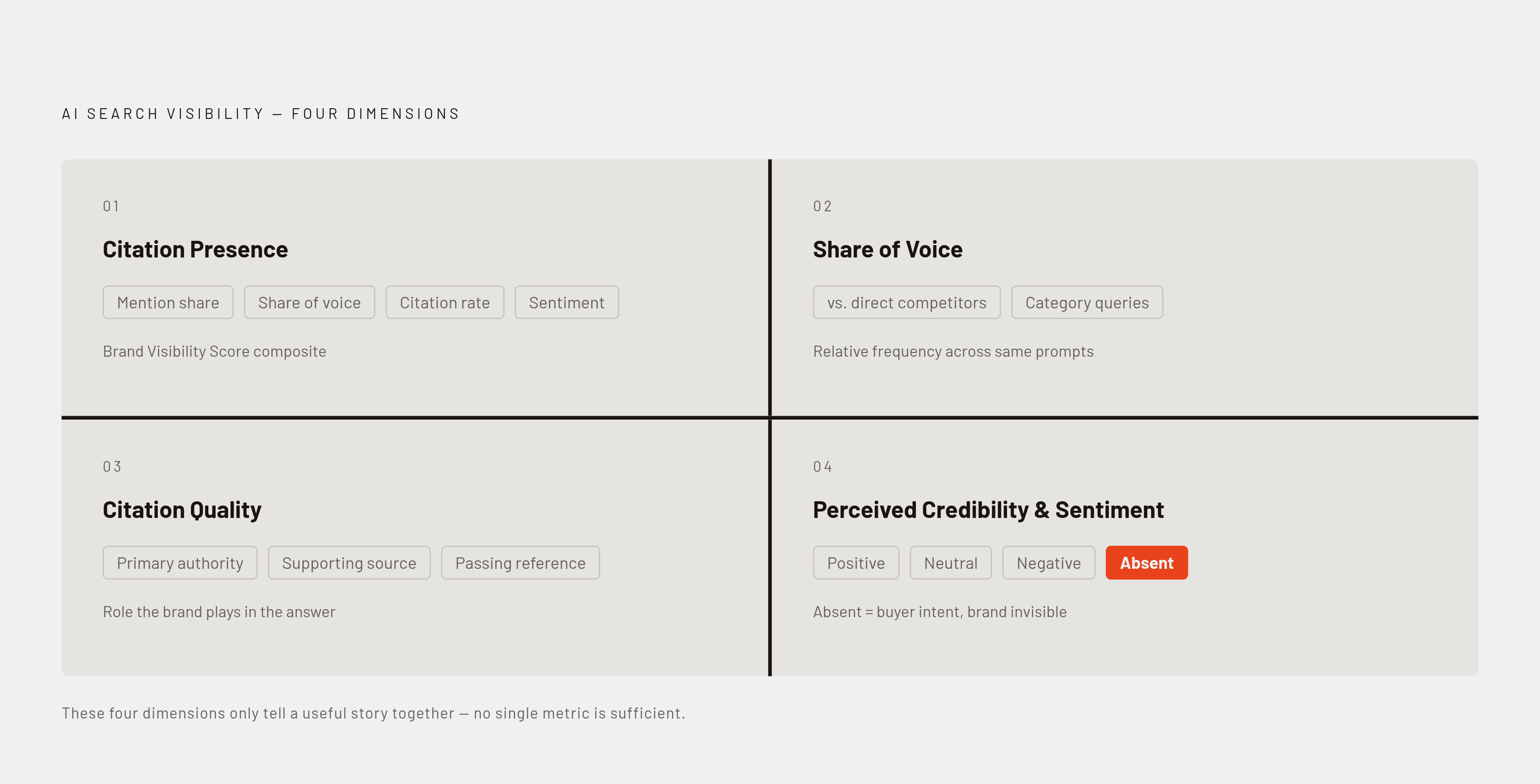
Given how representation actually forms, a measurement system has to work across four distinct dimensions at once, because any one of them in isolation produces a misleading read of where a brand stands. The first is citation presence, often expressed as a Brand Visibility Score: a composite figure combining the share of relevant answers that mention the brand with its share of voice, citation rate, and sentiment across a fixed set of prompts. AirOps research treats this score as the North Star metric for AI search, the single number a team should check first.
The second dimension is share of voice, sometimes called share of model: how often a brand appears in AI answers relative to its direct competitors across the same category queries. A brand can carry a respectable visibility score on its own and still be losing ground, if competitors get cited more consistently in the exact queries that matter most. The third dimension is citation quality. An AI system can treat a brand as the primary authority on a topic, mention it only as a supporting source paraphrased alongside others, or drop in a passing reference that barely registers; these three outcomes carry different weight and need to be tracked as separate facts. The fourth is perceived credibility and sentiment, which is not a simple positive-or-negative read but a four-part classification: positive, where the brand is recommended or praised; neutral, where it is mentioned factually with no particular charge either way; negative, where it is criticized or compared unfavorably; and absent, where it should have come up in a relevant category query and didn't.
These four dimensions only tell a useful story together. A brand might score well on sentiment, well regarded whenever it comes up, but still show weak share of voice because it rarely comes up at all in the category queries that drive discovery. Another brand might show strong share of voice, appearing constantly, while scoring poorly on attribute accuracy because the descriptions attached to it don't match what the brand actually sells. Looking at only one of these numbers hides the other problem completely.
Building the prompt library that makes measurement repeatable
None of these four dimensions can be measured without a structured prompt library, which functions as the instrument for the entire system. Without a fixed, repeatable set of prompts, there is no consistent way to detect whether citation presence, share of voice, or sentiment are changing over time, and any single query run once tells a team almost nothing.
The library needs to cover three distinct kinds of questions. Broad category questions, such as "what's the best project management tool for small teams," test whether a brand appears at the top of the funnel, before a buyer has settled on any vendor. Competitor comparison queries, such as "is one vendor or another better for agencies," test how a brand holds up directly against named rivals. Branded queries, where the brand's own name appears in the question, confirm the baseline case where the brand should obviously show up. Category and competitor queries carry the most diagnostic weight among these three, because they show whether a brand is present at the exact moment a buyer is still deciding; that is where AI search exerts its strongest pull on pipeline.
Every query in the library should run across multiple platforms in the same session: ChatGPT, Perplexity, Gemini, Claude, and either Microsoft Copilot or Google AI Overviews. Platform behavior diverges enough that a brand's presence on one tells a team very little about its presence on another, so skipping platforms leaves real blind spots. For each query-platform pairing, the team should log whether the brand was mentioned, the citation quality (primary, paraphrase, or passing), which competitors were mentioned alongside it, which URL the AI pulled from for attribution, and where the mention falls on the four-category sentiment scale. What makes this data usable is doing it the same way every time. Running the same prompt set on the same schedule is what reveals a trend; one-off queries run whenever someone remembers to check produce impressions, not measurements. Pat Reinhardt of Conductor frames the distinction between traditional SEO and answer engine optimization in exactly these terms: the real difference between the two disciplines isn't in creating content or building topical authority but in measurement and scale.
Setting up analytics to capture AI-referred traffic and pipeline
A prompt library shows what AI systems say about a brand. It says nothing about what happens once someone acts on that answer, and a measurement system needs both halves to be worth defending to a budget committee. Analytics infrastructure is what closes that second half, by tracking what actually arrives at the brand's own properties once an AI system sends someone there.
AI-referred traffic shows up in analytics tools with identifiable referral sources, domains like chat.openai.com, gemini.google.com, and perplexity.ai among others. These need to be pulled into their own dedicated channel group in GA4 or whatever analytics platform a team runs, rather than getting absorbed into a generic "referral" or "direct" bucket where they become invisible. For any content or campaign built specifically to earn AI citations, UTM parameters should be attached from the start, so a team can tell passive AI referral, where an AI system cited something that already existed, apart from active referral, where it cited something the team built with this exact purpose in mind.
The traffic that arrives this way behaves differently from ordinary organic visitors. People coming from an AI citation tend to arrive with longer, more specific queries already answered in their head, spend more time on the page once they land, and convert at noticeably higher rates. Measuring that behavior is what confirms whether AI citation is actually producing pipeline rather than just showing up as a vanity number in a dashboard. The pipeline influenced by AI-sourced visits deserves its own tracked metric, distinct from citation frequency: citation frequency in the prompt library acts as a leading indicator, while AI-sourced pipeline conversion is the lagging number that confirms the whole framework actually connects to revenue. Last-click attribution alone will understate all of this, because AI citations tend to reduce the raw number of clicks a brand gets while raising the quality of the buyers behind each one, so a team reading volume alone will consistently miss the value of the channel.
Which signals most strongly predict citation probability
Once both halves of the measurement system are running, a team has data to interpret, and that data reliably points back to a handful of signals. Citation frequency is not random. The factors driving it are identifiable, which is what makes AI search a channel a team can actually work on.
When a brand's visibility score is low on category queries specifically, review signal quality is one of the first things to examine. What matters here is not just the aggregate star rating but the actual language inside the reviews, because these models read the text, not just the number attached to it. A brand with a somewhat lower star rating but reviews that consistently use positive, specific language will often score better on trust assessment than a brand with a higher star rating where the same complaint about the same issue keeps reappearing across reviews. Schema markup, specifically AggregateRating markup, raises the odds that review signals get registered by AI systems.
Platform-specific weighting is another signal to check against the data. Community and discussion content, Reddit threads in particular, carries far more weight in how Perplexity cites than in how Claude does. That means a brand's Reddit presence is a meaningful measurement signal for how it performs on Perplexity, but a much weaker predictor of how it performs on Claude, and a team diagnosing a platform-specific gap should check source type before assuming the problem is the brand's content.
Scoring perceived credibility across AI systems, not just tracking mentions
Showing up and being trusted are two different outcomes, and a measurement system has to separate them. Citation frequency tells a team whether a brand gets mentioned. Perceived credibility tells a team whether, once mentioned, the AI system presents that brand as something worth trusting, and these two numbers can move in opposite directions from each other.
A brand can appear in a high share of AI answers and still get described with hedging, caveats, or an unflattering comparison to a competitor sitting right next to it. Scoring credibility properly means applying the same four-category sentiment framework, positive, neutral, negative, and absent, consistently across the full prompt library. The "absent" category is the one most teams overlook, and it tends to carry the most weight, since it marks the exact moment a buyer had category-level intent and the brand simply wasn't part of the answer.
Attribute accuracy deserves separate attention inside this same framework. The AI system either describes what the brand actually does and sells, or substitutes generic category language, or, worse, hands a competitor's strengths to it. If a brand gets cited but misdescribed, it is effectively handing its airtime to someone else's positioning. Cross-model divergence in credibility framing is itself a signal to log: when one model frames a brand well and another hedges or skips it entirely, that gap points to a weak source footprint relative to whatever that particular platform draws on for retrieval. Treating credibility as its own scored dimension, rather than a mental impression formed from scanning a few outputs, is what turns a citation count into an actual measurement system.
Establishing baselines and cadence before touching content or strategy
All four dimensions and both infrastructure layers only become useful once a team has a documented starting point. Without a baseline, any later change in citation frequency, share of voice, or sentiment has nothing to be compared against, and a team has no way to say whether a content change helped, hurt, or did nothing.
You build a baseline by running the complete prompt library across every target AI platform in one pass, logging the results in a consistent format, and timestamping the run so it can be referenced later. That run becomes the control every future measurement gets checked against. It needs to capture all four dimensions at once: citation presence, share of voice against named competitors, citation quality, and credibility or sentiment classification, broken out per query and per platform. The analytics side needs its own baseline running in parallel: current AI-referred traffic volume broken out by source, existing on-page behavior metrics, and whatever pipeline attribution is already visible before anyone touches a single page. That number is what anchors the business case for the work that follows.
Cadence matters as much as the initial baseline. Running the full prompt library monthly is the minimum pace for catching drift in how these models represent a brand over time, and any significant event, a press mention, a product launch, a competitor's new campaign, should trigger an extra out-of-cycle run to catch the immediate effect before it gets buried in the next monthly cycle. Answer engine optimization follows its own loop: structure, extract, attribute, refine, and that loop starts with knowing exactly where a brand stands, not with publishing new content and hoping it moves the needle. A team that jumps straight to rewriting pages before it has a baseline has no way to know afterward whether anything it did actually worked.