AI Recommendation Engine Configuration for B2B Content Hubs
Structure B2B content hubs for AI citation, not just search ranking.

Configuring a B2B content hub for AI recommendation requires more than good SEO. The hub must give AI systems precise answers, a coherent body of knowledge, and independent evidence that its claims deserve citation. Configuring the hub means working on its structure and evidence, and success depends on how accurately and favorably AI answers describe the brand as well as whether its pages draw visits.
How AI engines decide which B2B content hubs to cite
AI platforms decompose a buyer’s question into multiple sub-queries, retrieve information across sources, and synthesize an answer. A hub with dedicated answers to those sub-queries offers more retrieval targets than a standalone post. Coverage alone is not enough, however. AI systems also draw on signals from analysts, journalists, and communities when deciding which brands to surface as authoritative. The causal chain runs from relevant coverage to usable evidence to corroboration, rather than from a page’s search position directly to a recommendation.
This makes citation a different objective from ranking. Traditional search rewards keyword relevance, backlinks, on-page optimization, and domain authority, while AI retrieval additionally favors structured direct answers, FAQ format, topical depth, cited data, and external citation authority. The two sets of signals overlap without producing identical outcomes. A hub can rank in traditional search yet remain absent from AI answers because its pages do not provide sufficiently direct answers or its expertise lacks outside corroboration.
The hub needs enough structured, credible information for an engine to cite it in response to a buyer’s question. Better writing cannot close every signal gap. Polished explanations may still lack verifiable claims, sufficient topic coverage, or evidence that independent sources trust the brand. Configuration effort pays twice where search and AI needs converge, particularly in topical depth, sourced claims, structural clarity, and external authority.
Why an "inverted discovery funnel" is the default state for most B2B hubs
Most B2B hubs appear in AI answers only after the buyer supplies the brand name. Discovery begins too late in the buying process. This “inverted discovery funnel” leaves the hub absent while buyers define their needs and form vendor shortlists, even when search performance suggests strong visibility. A recommendation during that earlier stage differs from a search link because the system has already selected the brand for inclusion in its answer. The diagnostic starts with three questions about the hub itself. Does its positioning name the buyer, problem, and method precisely enough to quote? Does it publish evidence, including specific case-study claims and first-party data, to support its promises? Does it have direct answers, FAQ sections, and markup that make clear which parts an engine can cite?
Positioning the hub so AI engines can quote it precisely
The lesson for practitioners is to make each important page’s opening paragraph answer who is served, what problem is solved, and what outcome is delivered. This applies to the hub homepage, pillar page, and service pages. The answer belongs immediately after the relevant heading because AI retrieval treats that first substantive paragraph as the direct response to what the heading asks. It should stand on its own as evidence. A paragraph that postpones the answer behind broad claims about value gives the engine less precise material to quote.
The citation-ready pattern is a single sentence naming the buyer type, the problem, and a specific outcome. Generic promises of business growth omit those distinctions. To test the difference, paste a service page’s opening paragraph into an AI tool and ask whether it is specific enough to cite in a recommendation query for that category. The test exposes vague positioning and leaves future citation unproven. Across the hub, H2 headings should likewise use questions buyers actually ask, with the first sentences beneath them answering directly before expanding. This answer-first structure also supports featured-snippet eligibility.
Authorship gives that positioning a source with identifiable expertise. Named, credentialed authors provide more context than anonymous content or unsupported bylines, but the content must also demonstrate what the author knows. Specific observations, original problem framing, and defensible conclusions that diverge from consensus make expertise legible. Marketing teams should work as internal journalists, interviewing product leads and consultants to learn what the firm knows from its own work. Evidence from the firm’s own client work should state its context, ranges, and conditions, so that a quotable outcome remains a bounded claim.
Hub architecture and internal linking that matches AI query fan-out
A pillar-and-spoke architecture links the buyer’s broad question to the separate follow-up questions an AI platform may retrieve on their own. The pillar covers the main topic, and each spoke goes deeper into one of the questions within it. Planning should start with that sequence of questions. Keyword clustering alone can miss the follow-ups that reveal gaps in buyer intent, so the map should include what a buyer would plausibly need to understand next.
A separate page is justified when a question serves a distinct purpose or needs deeper treatment. Closely related questions can stay together when that better serves the reader. More pages are not automatically better coverage. Contextual internal links should take readers from each answer to the next useful question while also serving SEO. Those links help make the hub a connected body of knowledge, with posts that belong together.
A comprehensive pillar page in the 2,500–4,000 word range can support both traditional head-term rankings and AI citation for category and definition questions. It should have several H2 sections, FAQ content, data to back up its claims, and links to cluster content. Comparison spokes address another important class of buyer queries. Comparisons and “X vs. Y” pages should assess where each option wins honestly, since a transparently biased comparison undermines the trust needed for citations and links.
Maintaining this architecture means refreshing content on a schedule driven by changes in facts, sources, links, or reader needs. Substantive updates should receive a visible “last updated” date and a documented change note. Silent edits conceal a useful recency signal. Astiva AI’s methodology guidance recommends documented testing processes over assumed refresh schedules and warns against attributing citation changes to internal linking or page count alone without documented conditions. Structural changes need both an evaluation record and a publication record.
Schema markup and structured data as AI-legibility signals
Schema markup adds machine-readable structure to the answers and relationships already expressed in the hub. Its role is to reduce ambiguity in extraction, quotation, and attribution. The writing still needs to be clear enough to cite. Markup cannot supply a missing outcome, establish an author’s expertise, or turn a generic statement into evidence, but it can make well-defined content easier for parsing systems to interpret.
Technical configuration should therefore preserve the distinctions that make the page useful to a reader. A question and its answer need a clear relationship, while headings need to distinguish broad topics from subordinate explanations. FAQ content shows engines exactly where to find an answer. The citation objective is not simply to add markup, but to make the relevant answer and its source unambiguous enough to use.
Visible formatting supports the same goal at the page level. H2 and H3 headings show which sections sit under others, numbered lists set out the steps in a process, bulleted lists keep criteria separate, and tables lay out comparisons. When a process or comparison is buried in undifferentiated prose, the engine must infer distinctions that the page could have stated directly. Schema and visible structure work together, but the hub still needs independent evidence to make its claims credible.
External authority signals that AI engines use to corroborate a hub's credibility
Independent sources give AI engines evidence that the brand has the expertise it claims. Analysts, journalists, communities, and peer voices provide that corroboration when they discuss the brand by name and attribute specific claims to it. Self-description is not independent validation of a claim.
Google’s EEAT framework describes Experience, Expertise, Authoritativeness, and Trustworthiness as dimensions for assessing source quality. These dimensions also help explain how a hub seeking AI citations needs to earn authority. On-page specificity can demonstrate knowledge, but it cannot by itself show that others rely on that knowledge. This is why further page optimization does not necessarily resolve a recommendation gap once the content is clear and well organized.
Original data provides a strong basis for outside attribution because the producing brand is its exclusive source. An industry report, benchmark study, or dataset can generate citations that connect an independent discussion back to the hub’s evidence. A brand named frequently in passing may gain visibility without acquiring the authority associated with a specific outcome, claim, or perspective.
A company can control the inputs that give third parties material to say about it. A company can choose to carry out original research, share expert interviews publicly, take part in analyst coverage, and be present in communities. Invest in material and participation that give independent sources something substantive to attribute, treating earned signals as inputs a company can influence alongside on-page work.
Measuring whether the hub is being cited, not just visited
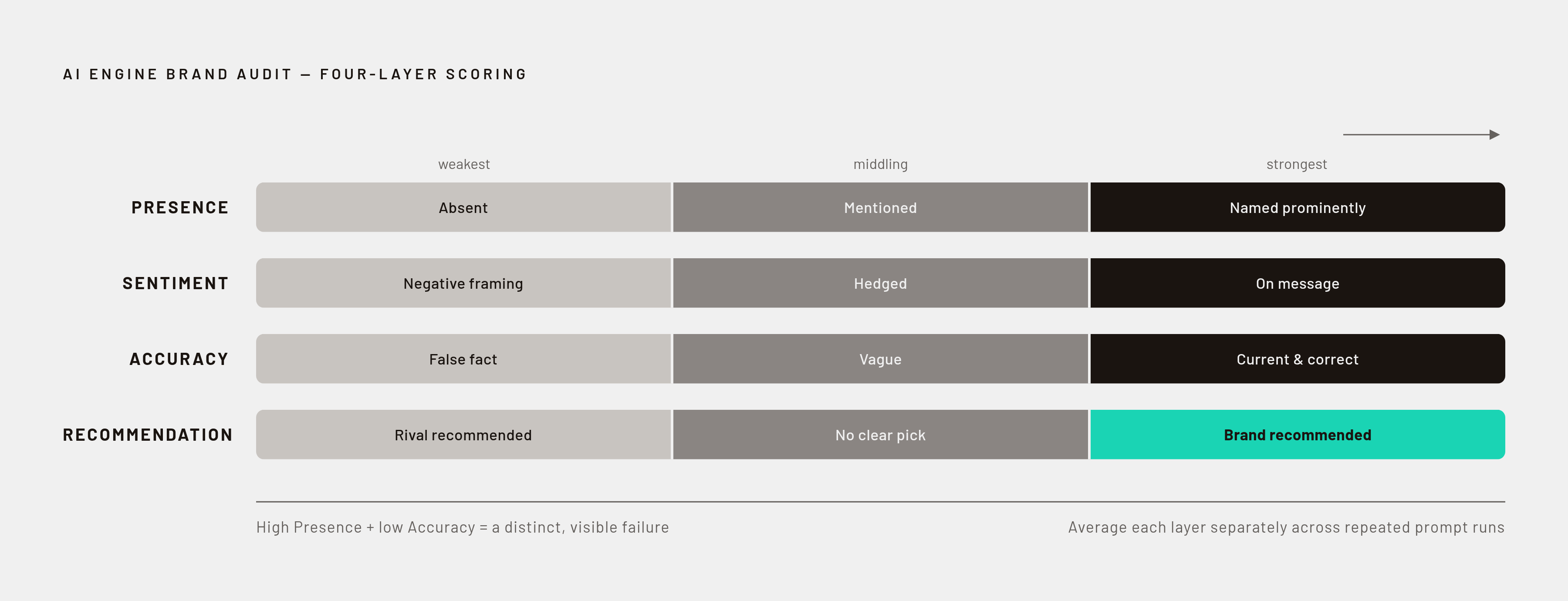
AI citation performance needs its own measurement category because rankings and traffic do not reveal how an engine represents a brand. Four outputs should remain separate, namely brand mentions in AI answers, explicit page citations with URLs named, identifiable AI referral traffic, and conversions from AI-referred sessions. Combining them obscures whether the hub gained recognition, supplied evidence, attracted a visit, or contributed to a conversion.
Measurement needs results from repeated runs as well as individual screenshots. The same prompt can return different recommendation lists from one run to the next, so each prompt should be run several times on each engine, with a record of how often each result appears. A single answer is not a baseline. Before configuration changes, the prompt set should capture both whether the brand appears and whether its intended message survives synthesis. A brand can appear often and still have weak message pull-through.
A four-layer audit scorecard makes that distinction observable. Presence records whether the brand is absent, mentioned in passing, or named prominently. Sentiment records whether it is framed negatively, hedged, or on message. Accuracy distinguishes a false fact from information that is vague but not wrong, and from information that is current and correct. Recommendation records whether a rival is recommended, there is no clear pick, or the brand is recommended. Averaging each layer across runs produces four trackable scores without collapsing different failures into one visibility figure.
A brand can appear prominently yet be described inaccurately, or receive a citation without receiving the recommendation. Perception measurement therefore extends beyond presence frequency to favorability, accuracy, message pull-through, competitive position, and consistency across runs.
To link those results to configuration decisions, teams should set a baseline before making changes, then rerun the same prompts and record the conditions. Without that discipline, shifts in citations cannot be distinguished reliably from changes outside the hub. Even then, attribution requires caution about the conditions recorded. The resulting practice is a repeatable cycle of scoring, fixing the identified signal gaps, and re-scoring, so that architecture, evidence, and positioning are judged by their effect on the brand’s representation rather than treated as a one-time implementation project.