Personalization Decay and Segment Refresh Cadences
Stale buyer data breaks personalization across CRM, search, and AI systems equally.
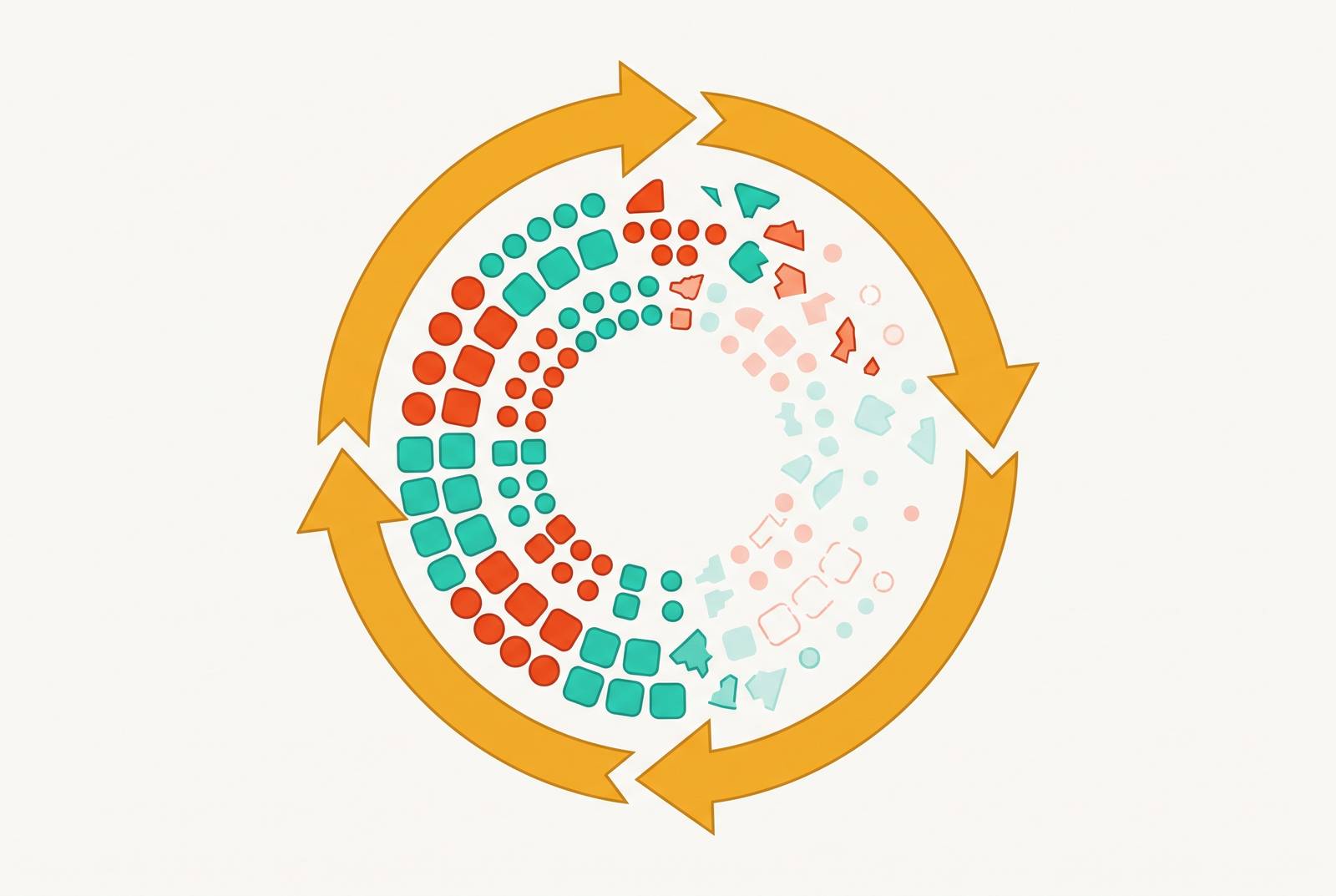
Personalization decay begins when a picture of a buyer no longer matches who the buyer is now. This article explains why the same problem extends to search algorithms and AI systems, and why refresh cadence must become a measurement-governed discipline across all three evaluator types. Staying accurately perceived depends not on refreshing everything equally, but on knowing which picture has drifted, how quickly, and where that drift matters most.
Why personalization segments go stale — and why the same logic extends far beyond the CRM
A segment built on last quarter’s behavior describes the buyer as they were then and may be wrong about who they are today. Its membership may have been accurate when the segment was created, but buyer reality moves continuously. Every segment therefore begins decaying as soon as it is built. As the data gets older, the relationship between the recorded behavior and the buyer’s current needs becomes less dependable.
That gap widens fastest around lifecycle events, including a first purchase, a cancellation, or a price change. These events can change what earlier behavior means for the next interaction. A segment that remains untouched may continue to classify the buyer correctly in historical terms while becoming less useful for present decisions. Consequently, segment validity depends on how quickly behavior changes and how carefully the original segment was designed.
This is why segmentation guidance treats long-untouched segments as suspect and calls for auto-updating membership. Monthly updates are a starting point, while quarterly refresh is the minimum for many businesses and the usual pace where change is slower. Those intervals address stale segment membership in the CRM, but the mechanism does not stop at the CRM. Every evaluator that holds a picture of a business builds that picture from evidence collected at some earlier point. When the business changes faster than its representation, the evaluator begins acting on a stale picture.
How fast different evaluators' pictures of a business go stale
The rate of that mismatch differs across audience segments, algorithmic systems, and AI systems. For audience segments, the clock follows the speed of behavioral change within a category. Fast-moving categories, including entertainment, beauty, gaming, and food and drink, warrant quarterly segmentation review at minimum. More stable categories, including B2B, financial services, and healthcare, can tolerate annual refresh with quarterly monitoring. A broad segmentation review and an update to behavioral membership therefore happen at different rates, even within the same program.
Algorithmic evaluators, including search, recommendation, and ranking systems, update continuously. However, continuous updating does not mean that a business can see how its current evidence is being weighted. Recency signals may gain or lose importance without an obvious explanation in the resulting ranking. The evaluator can be active while the business’s understanding of its evaluation remains incomplete. That is a different form of uncertainty from a segment whose last refresh date is known.
LLMs introduce another clock because their underlying model of a business does not update in real time. It is anchored in training data and the web content that was legible at crawl time, making it potentially the most lagged picture of all three. Tugtekin’s AI Perception Index 2026 shows how much perception of the same brand can drift across models. Different AI systems can thus have different outdated pictures at the same time. An old representation poses an operational risk, compounded by uncertainty about which evaluator is behind reality and by how much.
Why AI visibility is the most operationally dangerous form of decay
In an AI-generated answer, a brand’s inclusion is binary within that interaction, with an omitted business remaining undiscoverable even to a buyer willing to look for a “page two” equivalent. An answer can also satisfy the buyer without producing a website visit. The buyer may form an opinion and move on without that encounter ever being recorded in the business’s traffic report. This makes AI perception decay both binary per interaction and difficult to detect through conventional analytics.
As a result, stable traffic is not evidence of stable AI discoverability. An omission or an outdated description may therefore matter before a conventional report shows a change. The visible part of the buyer journey becomes an incomplete guide to how the business is being considered.
Strategy&/PwC research from June 2026 found that 40–60% of AI citations change monthly. That turnover makes AI visibility a continuing task. Erlin’s analysis of 500+ brands found that traditional SEO ranking explains very little of why a brand receives citations in AI responses. A page can rank first on Google and still be absent from an LLM’s answer to the same query. Strong SEO is therefore not a safety net, because the signals behind search ranking and AI citation overlap only partly.
What makes AI's picture of a business go stale — the mechanics of LLM perception decay
An LLM’s picture of a business is a probabilistic distribution shaped by the corpus that informed its training. Discoverability depends on how clearly the brand is represented, how easily that representation can be retrieved, and how consistently it is reinforced across contexts. A business can be present in the source material without having an equally clear or retrievable representation in every system. Presence alone does not settle how the model will frame it.
Each AI engine writes its own answer and draws on different source pools. Consequently, a brand narrative varies across systems as well as over time. Changes in the surrounding corpus do not amount to an immediate rewrite of every model’s underlying knowledge. The business thus faces pictures of itself that shift, draw on different sources, and update at different times. Leaving that evidence unmanaged leaves the direction of change to chance.
The gap can also run between AI descriptions and actual customer sentiment. Listen Labs’ AI brand perception analysis identifies divergence that becomes visible when LLM output monitoring is paired with qualitative human validation. An LLM may describe a brand as “trusted” while micro-expression data shows hesitation at “reliable.” That difference is a measurable disagreement between evaluators.
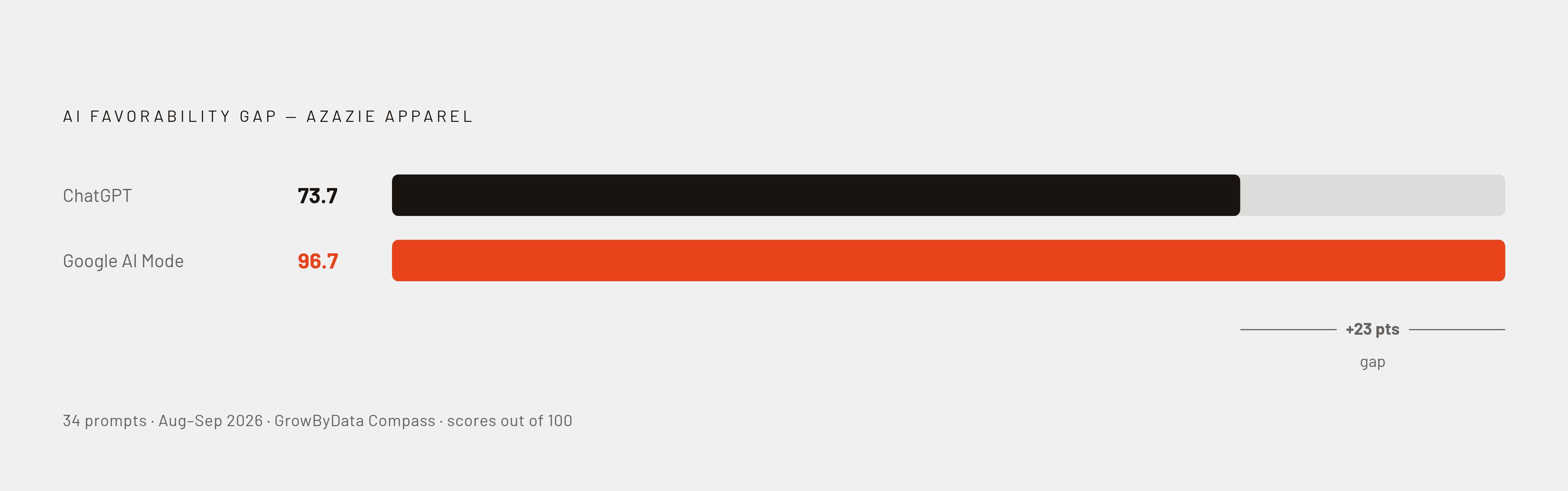
GrowByData Compass found a gap between how systems viewed apparel brand Azazie in August–September 2026. For the same 34 tracked prompts, Azazie had a favorability score of 73.7 in ChatGPT and 96.7 in Google AI Mode, a 23-point gap. Managing one system’s representation would not, by itself, address the other.
Recency as the dominant validity dimension across all three evaluators
Recency links these different forms of decay because it tests whether the evidence still fits what is true now. A behavioral segment can be precise about a buyer’s past and wrong about the next interaction. An algorithm can process signals continuously while giving less weight to evidence that has stopped changing. An AI system can produce a clear account of a business that no longer matches its current state.
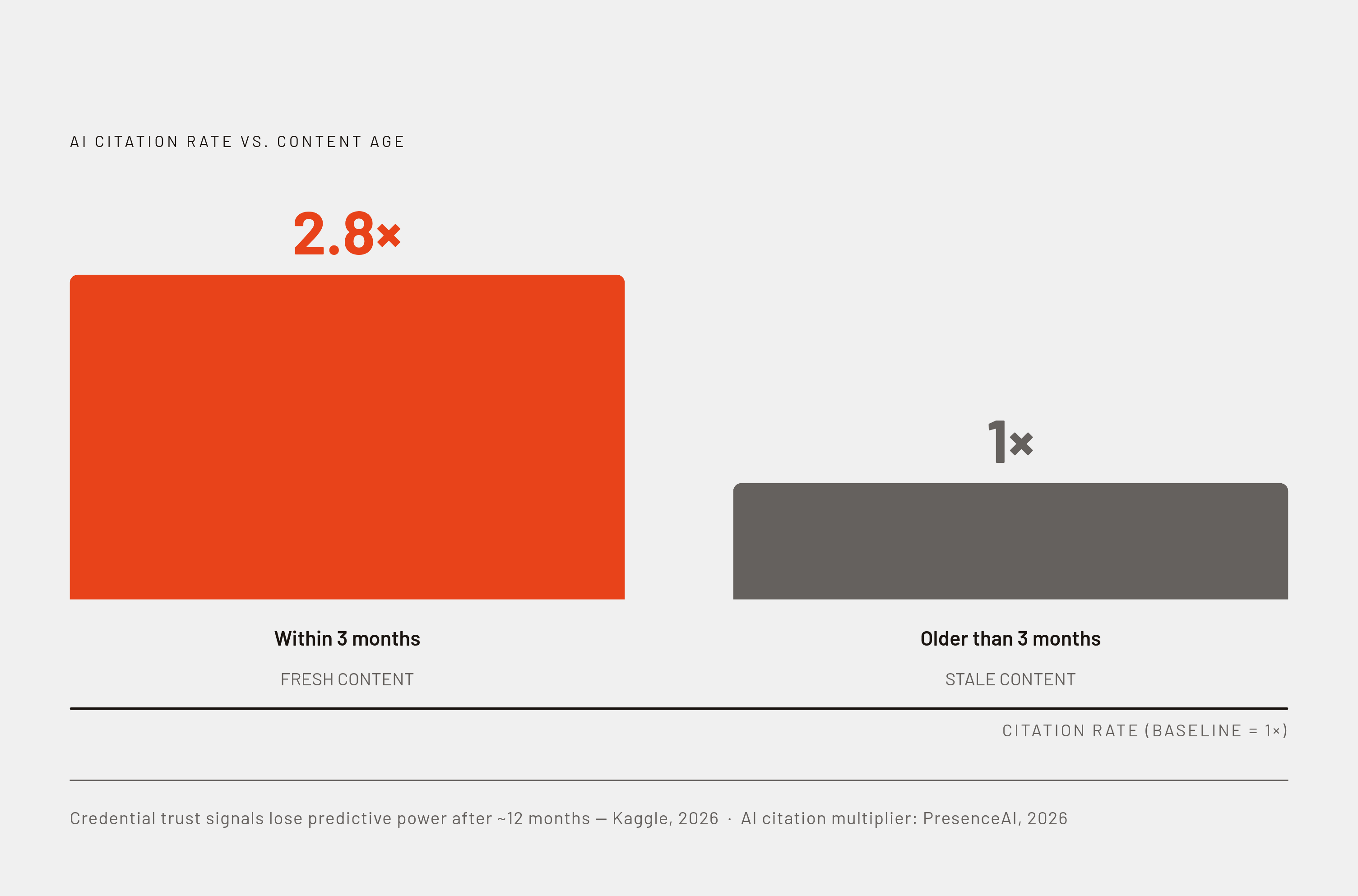
Research auditing Kaggle’s 2010–2026 archive across hundreds of thousands of participations found that a credential’s predictive power sits almost entirely in its first year. The finding shows how sharply the usefulness of a trust signal can depend on its age. PresenceAI’s citation optimization research from 2026 found that content updated within three months has a 2.8x higher citation rate than older content. Together, these findings support treating recency as a central validity dimension.
That does not make recency a substitute for quality or authority. Ahrefs’ research found that mentions of a brand on the web had the strongest correlation with how visible the brand was in AI Overview. Fresh evidence and credible representation can reinforce one another. The unifying discipline is therefore not to make every signal newer at any cost. It is to refresh evidence at the frequency needed to keep each evaluator’s picture valid, while preserving the substance that makes the evidence useful.
The signals that decay fastest and how to sequence their refresh
The first priority is evidence tied directly to changing behavior. Behavioral segment membership, including purchase history, session frequency, and feature use, should update weekly or faster through a CDP. Personalization relies on these signals to make decisions, so stale membership can lead to targeting the wrong people. A quarterly review of the segmentation framework cannot substitute for that faster operational update. The framework may remain sound while the people assigned to its segments have changed.
Content freshness and LLM output monitoring also belong in the fastest review cycle, with continuous or weekly attention. The three-month freshness finding gives content age a measurable connection to citation performance. Monitoring shows what different AI systems are saying now as their answers change. Frequent observation means changes in the evidence and changes in the resulting representation must become visible quickly enough to guide the next refresh.
The middle cadence covers the RFM transactional base, namely recency, frequency, and monetary value, with monthly refresh. Review recency and velocity need a monthly-to-quarterly cycle because algorithmic systems give weight to recent review activity. A large review profile that stops receiving additions can lose ranking weight over time.
Structural signals decay more slowly, but any gaps found in quarterly audits need to be fixed at once. Entity consistency includes spelling the brand name the same way across major platforms, using Organization schema with the sameAs property to link to verified external profiles, and being on knowledge databases such as Wikidata and Crunchbase. Trust consistency spans Identity, Expertise, Evidence, Consistency, and Accountability. Accountability, expressed through updating, correcting, and responding, has the most direct connection to recency. The sequence matters because decay compounds, with stale behavior weakening personalization and stale content reducing citations that could otherwise reinforce the brand’s entity signals.
Why measurement must precede and govern the refresh cadence
A schedule cannot reveal whether the signal it refreshes has materially changed. Without measurement, a cadence can be too slow because decay stays hidden, or too fast because unchanged evidence consumes repeated effort. Scoring is therefore a prerequisite for setting the cadence. Distinguishing a stale picture from a stable one shows whether the next action is due, overdue, or unnecessary.
Differences in favorability across models show why conventional analytics can tell only part of the story. Audience segmentation has a related measurement problem when its categories cannot be used in practice. Pulsar’s segmentation framework identifies creating segments that cannot be activated as the most common segmentation failure. Teams may then count the segments they have without learning whether they can use them for targeting. A refresh count is not a validity score.
Tugtekin’s AI Perception Index 2026 calls the practice of measuring and managing how AI systems semantically represent brands “Perception Control.” The report validates that practice empirically using the Perception Control Framework v2. For the wider set of evaluators, perception intelligence means scoring the algorithmic, AI, and human-audience dimensions together. Its role is to show which representation has drifted furthest from reality.
Measurement adds work, but its overhead is bounded while undetected decay can compound through AI invisibility and mis-targeted spend. A combined view of AI perception, algorithmic credibility, and audience segment accuracy supports differentiated cadences and out-of-cycle refreshes when the evidence warrants them.