Identity Resolution for Cross-Channel Personalization Programs
Unified customer profiles require identity resolution to connect fragmented signals across channels.

Cross-channel personalization depends on identity resolution, the infrastructure that connects fragmented customer signals into one accurate profile. Without it, messages, recommendations, and measurement work from an incomplete picture. A program that works starts with identity it can trust, uses it to act in time, and checks that the experience makes sense to customers and the systems that assess the brand.
Why cross-channel personalization fails without a unified view of the customer
A customer abandons a cart, later buys in-store, and still receives the cart-abandonment email. The message may be well written and correctly triggered within the email system, but it is wrong for the customer. The purchase and the abandoned cart belong to the same person, yet the systems handling them cannot make that connection. The failure is in the identity infrastructure beneath the message and the channel.
Braze describes a customer who clicks an ad on mobile, browses on a laptop, and converts on a tablet. When those signals are not linked, one person looks like three separate users, each with only part of the history. Those duplicate records distort audiences and produce disconnected decisions, including duplicate sends, inconsistent messaging, and suppression that does not fire. Improving the campaign cannot repair a customer view that leaves out the behavior the campaign needs to recognize.
What identity resolution is and how it connects fragmented signals into one profile
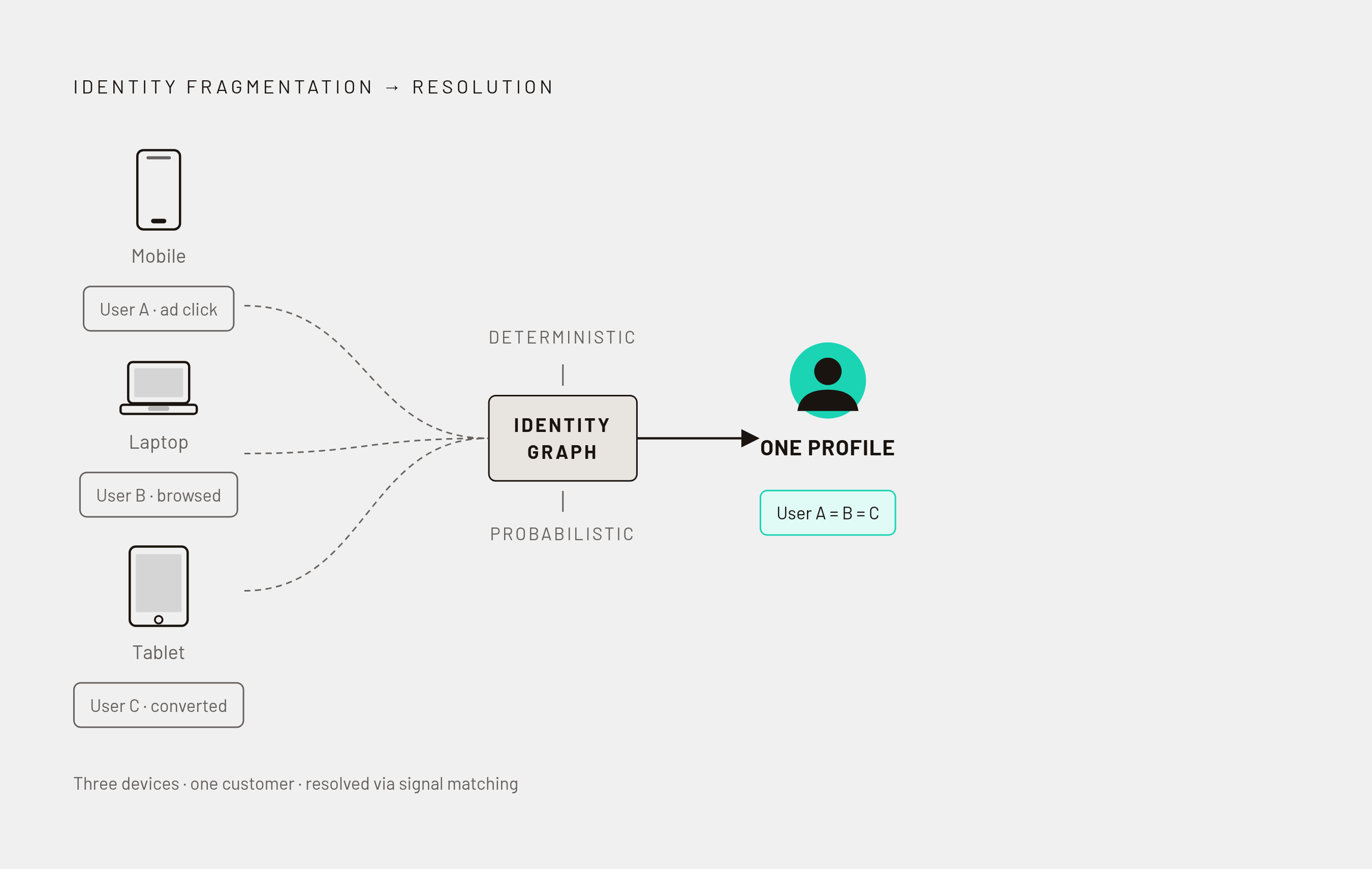
Identity resolution connects customer data from different channels, devices, browsers, and touchpoints into a single, accurate profile of one real person. It establishes which signals belong together so that each interaction can inform the next decision. Two matching methods support that process, with different levels of certainty and reach.
Deterministic matching links records through exact, known identifiers, including email addresses, phone numbers, and login credentials. Braze and BlueConic describe it as a high-confidence method whose coverage is limited to people who have shared those identifiers. Probabilistic matching instead uses statistical models to infer connections from device fingerprints, IP addresses, browsing patterns, and location. It extends recognition to people who have not identified themselves, but some inferred connections will be wrong. The trade-off is coverage versus accuracy.
Modern platforms combine these methods, using deterministic matching where exact identifiers exist and probabilistic matching to extend coverage. An identity graph maps the relationships between identifiers in real time and supports the unified profile. That profile is not a static record. BlueConic emphasizes that it must update as new information arrives. Otherwise, a correct match can still support an outdated decision.
The inputs also differ in quality and durability. Zero-party data, which people choose to share through surveys or preference centers, has the highest quality but the smallest scale. First-party data, including website behavior, purchase history, email engagement, and app usage, provides the essential foundation, while a trusted partner’s first-party data becomes second-party data that extends reach. Third-party data, aggregated by providers without direct consumer relationships, offers the broadest scale but the least accuracy and the greatest exposure to regulatory pressure. These differences now matter more because the availability of identity signals is under structural pressure.
Why signal erosion has made identity resolution harder and more urgent at the same time
The signals once used for probabilistic matching are harder to get just as cross-channel programs need to recognize more of each customer’s activity. A large and growing share of impressions, especially on mobile, arrives without an identifier attached. That makes it harder to link anonymous activity to a known customer. The need for resolution has not diminished with the loss of signals. Instead, programs must achieve reliable recognition with fewer inputs they can depend on.
Google announced in July 2024 that it would not deprecate third-party cookies in Chrome and confirmed in April 2025 that it would not introduce a replacement prompt. Even so, the wider loss of signals and privacy rules change which identity methods can still work. Organizations built around abundant third-party signals face a more disruptive rebuild than those with strong direct customer relationships. Privacy is therefore an architectural constraint.
Braze identifies first-party and zero-party data collected with consent as the primary basis for durable identity resolution. These inputs give the organization a direct foundation for recognizing customers rather than depending on externally aggregated signals. They do not remove the need to manage quality, duplicates, or privacy rules, which BlueConic identifies as common challenges. They do, however, change where the program’s reliable evidence comes from.
How a working identity resolution architecture turns a unified profile into cross-channel action
The identity graph sits at the center of a working architecture. It maps relationships between identifiers, including an email address, device ID, cookie, and loyalty number, so the system can recognize the same person at another touchpoint. As new signals arrive, the unified profile changes to reflect the customer’s current state. That change must then reach the campaign or AI decisioning layer. If it waits for a batch export, the organization may know who the customer is without acting on what the customer just did.
The abandoned-cart example provides a practical test of that connection. A purchase in-store must stop the cart-abandonment email, rather than leave it waiting in a separate channel’s workflow. The same shared context supports frequency management and messages that reflect more than one channel’s history. Braze identifies further applications in attribution, churn prevention, and onboarding optimization. A connected journey supports measurement, while behavior across touchpoints can reveal warning signs or inform the next-best action early in the relationship.
Customer engagement platforms with native email and messaging can trigger actions quickly because the profile and execution layer share a system. A CDP paired with an email service provider that relies on batch exports or scheduled syncs adds delays, so suppression may fail to happen in time. Marketing cloud suites offer breadth, but identity can be inconsistent across their modules. The features a platform has matter alongside whether they work from the same up-to-date profile.
Warehouse-native approaches preserve the data warehouse as the source of truth, but they also require careful engineering to avoid sync lag. Bi-directional connectivity with Snowflake, Databricks, and Google BigQuery supports zero-copy segmentation, allowing profile updates to reach execution without a full data movement cycle. Amazon Redshift supports scheduled sync but not zero-copy segmentation. These differences matter when the use case depends on an update arriving before a message is sent. A unified profile delivers operational value only when the execution architecture preserves its timeliness.
What a fragmented identity does to attribution, and why measurement breaks first
Measurement breaks at the point where a system cannot connect an interaction to the journey it belongs to. Consider a customer who sees an ad on mobile, clicks an email on desktop, and purchases in-store. Without identity resolution, those events look unrelated, so the attribution model cannot assess them as parts of the same sequence. The channel that influenced the decision is invisible within that broken journey. Teams then optimize against evidence that is incomplete by construction.
Resolution makes the full journey available for attribution, allowing each touchpoint to be evaluated for its contribution. It supplies the continuity the attribution model needs. That distinction has direct consequences for which channels receive budget, which sequences are repeated, and which messages are retired. Measurement is therefore not a separate benefit added after personalization works. It provides evidence of personalization’s effectiveness.
AI personalization has the same dependency on connected evidence. Models that recommend next-best actions or select send times learn from behavioral signals, so unresolved profiles give them an incoherent picture of the individual. Braze states that complete, accurate customer profiles are necessary for AI personalization to perform at the individual level. More advanced decisioning cannot compensate for behavior assigned to the wrong profile or left outside it. The profile determines what the model can learn about the customer.
This creates a self-reinforcing investment problem. Teams with weak attribution cannot clearly show which personalization investments work, so they have a harder time making the case for the infrastructure that would improve attribution. Fragmentation has diffuse costs, while the proposed fix has a visible and immediate cost. A third evaluator of brand coherence, external AI systems, extends the problem beyond the program’s own channels.
How AI systems evaluate brands and why fragmented identity undermines AI perception too
AI systems evaluate brands by synthesizing information into summaries and recommendations. Large language models do not simply retrieve a fixed set of brand facts. They form probabilistic associations from patterns in training data and retrieved sources, so their descriptions reflect more than the brand’s own publishing. Sentiment may appear explicitly or be implicit in the structure of a response. Contradictory information can therefore undermine representation even when no single sentence is plainly negative.
Muck Rack’s May 2026 Generative Pulse analysis found that earned media drives 84% of AI citations across ChatGPT, Claude and Gemini. Those sources include review platforms, forums, and third-party publications as well as brand-owned content. AI representation also draws on both the associations learned during training and the information found in current web sources. A brand that has pivoted, rebranded, or changed its offering may consequently still be described in its old terms.
Customer identity resolution and AI brand representation are distinct problems, but both depend on coherent signals. Resolving customer-facing identity supports consistent messaging across touchpoints, while conflicting claims, product descriptions, and review patterns give AI systems contradictory material to synthesize. A unified customer profile establishes a foundation for coherent experiences, whose wider representation requires a separate measurement lens. Perception intelligence looks at the gap between what a brand means to say and how AI represents it.
What good identity resolution infrastructure looks like in practice — and what to get right first
Start with a data audit that covers the website, app, email, CRM, support, and offline purchases. Establish where data sits in silos and where the same customer appears as multiple records. That map defines the fragments the program must connect. Cleaning and de-duplicating those records is often the prerequisite to meaningful resolution.
Next, collect first-party data with consent through loyalty programs, preference centers, and logged-in experiences that give customers a reason to identify themselves. These mechanisms create a more durable foundation than dependence on third-party probabilistic signals. Then evaluate platforms on trigger latency and profile propagation speed. A system that must wait for batch exports to suppress a message cannot meet a use case that requires prompt cross-channel action.
Once the profile layer can be trusted, predictive segmentation, next-best channel selection, and send time optimization can use inputs that fit together. Teams must then keep measuring identity quality to check that it holds as customers change devices, emails, and behavior. The same discipline applies to AI brand perception, where accurate representation requires ongoing monitoring. Bringing algorithmic, AI, and human evaluation into a single scoring framework allows teams to see the complete picture rather than improve one surface while another degrades.