Brand Voice Preservation in High-Volume AI Drafting
Concrete systems prevent AI drafting from eroding brand voice at scale.

If you run enough AI-drafted content through enough hands, nobody in particular is left in it. Large language models train on the aggregate of the internet, so their default output settles toward an industry-average tone, the kind of sentence that could have come from any company selling a similar product in a similar category. The cause sits in the math, not in the people typing the prompts. Three failure modes compound once drafting volume climbs. Tone drift pulls the voice toward the internet's statistical mean, so phrases read as professional, but they belong to no one in particular. A model saw the generic industry term far more often in training, so it swaps out a brand's proprietary product name or specific phrasing for that term. Perspective loss is most visible in thought leadership, where models default to consensus positions because consensus is what dominates the training data, and a brand's actual point of view gets smoothed away. None of this damage is dramatic on its own. A single off-brand post doesn't sink a company. What happens instead is cumulative: dozens of slightly generic pieces, published over months, quietly erode the distinctiveness a brand spent years building. Contentstack's analysis frames this as a homogenization risk with real financial stakes: consistent brand presentation can lift revenue substantially, but only a minority of companies actually use their own brand guidelines in practice. Left ungoverned, AI drafting doesn't close that gap. It widens it.
Why this is a governance failure
The instinct, once tone drift appears in a draft, is to fix the prompt. That instinct is aimed at the wrong layer of the problem. The most common failure inside enterprise content teams is an ungoverned team, where every drafter writes their own prompt from scratch, interprets the brand brief their own way, and produces a slightly different voice every time. No single prompt edit fixes that, because the problem isn't in any one prompt, but in the absence of a shared system that all of them should be drawing from.
Luddites refuse to touch AI and lose the throughput advantage. Tourists experiment with no governance structure, and they generate what amounts to slop at scale. Zealots automate everything immediately, and then, in the guide's own phrasing, they wonder why legal is in their Slack at 11 p.m. The three look like opposite responses to the same technology, but they share one structural defect: in each case, generation happens before governance gets established.
Prompts fail individually because they're fragile by nature. They depend entirely on whoever happens to be typing that day. They get forgotten the moment a session ends, with no persistent memory of what worked last time. If two different drafters work from the same creative brief, each writing their own prompt, you reliably get two different voices. Contentstack's framing draws the contrast cleanly: a persistent Brand Kit, built into the content system itself, travels with the system rather than with whichever individual happens to be using it that day. Under that structure, a junior editor working inside properly governed guardrails can produce copy at the same voice standard as a senior strategist, because the constraint lives above the individual, not inside their personal prompting habits.
What a machine-readable voice specification contains
A brand voice guide that describes the brand as "confident, direct, irreverent" gives a model almost nothing to work with. Those adjectives mean something to a human reader who already has the brand's full history in their head. They mean nothing computationally. A voice specification that an LLM can actually apply has to be a structured, measurable artifact, not a page of descriptive language.
That starts with sentence-length distributions, pulled directly from the brand's own highest-performing, most-quoted published work, so the model has an actual numeric pattern to match rather than a vague impression of "concise" or "punchy." It requires somewhere between 15 and 25 annotated exemplar passages that show, concretely, what on-voice writing looks like in practice, with annotations explaining why each passage works. And it needs to live as a versioned system prompt inside a shared, version-controlled repository, the kind of file engineering teams already know how to manage, not a Notion page that three people can edit without anyone else noticing.
Growth Rocket takes the same problem and adds two categories that most brand teams skip. The first is contextual usage examples, which show how the voice adapts across content types, say a technical white paper versus a newsletter, while staying recognizably the same brand underneath. The second is negative examples: documented samples of what the voice is not. A negative exemplar is often more instructive than a positive one, because it draws the boundary of the voice.
The test for whether a voice specification is actually finished has nothing to do with sign-off. Completion is an operational result: three independent drafters, each working from the same system prompt, produce copy that scores within one point of each other on every tone dimension being measured. If that result doesn't hold, the spec isn't done yet, regardless of how polished the document looks. And the spec doesn't stay static once it passes that test.
Turning the Voice Specification into Repeatable Output
The voice specification defines what the brand sounds like. On its own, it doesn't make that sound happen inside a content team of twenty people drafting fifty pieces a week. That's the job of the prompt library: the delivery mechanism that applies the specification to every content type without asking each individual drafter to reconstruct or reinterpret it from memory.
A properly governed prompt library runs on role-based access, with clear separation between who can edit the underlying templates and who can only use them to draft. That separation accounts for the single most common source of voice drift: freelance prompting, individual contributors writing their own ad hoc prompts instead of pulling from a shared, approved template. Eliminating that source of drift takes a structural fix, not a reminder in a team meeting.
For teams operating at real sophistication, Growth Rocket describes a multi-model routing setup: separate fine-tuned models built for different content types and different audiences, with a master routing system selecting which model handles a given piece of content based on its context. Contentstack's Brand Kit, which bundles Voice Profiles and Knowledge Vaults, operationalizes the same idea at the CMS layer. Because the constraints stay persistent across every AI interaction in the system, if you update a product name or add a banned phrase to the list once, it propagates automatically to every future AI-assisted draft. Nobody has to go update twelve separate prompts by hand.
A brand rule inside the prompt library travels with the system itself, reaching every drafter who uses it. That's the actual line between governance that scales and discipline that depends on individuals remembering to follow it.
Why structured content architecture makes brand governance scalable across channels
A voice specification and a governed prompt library solve a real part of the problem, but they stop short if the brand rules themselves still live inside page-bound templates or scattered documents that AI tools can't apply consistently across every channel a brand publishes through. Contentstack argues that structured content inside a headless CMS breaks brand identity down into discrete, machine-readable fields, so an AI system can apply them the same way every time, no matter where the content ends up.
If you update a brand rule once inside that structured model, it propagates automatically across every AI-assisted workflow running on the system. A "create once, publish everywhere" architecture means one brand-governed AI profile can power output ranging from a white paper to a chatbot response, without anyone having to rebuild the voice specification separately for each channel. Contentstack's Knowledge Vaults centralize the brand's approved assets, messaging, and reference material in one place, so the AI draws from a curated, governed corpus instead of inferring tone from whatever generic patterns it picked up in training.
The practical gap between this and a traditional CMS is concrete. In a page-bound system, brand rules sit embedded inside individual templates, and updating them means going template by template, by hand, hoping nothing gets missed. In a structured content model, the rule lives in a single place, and an update there is systemic.
There's a second cost to getting this wrong that extends past content quality. When a brand's website positions the company one way and its other properties position it differently, AI systems trying to categorize that brand run into conflicting signals and tend to fall back on generic, undifferentiated representation. Voice governance and AI visibility turn out to be the same problem, viewed from two different angles, and the next section develops that point further.
What quality gates catch before inconsistency ships
A well-built voice specification and a properly governed prompt library still won't prevent drift on their own, because AI output is probabilistic. The same prompt, run twice, can produce two outputs that differ slightly in tone even when nothing about the input changed. If you have no review layer built to catch that variation before publication, it ships.
Growth Rocket's structure for this review runs in two tiers. The first tier is automated: voice scoring software that analyzes each output against the brand's defined voice characteristics, checking sentiment, tone, complexity, and keyword usage patterns, and flagging anything that deviates before a human ever sees it. The second tier is staged human review, tiered by how important the content is and where it's going to run. A homepage rewrite or a major campaign asset gets comprehensive review. A lower-stakes internal piece gets a lighter touch.
For high-risk verticals, financial services, healthcare, life sciences, government, and regulated B2B SaaS handling personal data, the guide calls for legal counsel on retainer specifically. And the guide is blunt about what makes these gates actually hold: without written approval from a VP-level executive empowering someone to enforce prompt governance, the guardrails get overridden the first time a deadline slips. Quality gates are an organizational authority problem before they're a process design problem.
Contentstack frames the human role inside this system precisely. AI handles the drafting. Humans serve as the final editors, catching the nuance, the cultural context, and the emotional tone that a model can miss, a defined checkpoint in the workflow. Every deviation a quality gate flags should feed back into the voice specification and the prompt library, so the system gets tighter with each flagged error.
Brand voice consistency in AI drafting and external AI representation
Everything described so far protects content quality inside the organization. The same consistency also shapes something outside it: how coherently AI systems categorize and represent the brand when a buyer asks a question and an AI model has to decide how to answer it.
When a brand's signals conflict, the website says one thing, the LinkedIn page says another, owned content uses different terminology than the press coverage uses, AI systems trying to make sense of the brand receive contradictory inputs. AI systems typically retreat to generic categorization and recommend the brand with less confidence. The inverse holds too: brands that keep a consistent voice across both what they own and what gets published about them elsewhere become more legible to AI systems, which raises the odds of accurate, favorable representation when those systems generate answers for buyers.
This is where measurement has to enter the picture, because a governance system produces outputs, and only measurement can tell whether those outputs are actually shifting how a brand gets perceived by the AI systems buyers increasingly rely on. Evident operates at exactly this layer, treating measurement as the step that has to come before optimization rather than after it: understanding how a brand is currently represented in AI-generated answers before attempting to change that representation. Voice governance, under this view, no longer stays a purely internal content discipline. It becomes part of how a brand manages its own visibility in an AI-mediated market.
A complete brand voice governance system in practice
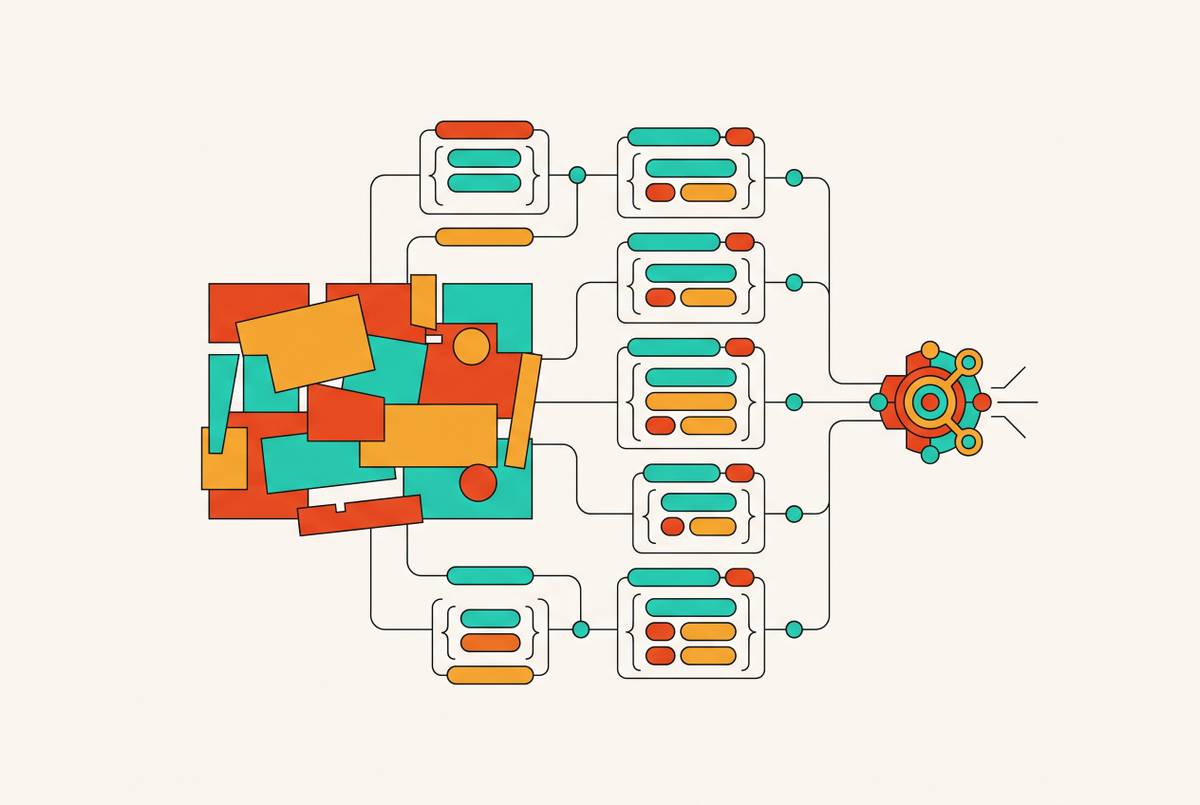
Brand voice preservation at scale is the output of a system, built from four interdependent layers rather than a loose collection of individual best practices or careful hiring.
The voice specification comes first: a machine-readable, measurable document, built from real sentence-length data and annotated exemplars, including the negative examples that mark the voice's actual boundaries, and revised on a quarterly cycle. The prompt library comes second, turning that specification into something a whole team can use consistently, with role-based access that removes freelance prompting as an option. Structured content architecture comes third: you move brand rules out of individual templates and into a content model where one update propagates everywhere the brand publishes. Quality gates come fourth, closing the loop with automated scoring, tiered human review, and named reviewers who hold real authority to stop a piece before it ships, backed by executive sign-off that keeps the gates from getting waived under deadline pressure.
None of these four layers substitutes for the others. If a voice specification has no prompt library, it stays a document nobody applies consistently. A prompt library without structured content can't scale past the content types it was built for. Structured content without quality gates will still let probabilistic drift through. And quality gates without organizational authority behind them get overridden the first time someone is in a hurry. Put the four together, and brand voice consistency becomes a specification, measured, versioned, and enforced like any other operational standard a business depends on.