How AI Systems Score Brand Authority Before a Human Ever Searches
AI systems form authority judgments about brands during training, not when users search.

AI systems form a working judgment of brand authority before a human searches, then refine it through retrieval when answering. A perception intelligence platform for AI era brands needs to measure both whether assistants recommend a brand and whether they represent it accurately. Search rankings and mention counts cannot answer those questions alone.
Why AI systems form a verdict on brands before any human query arrives
The shift is from earning a ranking to already having a verdict. A brand enters an AI conversation with a history the user cannot see. During training, models absorb patterns that shape which brands seem credible and relevant. The resulting judgment is statistical inference. The user opens the conversation, but not the case file.
That verdict is provisional. Retrieval-augmented generation splits the process between what a model absorbed during training and what it retrieves when answering. The retrieval step happens in real time, so not every part of the judgment predates the query. A brand has to contend with both its learned standing and the evidence available for retrieval.
The commercial consequence is that recommendations can be shaped before a brand knows it is being considered. AI-referred traffic has surged, and users more often ask assistants which products to choose before going to traditional search engines. Silence is not a neutral starting position. A brand that has not examined its AI standing may already be losing recommendations without knowing which part of the process excludes it.
The three signal layers AI systems use to build a brand's authority score
The first layer asks an implicit question about language. Does this brand say exactly what it means about its subject, or mostly praise itself? Textual and linguistic signals help models tell clear claims from sales talk. Hyperbole can count against a brand, so models may do more than just ignore it. “Trustworthy” is not a credential just because the marketing department found the bold button.
The second layer asks who else backs up those claims. Source-network signals strengthen when reputable, independent sources describe a brand consistently. Repetition on owned properties or low-authority sites provides weaker corroboration, however often the name appears. The high-weight categories described for 2026 include dual-layer citation quality, schema completeness, named expert authorship with a verifiable credential chain, original research on structured landing pages, specific outcome-oriented reviews, and proprietary framework terminology with independent external citation. These categories connect the quality of a claim to the evidence around it.
The third layer asks which entity the evidence points to. Schema markup, consistent naming across directories, and knowledge graph representation provide machine-readable anchors for a brand’s identity and subject area. Attribution is the hinge between the layers. Strong entity recognition makes citations easier to connect to the right brand, while independent sources validate its topical claims. Precise language then helps prevent otherwise strong evidence from being discounted.
What the hotel study reveals about which signals AI actually acts on versus which it claims to
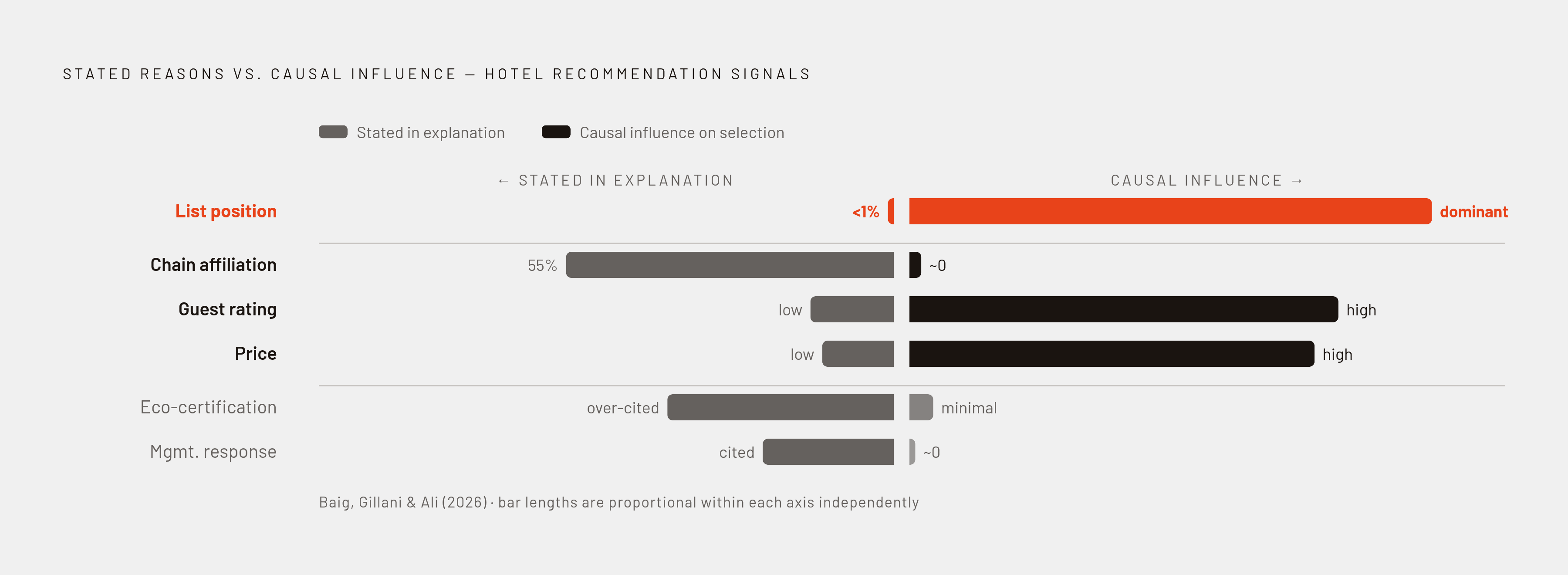
Baig, Gillani and Ali (2026) audited twelve open-weight and proprietary models choosing among five hotels. Their peer-reviewed study independently randomized guest rating, review volume and recency, management response, chain affiliation, price, eco-certification, and list position. That design separated what changed a recommendation from what a model said changed it. The distinction exposed a substantial explainability gap. A plausible explanation was not necessarily a faithful account.
Guest rating and price dominated hotel selection. Eco-certification was over-weighted, management response was ignored, and chain affiliation barely influenced choices despite featuring prominently in explanations. List position also causally shifted recommendations, even though it contained no information about hotel quality. Yet models mentioned position in at or below 0.7% of stated reasons across all models. The order of the menu affected dinner, but almost nobody admitted reading from the top.
Brand affiliation showed the reverse pattern. One model cited it in up to 55% of stated reasons even though its actual influence on selection was near zero. Across models, stated mention shares and revealed importance were positively related, but the relationship was incomplete. Models said too much about the role of appealing factors such as brand and eco-certification and too little about the role of position and volume.
For brand managers, the lesson is methodological. Asking why an assistant recommended a competitor can produce hypotheses, but its answer is not a reliable optimization plan. What models actually do needs to be tested across prompt families, repeated runs, and different contexts. Otherwise, a team may spend its budget improving only the explanation.
How brand inclusion is distributed across AI systems — and why a strong score on one platform hides gaps on another
Zatuchin (2026) measured brand inclusion across five industries, 50 brands, and hundreds of queries put to GPT-5.2, Gemini 3 Flash, and Perplexity sonar-pro in February and September 2026. Recommendation Share was highly stable across dates, with a Spearman correlation of 0.994. But agreement across systems was far from universal. Stability over time did not mean portability between platforms. A brand’s AI standing was a distribution across systems.
The same study found concentrated recommendation patterns. At least one sampled brand dominated answers to a large majority of queries, while co-mention asymmetry showed that brands appeared together or apart more often than their individual inclusion rates would predict by chance. That gives competitive context its own role in perception. Being named beside a dominant brand is different from appearing in isolation. Individual mention counts miss that structure.
The hotel audit explains why a platform gap cannot be diagnosed simply by asking the systems to justify themselves. A brand can be absent from Perplexity, which retrieves live documents, yet present on GPT-5.2, which relies more on its training corpus. Platform-disaggregated measurement is therefore necessary to locate the gap. A score that blends platforms can look healthy while hiding a brand’s absence from one that matters to its business.
Why GEO and traditional SEO are related but measure different things — and what falls through the gap
Generative Engine Optimization, or GEO, is the practice of structuring content and digital presence so AI-powered platforms can retrieve, cite, and recommend a brand. Its measures include citations, brand mentions, and share of voice alongside rankings and click-through rate. SEO remains part of the foundation. Technical accessibility, quality content, and credibility signals support both kinds of discovery.
Search engine appearances were the strongest single external signal in LLM recommendation scores, but explained only a small fraction of their variance. Only 37% of LLM-recommended domains appeared in tracked Google results. That finding shows that tracked search results capture only part of the recommendation environment. A strong Google position is not an AI recommendation receipt.
The measurement gap works in both directions. A brand can rank well in search yet be absent from generated recommendations, while a recommended domain may not appear in tracked search results. Traditional SEO dashboards need a separate record of assistant behavior alongside rankings and traffic to establish that relationship. Without that record, teams decide where to spend based on a proxy without seeing its limits.
SEO and GEO are therefore distinct, related disciplines. Search work can improve the conditions for AI discovery without determining which brands an assistant selects or how it describes them. GEO also tracks generated answers, including those from controlled testing as well as those from a customer visit.
Why visibility scores alone are a misleading measure of AI brand authority
Frequent appearances can conceal poor representation. An assistant may repeatedly name a brand while describing it through a legacy category or a competitor’s framing. The brand is present, but its intended meaning is not. Counting appearances alone gives no indication of whether its important messages are explicit, implied, absent, or contradicted.
Dhaimade and Henderson (2025) found that LLMs fabricated a large share of citations while maintaining consistent confidence levels in a clinical examination study. Their work was a preprint awaiting peer-review certification. For brand recommendations, the study challenges the assumption that confident wording and a citation automatically make an answer reliable. A brand’s cited appearance still needs assessment of the supporting source.
Gallifant et al. (2024) found significant inconsistencies in how LLMs processed brand versus generic cancer drug names, including sentiment differences tied to naming convention. The finding’s relevance to commercial brand bias is limited to this clinical context. Different forms of a name can change how models respond, so naming variation has a place in perception testing.
Two brands can receive the same score even if one result holds across models, prompt families, and retrieval conditions while the other depends on a few favorable prompts. The number alone cannot distinguish those cases. Exposure needs interpretation, and interpretation needs a record of how the result was obtained.
How do you measure whether AI assistants represent your brand accurately?
An AI visibility score measures exposure, while an LLM perception score measures what that exposure means. The first establishes whether a brand is in the room. The second establishes what the room thinks of it. A defensible framework separates the identity and category assigned to a brand from the messages attributed to it.
At minimum, the framework needs four dimensions. Mention rate measures how often the brand appears, position quality measures where it appears in a response, citation rate measures whether it is the named source, and sentiment index measures how it is characterized. One 2026 audit framework places these components on a 100-point rubric, with mention rate and citation rate together accounting for half the score. The weighting makes the calculation explicit. It does not remove the need to inspect message pull-through and supporting evidence.
Confidence depends on the testing behind the result. More models, more prompt families, repeated runs, separate web-retrieval-on and web-retrieval-off conditions, and a documented earned-media corpus strengthen the basis for interpretation. Cross-model stability testing also exposes gaps that an average conceals. An identical score can warrant different confidence depending on that coverage.
Evident, as a perception intelligence platform, should be judged by these measurement principles, with tests that go beyond counting how often a brand appears. For buyers comparing AI perception with human perception, assistants’ recommendations and statements provide one evidence stream, while metrics of people’s views provide another. Neither substitutes for the other. A rigorous assessment keeps those evidence streams distinct so that agreement and disagreement remain visible.
The concrete signals brands can act on to change their AI authority score
The first intervention is measurement. A baseline separated by model, prompt type, and retrieval condition identifies where the weakness sits. Without it, a team cannot distinguish an attribution problem from weak source support or inconsistent representation. The order of work should follow that diagnosis. Without that diagnosis, optimization becomes a costly guessing game with a dashboard.
Entity consistency lays the groundwork for what comes next. Consistent naming across directories, accurate knowledge graph entries, and schema markup including FAQPage, HowTo, Speakable, and Person help connect evidence to the right entity. Building third-party sources then offers the best chance to make a difference. Only 32% of AI citations come from brand-owned properties, making authoritative external mentions central to the evidence available beyond a brand’s own claims.
Multi-platform presence across four or more channels correlates with substantially higher citation likelihood. That association supports building a broader presence, but it is not a guarantee from opening more accounts. Independent corroboration is the useful mechanism. Multiple reputable sources agreeing about a brand provide stronger support than the brand repeating itself in several places.
Named expert authorship with a verifiable credential chain strengthens source quality. Original research on structured landing pages can also establish proprietary framework terminology that gains authority when independently cited. The language throughout that work should be exact and free of sales talk. It removes reasons for models to discount evidence that is otherwise strong.
The sequence connects each intervention to the next. Entity consistency enables attribution, third-party mentions build corpus salience, and expert authorship and original research improve source-network quality. Teams must then measure again to see whether those changes affected recommendations, citations, or message pull-through. A one-time audit records a position. Ongoing scoring tests whether the work is changing it.
Sources
- Multidimensional Evaluation of Large Language Models on the AAP In-Service Examination: Assessing Accuracy, Calibration, and Citation Reliability
- Who Owns the AI Recommendation? A Multi-Industry Empirical Map of Brand Category Ownership Across Large Language Models
- Reliability of large language model knowledge across brand and generic cancer drug names