Suppression List Management in Large-Scale Automation Programs
Suppression lists protect deliverability and legal standing at scale.

A suppression list is a working record of every address a program must not send to, not a synonym for an opt-out list. It's a working record of every address a program must not send to, and the reasons pile up: hard bounces, spam complaints, unsubscribes, role-based addresses, legal erasure requests. Get the architecture wrong and suppression stops being routine hygiene. Get the architecture wrong and suppression becomes the mechanism by which a large program either protects its deliverability and its legal standing, or slowly poisons both, with the damage appearing in inbox placement numbers or a regulator's letter before anyone notices.
Five categories belong on every suppression list, and they're not interchangeable. Hard bounces mean the address doesn't exist or the domain is dead, a permanent failure with no path back. Spam complaints carry more weight than a bounce ever will, because a bounce is a technical failure while a complaint is a real person telling their inbox provider that a message shouldn't have arrived. Unsubscribes and explicit opt-outs are the most familiar category, but addresses that should never receive marketing mail for operational or strategic reasons can also belong on the list, since sending to them wastes send volume and can create unintended exposure. Legal deletion requests under GDPR's right to erasure and similar privacy regulations round out the list, and they carry consequences well beyond a bounce or complaint.
Suppression works at the address level, not the contact or account level. The contact record stays whole. Only the specific address that triggered suppression gets blocked. The contact record stays whole while the specific suppressed address remains blocked, keeping compliance intact going forward. That's different from exclusion, which is a strategic, campaign-specific decision (holding back a segment from a particular send for business reasons). Treating suppression and exclusion as the same thing is how compliance risk creeps into a program that thinks it's being careful.
List decay and scale transform suppression from hygiene task to systems problem
Lists rot. At least 23% of a typical email list degrades within a single year, meaning even a well-run program can't treat suppression as a quarterly cleanup task. It has to run continuously, because the addresses going bad today are not the same ones that went bad last month.
Scale changes what a mistake means. At low volume, a missed suppression is a shrug, one email that shouldn't have gone out. At high volume, the same miss is systemic: it cascades through ISP reputation scoring and starts shaping how mailbox providers treat every message the program sends afterward, not just the one that slipped through.
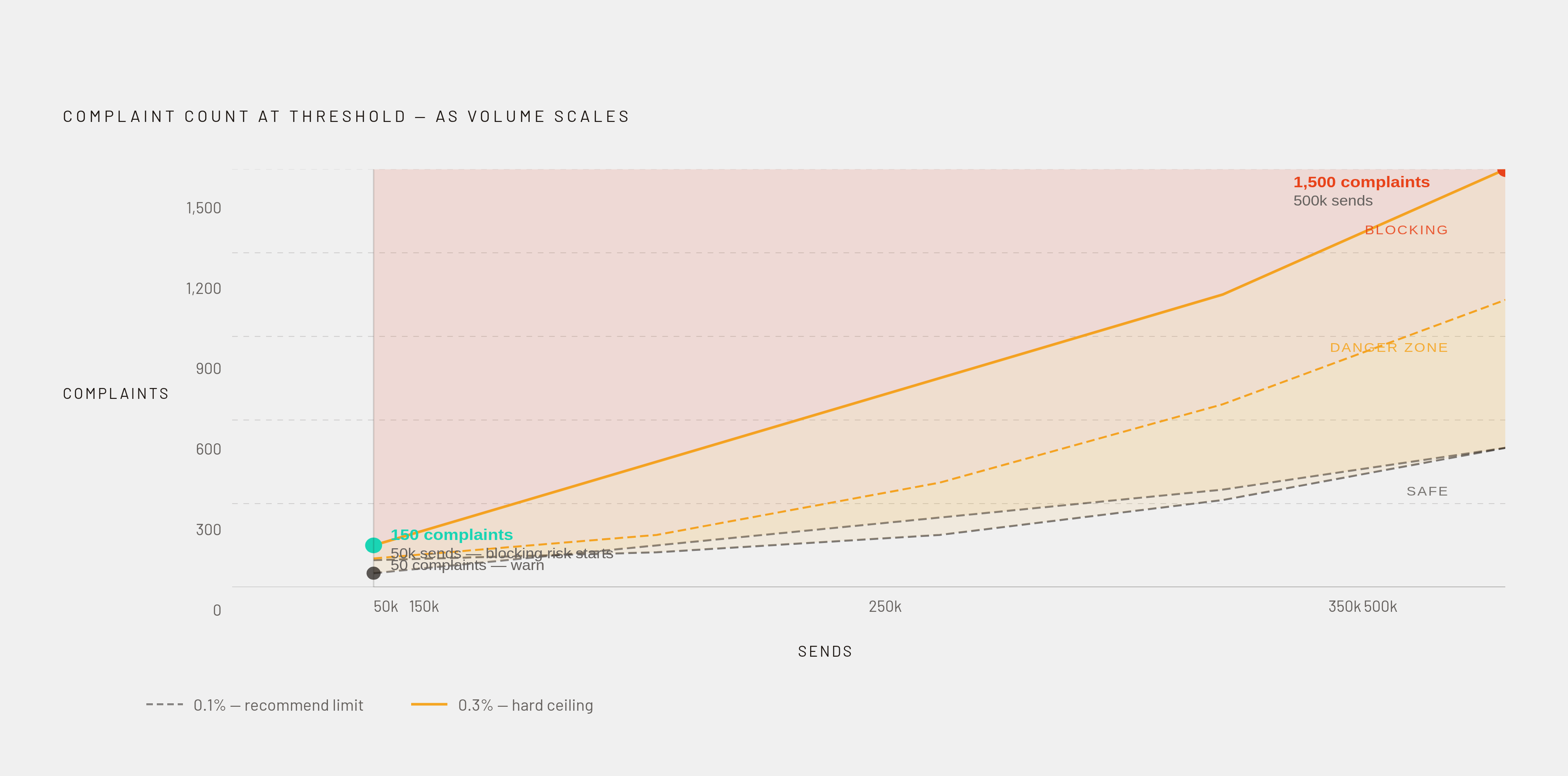
Gmail sets a hard ceiling of 0.3% on spam complaint rate and recommends staying under 0.1%. On a 50,000-email campaign, the danger zone starts at 50 complaints, with active blocking risk beginning around 150. At 500,000 sends, those same percentages turn into thousands of complaints, and the margin for error effectively disappears.
Bounce rates tell a similar story. Under 2% is considered safe by 2026 industry benchmarks. Above 5% is critical. ISP filtering triggered by a bad bounce rate can suppress inbox placement for the next several sends, so a single bad list import can cost a program weeks of deliverability it has to earn back one clean campaign at a time.
The compliance architecture suppression lists must enforce: CAN-SPAM, GDPR, CASL, and the 2024 one-click mandate
Three regulatory regimes govern most global email programs in 2026: CAN-SPAM in the US, GDPR in the EU, and CASL in Canada. Each one imposes distinct obligations, and a suppression architecture built for a single-market program will not hold up once a business sends across all three.
CAN-SPAM requires a working unsubscribe mechanism in every commercial message, and requests must be honored within 10 business days by statute, though the practical bar in 2026 sits closer to two days or less. Penalties run up to $53,088 per violation. Permanence trips up automation design most often: once someone opts out, that suppression record cannot expire. There's no re-permission window, no annual reset.
GDPR runs on different logic. Article 21 gives individuals a standing right to object to direct marketing, and once that right is exercised, processing for that purpose has to stop, full stop. Erasure requests are permanent and carry substantial fines, a consequence large enough to reorder a company's risk priorities on its own. GDPR doesn't name a fixed timeframe for processing consent withdrawal the way CAN-SPAM does, but "without undue delay" is not an invitation to sit on the request either. Regulators have made clear that an open-ended grace period isn't a defense.
Then there's the one-click unsubscribe mandate under RFC 8058, which became mandatory for bulk senders in February 2024. It's table stakes. It's table stakes, and any suppression architecture built after that date needs to assume it's a baseline requirement, not an optional feature to evaluate.
Suppression list architecture for multi-platform programs
Most professional ESPs check every outbound send against a suppression list before dispatch, and that built-in coverage works fine, as far as it goes. It stops working the moment a program uses more than one platform, because the ESP's suppression logic only sees its own list. It has no visibility into what's suppressed somewhere else.
Auto-suppression behavior varies by platform, and knowing the specifics is prerequisite to designing a governance layer on top of it. MailerSend, for example, automatically adds hard bounces, unsubscribes, and spam complaints to its suppression list, but soft bounces get different treatment: five occurrences within 30 days puts an address on hold for 72 hours rather than suppressing it. A program that assumes uniform behavior across platforms, without checking each one's actual rules, is building on an assumption that won't hold.
Multi-system environments are where real compliance failures happen, not inside any single platform. The gap between the CRM, the ESP, the marketing automation platform, and the transactional email service is the highest-risk zone in the entire architecture, because each system holds its own suppression state and none of them is automatically aware of the others.
Three failure modes recur. An unsubscribe processed inside the ESP that never syncs back to the CRM means the next list import re-adds the very contact who opted out. A suppression that lives in the marketing automation platform but not the transactional service means someone who opted out of marketing mail still gets password resets and order confirmations they never objected to, which sounds harmless until the complaint lands anyway. And in a multi-ESP setup, stale suppression data on one node means the address gets a send from whichever platform hasn't caught up yet. None of these are exotic edge cases. They're the default outcome of treating suppression as a per-platform feature instead of a synchronized system.
Automation design for suppression workflows
Automation earns its keep at the execution layer. Adding hard bounces, spam complaints, and unsubscribes to the suppression list the moment they happen, syncing that state across every connected platform on a defined schedule, and checking every outbound send against the current list before it goes out: none of that needs a human in the loop, and slowing it down with manual review only widens the window where a stale system sends to someone it shouldn't.
Two things stay under human approval no matter how mature the automation gets. Removal reports, the record of who's about to come off a suppression list, need a human set of eyes before any bulk deletion runs, because reviving a suppressed contact at scale is the single highest-risk action in the entire workflow. And changes to the suppression rules themselves, the policy the automation is executing, stay a human responsibility. Automation should run the policy. It shouldn't get to write it.
AI orchestration adds a risk category that didn't exist a few years ago. When an AI agent has authority to generate campaigns and personalize content, that authority has to stop well short of overriding consent fields, reviving suppressed contacts, or deciding on its own that engagement (an open, a click) counts as inferred permission. Engagement is not consent, and a system that treats it as such will eventually mail someone who has already said no.
That means consent basis, geography, suppression status, and unsubscribe history need to be structured, machine-readable data available before any AI-driven copy generation or send-approval step begins, not something checked afterward as a courtesy pass. Checking after the fact catches the mistake once it's already been made. The record has to be visible to the system before it acts, not after.
Governance structure: ownership, audit cadence, and the documentation trail that compliance requires
Suppression list management needs a named owner. In programs of any real size, shared ownership functions as no ownership at all, because when something breaks, a distributed responsibility means no one is actually the one who fixes it.
Audit cadence should scale with volume. Programs sending 500,000 or more emails a month need monthly audits, not quarterly ones, because the compounding effect of a sync failure at that scale outruns a quarterly review cycle. Lower-volume programs can run on a quarterly reconciliation across the CRM, the ESP, the marketing automation platform, and the transactional service, but that's a floor, not a target.
An audit worth running checks four things. Cross-platform suppression consistency, confirming no divergence between systems. Suppression growth rate trends, since a sudden spike or drop demands root-cause investigation rather than a shrug. Hashed retention of suppression records even after the underlying contact data gets deleted, because the record that blocks re-addition has to outlive the contact data it's based on, or the whole erasure-then-resuppress logic falls apart. And geographic compliance mapping, confirming the right suppression rules apply to the right jurisdictions, since a rule built for CAN-SPAM won't automatically satisfy GDPR's stricter standard.
None of this matters without documentation. CAN-SPAM, GDPR, and CASL all require provable compliance, and suppression logs, opt-out timestamps, consent records, and sync histories are the evidence trail regulators expect to see. In an enforcement proceeding, the absence of documentation gets treated the same as the absence of compliance itself. A program that did the right thing but can't prove it is, for regulatory purposes, in the same position as one that didn't.
The link between deliverability reputation and AI perception of a brand
Deliverability reputation already functions as an algorithmic credibility signal. Gmail, Yahoo, and Microsoft evaluate sender behavior continuously and use that ongoing read to decide where a message lands: inbox, promotions tab, or nowhere. Suppression management is the operational lever behind that judgment, since complaint rates and bounce rates are the raw inputs the algorithm is scoring.
That same dynamic is emerging in how AI systems describe businesses. AI systems like ChatGPT, Claude, Gemini, and Perplexity synthesize information about businesses and present it in a voice users tend to accept as settled fact, even when the underlying picture is partial or dated. Brand health signals from deliverability and complaint history feed into the broader information ecosystem those models draw from when they describe a company to someone who asked.
A program that treats suppression as a systems discipline, not an afterthought bolted onto the send pipeline, is protecting more than its next campaign's open rate. A program that treats suppression as a systems discipline, not an afterthought bolted onto the send pipeline, is protecting more than its next campaign's open rate. It's protecting the version of the brand that shows up when a mailbox provider scores it and, increasingly, when an AI model gets asked to describe it. Both outcomes trace back to the same operational discipline: the suppression list is either actually current, actually synchronized, and actually enforced, or just assumed to be.