AI Search KPI Measurement for Demand Generation Teams
Benchmark your brand against rivals in AI answers to measure demand impact beyond website traffic.

Competitive AI visibility benchmarking shows which rivals AI assistants name instead of a brand by comparing citation share, prompt coverage, and recommendation prominence across the same buyer questions. AI search KPI measurement for demand generation teams must connect those comparisons to both referral traffic and AI-influenced pipeline. The missing layer measures where buyers encounter a brand, how AI describes it, and whether that exposure contributes to demand.
Why traffic-based KPIs now systematically undercount B2B pipeline
A majority of B2B buyers now start research with AI chatbots more often than with traditional search. Most senior marketers also use large language models every day, so AI answers are part of how they research what to buy. Vendor consideration can begin before a website visit. When a buyer develops a shortlist inside an AI conversation, website analytics cannot show every brand considered or excluded along the way.
Most Google searches now end without a click, while AI Overviews reduce click-through when they appear. A brand can rank first on Google and be absent from an AI answer to the same query. Adobe’s August 2026 analysis shows how traffic-based reporting misses the visibility, authority, and consideration a brand can gain without a click right away.
How do AI systems decide which brands to recommend instead of yours?
LLMs draw on two layers of brand knowledge when producing answers. Static associations come from the contexts, descriptions, and co-occurrences absorbed during training. Dynamic retrieval augmentation supplements that knowledge with current web sources at query time. Freshness therefore becomes a live variable for retrieved answers. Citation presence depends on where and how a brand appears across the web, including its position in Google results.
Review presence on G2, Capterra, and Trustpilot also correlates with higher citation rates. These findings make third-party validation central to competitive comparison. A strong owned website does not establish equivalent visibility across the sources from which AI systems form and retrieve brand associations.
Fact density, third-party validation, structured data, and content recency are the signal categories associated with differences in LLM brand visibility alongside raw backlink counts. Their roles are not equally settled, particularly for structured data. Platform capabilities also differ. Google’s Gemini documentation describes processing YouTube audio and video, with selective transcript inspection in agentic mode, illustrating why the relevant source environment extends beyond text pages. Because AI answers cite only a small number of brands, selection determines who enters the buyer’s immediate consideration set.
Why the standard attribution model misses most of AI search's pipeline influence
An AI recommendation can influence a purchase without producing an identifiable AI referral. A buyer may later search for the brand by name, type its URL directly, or mention it during a sales call. The recommendation precedes the recorded interaction. Last-click attribution credits the later channel, while multi-touch attribution still misses the earlier AI influence if that interaction was never recorded.
Adobe’s framework describes the resulting asymmetry in reporting. A brand may lose clicks on informational queries while gaining visibility in AI-generated answers, but click-based reporting records the loss without the gain. GA4 does not reveal citations and brand-shaping conversations by default. Referral sessions therefore capture only the direct portion of AI search influence, and a dashboard built around those sessions can make effective visibility work appear to produce no return.
The remedy is a broader evidence trail. Self-reported attribution, branded search lift, CRM-recorded mentions, and prompt-level visibility data can link parts of the journey that would otherwise stay separate. Each contributes a different kind of evidence. Together, they support a composite account of influence without treating every later conversion as AI-generated. A complete measurement system therefore needs to track how visible a brand is compared with rivals, how good the answers are, and what signs of demand follow.
The seven KPIs that connect AI search presence to demand generation outcomes
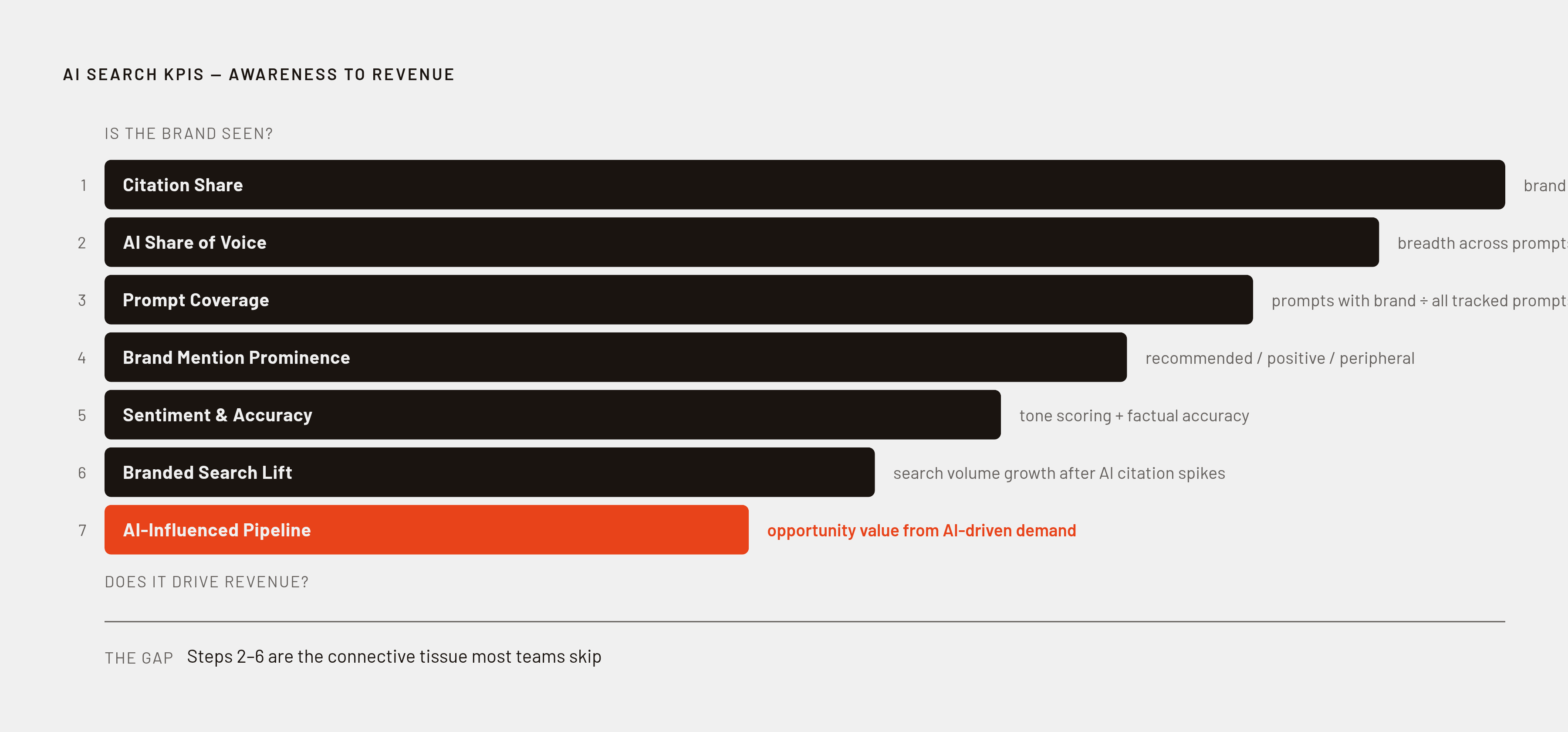
Citation Share is the percentage of category citations a brand owns across tracked prompts. Its formula is brand citations divided by total category citations, multiplied by 100. The denominator distinguishes it from a raw count. Because how often engines cite sources varies by query type, share makes it easier to compare a brand with its rivals. For demand generation, it reveals whether the brand is gaining a larger portion of the cited consideration set rather than merely collecting more citations as answer volumes change.
AI Share of Voice (AISoV) measures how often a brand appears relative to competitors across prompts, platforms, and query clusters. It is the broader share-of-model view, extending beyond citation counts to presence across buyer conversations. Measurement requires a defined competitor set and consistent prompt library. Breadth is its distinctive contribution to the framework. A brand may have a strong share of citations in one cluster while rivals dominate conversations elsewhere, so AISoV shows how widely the brand appears compared with its rivals.
Prompt Coverage is the percentage of tracked buyer-intent prompts in which the brand appears. It is measured by dividing prompts with a brand appearance by all tracked prompts and multiplying by 100. Coverage should include questions that are informational, commercial, comparison, and solution-seeking. Gaps can show up before any pipeline losses do. Strong visibility on informational questions does not compensate for absence when buyers ask for vendor comparisons, so this metric identifies the stages where competitors enter consideration instead.
Brand Mention Prominence records where a brand appears and how strongly the answer recommends it. A practical scoring approach distinguishes a recommended or top choice, a positive mention as a relevant option, and a weak or peripheral mention. Position and framing both shape this assessment. A first recommendation and an “also consider” reference are not equivalent outcomes. Prominence shows whether a mention is likely to help buyers choose or just give them background, which citation share alone cannot show.
Sentiment and Accuracy Score measures the language attached to a brand and the correctness of the claims made about it. Answers can be assessed for positive, neutral, hedged, or negative descriptions, together with factual accuracy. Frequent mentions can conceal a weak competitive position. Reliability caveats may undermine consideration even when visibility is high, while outdated product information can send buyers into sales conversations with incorrect assumptions. This KPI separates the quality of exposure from its volume and identifies the descriptions that may obstruct conversion.
Branded Search Lift measures how much branded search volume grows in a set lag window after a spike in AI citation activity. Google Search Console provides data on the searches that follow, linking AI visibility to a reporting system already in place. It is an accessible proxy for AI-influenced awareness. For teams without full citation tracking, branded demand movement offers an initial signal, although it cannot establish AI causation by itself.
AI-Influenced Pipeline measures the value of opportunities where AI search helped create demand or make it grow faster. It draws on branded search lift, assisted conversions, self-reported attribution, and CRM records of AI-sourced awareness, with no single formula that fits every case. This is the framework’s connection to revenue decisions. Those findings make referral volume alone an inadequate basis for valuing AI-influenced opportunities.
How to build an AI search KPI dashboard demand gen teams will actually use
For teams implementing this framework, the first step is an off-site signal audit. Review sites, community forums, and video presence establish whether the brand has a footprint that can support training-time associations and retrieval-time discovery. Most brands have not completed this audit. Without it, a dashboard may show poor visibility but miss that the brand is absent from the sources behind the answers. The audit gives subsequent measurements an operating context.
The next step is to define the prompt universe and tracked competitors. Prompts should reflect actual buyer-stage questions rather than branded queries alone, with a consistent library that can evolve as buyer language changes. Citation tracking then needs samples from across AI platforms, gathered in a consistent way. Comparisons depend on a stable measurement basis. A rival’s prominence on comparison prompts and the brand’s presence on informational prompts answer different questions, so those results need to remain distinguishable.
Adobe’s framework and another vendor’s framework support dashboards with defined formulas, assigned owners, a reporting cadence, and an evidence trail to business outcomes. The executive view condenses performance into prompt coverage, inclusion rate, citation rate, competitive share, and branded demand movement. Leaders need those signals connected to the underlying seven KPIs and to the opportunity evidence that supports claims of pipeline influence. Fact density, third-party validation, structured data, and content recency provide leading indicators to watch without assuming each has equal causal weight.
Operationally, Google Search Console offers the fastest starting point for branded search lift, while CRM fields or tags can capture self-reported attribution together with assisted conversion data. Prompt coverage and citation share should be tracked weekly to detect competitive shifts early. Downstream effects need a longer observation window. Branded search lift and pipeline influence belong on monthly or quarterly reporting cycles with a defined lag, so short-term answer changes are not mistaken for immediate revenue outcomes.
Where current measurement practice falls short and what the disagreements reveal
Attribution is still the biggest gap in practice, even for teams that already track citation share. Standard CRM and analytics configurations do not cleanly connect AI awareness to later branded searches, direct visits, and opportunities. Deliberate instrumentation is still required. A composite evidence trail improves the account of influence, but it does not turn every association into proof of causation. This limitation calls for precision about what a dashboard records directly and what it infers.
Structured data presents a separate disagreement about what produces citations. Many practitioners describe JSON-LD schema as foundational to AI citation eligibility. Google’s May 2026 guide states that structured data is not required for generative AI search. Ahrefs’ May 2026 study found no meaningful citation increase in AI Mode or ChatGPT after adding JSON-LD, and a small statistically significant decline in AI Overviews citations for pages already visible there. The evidence does not support a universal schema requirement.
That finding does not settle every possible use of structured data across models and content types. Content quality, topical authority, original data, and well-structured Q&A remain the more defensible focus than schema presence alone. Teams should not interpret a structured-data indicator on a dashboard as proof that markup caused a citation.
Trust adds uncertainty to the value of visibility itself. Consumer confidence in AI search answers fell between 2025 and 2026, leaving an open question about how strongly future citations will influence buyers. An appearance and a persuasive recommendation remain different outcomes. By reviewing prompt libraries and attribution methods each quarter, teams can keep up with changes in platforms and buyer behavior while keeping their measurements consistent.
What a perception intelligence layer adds to the demand gen measurement stack
Citation and share-of-voice tracking establish whether a brand appears, but they do not fully explain what the brand means inside AI answers. AI brand perception analysis looks at how systems describe a brand when they answer the questions buyers actually ask. It is distinct from GEO tactics and traditional brand tracking. Its purpose is to connect visibility with the attributes, judgments, and comparisons that shape consideration.
That layer requires four dimensions, including AI mention rate, sentiment trend, share of voice movement, and attribute alignment score. Mention rate captures frequency, while sentiment trend records whether descriptions improve, remain stable, or deteriorate. Competitive movement shows which rivals appear more or less often compared with one another. Attribute alignment assesses how closely AI descriptions match intended positioning. Cross-model perception drift makes this especially important because GPT-4o, Claude, Gemini, and Perplexity can represent the same brand differently, leaving single-platform tracking with an incomplete picture.
Evident operates in this multi-model, multi-signal measurement category, scoring brands across algorithms, AI systems, and human audiences. Its role is to provide a combined view of perception health across platforms. Measurement must precede optimization because teams need to distinguish missing exposure, weak recommendations, inaccurate descriptions, and uncertain attribution before deciding which problem they face. A connected measurement layer makes it possible to address competitive gaps in AI perception before they become entrenched obstacles to pipeline growth.